

Topics in Current Chemistry (2018) 376:45
1 3
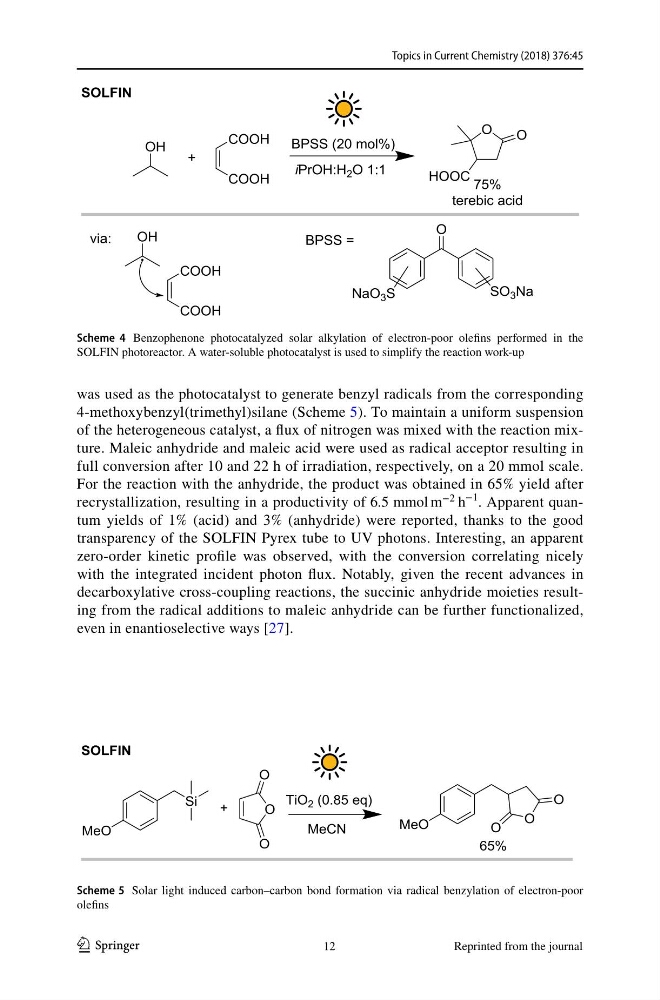
was used as the photocatalyst to generate benzyl radicals from the corresponding
4-methoxybenzyl(trimethyl)silane (Scheme 5). To maintain a uniform suspension
of the heterogeneous catalyst, a flux of nitrogen was mixed with the reaction mixture. Maleic anhydride and maleic acid were used as radical acceptor resulting in
full conversion after 10 and 22 h of irradiation, respectively, on a 20 mmol scale.
For the reaction with the anhydride, the product was obtained in 65% yield after
recrystallization, resulting in a productivity of 6.5 mmol m
−2 h
−1
. Apparent quantum yields of 1% (acid) and 3% (anhydride) were reported, thanks to the good
transparency of the SOLFIN Pyrex tube to UV photons. Interesting, an apparent
zero-order kinetic profile was observed, with the conversion correlating nicely
with the integrated incident photon flux. Notably, given the recent advances in
decarboxylative cross-coupling reactions, the succinic anhydride moieties resulting from the radical additions to maleic anhydride can be further functionalized,
even in enantioselective ways [27].
Scheme 4 Benzophenone photocatalyzed solar alkylation of electron-poor olefins performed in the
SOLFIN photoreactor. A water-soluble photocatalyst is used to simplify the reaction work-up
Scheme 5 Solar light induced carbon–carbon bond formation via radical benzylation of electron-poor
olefins
12
Reprinted from the journal
1 3
was used as the photocatalyst to generate benzyl radicals from the corresponding
4-methoxybenzyl(trimethyl)silane (Scheme 5). To maintain a uniform suspension
of the heterogeneous catalyst, a flux of nitrogen was mixed with the reaction mixture. Maleic anhydride and maleic acid were used as radical acceptor resulting in
full conversion after 10 and 22 h of irradiation, respectively, on a 20 mmol scale.
For the reaction with the anhydride, the product was obtained in 65% yield after
recrystallization, resulting in a productivity of 6.5 mmol m
−2 h
−1
. Apparent quantum yields of 1% (acid) and 3% (anhydride) were reported, thanks to the good
transparency of the SOLFIN Pyrex tube to UV photons. Interesting, an apparent
zero-order kinetic profile was observed, with the conversion correlating nicely
with the integrated incident photon flux. Notably, given the recent advances in
decarboxylative cross-coupling reactions, the succinic anhydride moieties resulting from the radical additions to maleic anhydride can be further functionalized,
even in enantioselective ways [27].
Scheme 4 Benzophenone photocatalyzed solar alkylation of electron-poor olefins performed in the
SOLFIN photoreactor. A water-soluble photocatalyst is used to simplify the reaction work-up
Scheme 5 Solar light induced carbon–carbon bond formation via radical benzylation of electron-poor
olefins
12
Reprinted from the journal