

Topics in Current Chemistry (2018) 376:45
1 3
To improve the understanding on the reactor photophysics, and aid in the development of other reactors based on the LSC-PM concept, a detailed description of
the photon path within the device was later reported by the same group via Monte
Carlo ray-tracing simulations [45]. In this analysis, it was observed that the photon
flux emitted at the device edges is proportional to that witnessed by the reaction
mixture flowing in the reactor channel (see Fig. 12). Based on this key observation, Noël and co-workers rationalized that it would have been possible to acquire
accurate information on the instant photon flux reaching the reaction channel by just
monitoring the variation in edge emitted photons. Once the relationship between the
kinetic profile and the light intensity is known, this information can then be used
to compensate the variations in solar irradiance by varying the residence time in
the reactor, affording a constant reaction conversion [46]. A simple reaction control
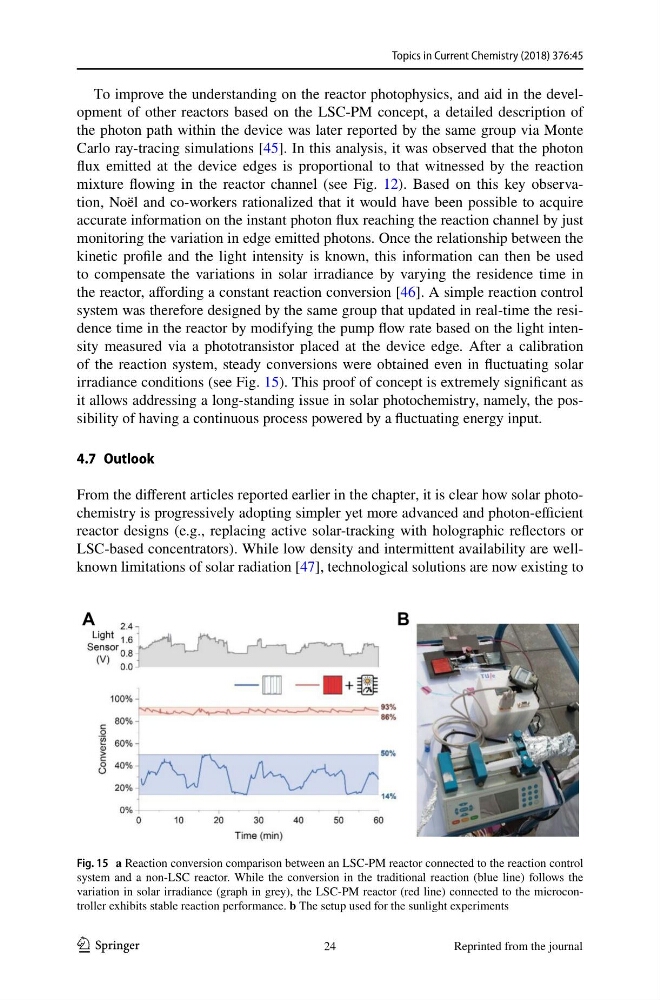
system was therefore designed by the same group that updated in real-time the residence time in the reactor by modifying the pump flow rate based on the light intensity measured via a phototransistor placed at the device edge. After a calibration
of the reaction system, steady conversions were obtained even in fluctuating solar
irradiance conditions (see Fig. 15). This proof of concept is extremely significant as
it allows addressing a long-standing issue in solar photochemistry, namely, the possibility of having a continuous process powered by a fluctuating energy input.
4.7 Outlook
From the different articles reported earlier in the chapter, it is clear how solar photochemistry is progressively adopting simpler yet more advanced and photon-efficient
reactor designs (e.g., replacing active solar-tracking with holographic reflectors or
LSC-based concentrators). While low density and intermittent availability are wellknown limitations of solar radiation [47], technological solutions are now existing to
Fig. 15 a Reaction conversion comparison between an LSC-PM reactor connected to the reaction control
system and a non-LSC reactor. While the conversion in the traditional reaction (blue line) follows the
variation in solar irradiance (graph in grey), the LSC-PM reactor (red line) connected to the microcontroller exhibits stable reaction performance. b The setup used for the sunlight experiments
24
Reprinted from the journal
1 3
To improve the understanding on the reactor photophysics, and aid in the development of other reactors based on the LSC-PM concept, a detailed description of
the photon path within the device was later reported by the same group via Monte
Carlo ray-tracing simulations [45]. In this analysis, it was observed that the photon
flux emitted at the device edges is proportional to that witnessed by the reaction
mixture flowing in the reactor channel (see Fig. 12). Based on this key observation, Noël and co-workers rationalized that it would have been possible to acquire
accurate information on the instant photon flux reaching the reaction channel by just
monitoring the variation in edge emitted photons. Once the relationship between the
kinetic profile and the light intensity is known, this information can then be used
to compensate the variations in solar irradiance by varying the residence time in
the reactor, affording a constant reaction conversion [46]. A simple reaction control
system was therefore designed by the same group that updated in real-time the residence time in the reactor by modifying the pump flow rate based on the light intensity measured via a phototransistor placed at the device edge. After a calibration
of the reaction system, steady conversions were obtained even in fluctuating solar
irradiance conditions (see Fig. 15). This proof of concept is extremely significant as
it allows addressing a long-standing issue in solar photochemistry, namely, the possibility of having a continuous process powered by a fluctuating energy input.
4.7 Outlook
From the different articles reported earlier in the chapter, it is clear how solar photochemistry is progressively adopting simpler yet more advanced and photon-efficient
reactor designs (e.g., replacing active solar-tracking with holographic reflectors or
LSC-based concentrators). While low density and intermittent availability are wellknown limitations of solar radiation [47], technological solutions are now existing to
Fig. 15 a Reaction conversion comparison between an LSC-PM reactor connected to the reaction control
system and a non-LSC reactor. While the conversion in the traditional reaction (blue line) follows the
variation in solar irradiance (graph in grey), the LSC-PM reactor (red line) connected to the microcontroller exhibits stable reaction performance. b The setup used for the sunlight experiments
24
Reprinted from the journal