

Topics in Current Chemistry (2018) 376:45
1 3
The SOLFIN reactor has been used both for photochemical reaction, including
2 + 2 Paternó-Büchi cycloadditions, photoisomerization and photocyclization, and
photocatalytic reaction with TiO 2 and benzophenone as photocatalysts.
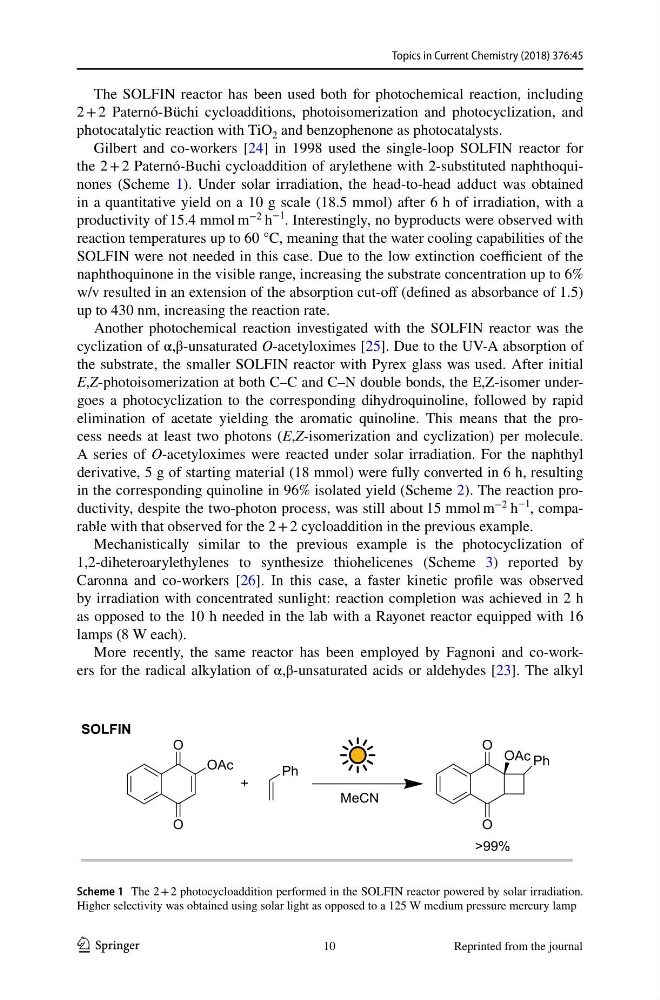
Gilbert and co-workers [24] in 1998 used the single-loop SOLFIN reactor for
the 2 + 2 Paternó-Buchi cycloaddition of arylethene with 2-substituted naphthoquinones (Scheme 1). Under solar irradiation, the head-to-head adduct was obtained
in a quantitative yield on a 10 g scale (18.5 mmol) after 6 h of irradiation, with a
productivity of 15.4 mmol m
−2 h
−1
. Interestingly, no byproducts were observed with
reaction temperatures up to 60 °C, meaning that the water cooling capabilities of the
SOLFIN were not needed in this case. Due to the low extinction coefficient of the
naphthoquinone in the visible range, increasing the substrate concentration up to 6%
w/v resulted in an extension of the absorption cut-off (defined as absorbance of 1.5)
up to 430 nm, increasing the reaction rate.
Another photochemical reaction investigated with the SOLFIN reactor was the
cyclization of α,β-unsaturated O-acetyloximes [25]. Due to the UV-A absorption of
the substrate, the smaller SOLFIN reactor with Pyrex glass was used. After initial
E,Z-photoisomerization at both C–C and C–N double bonds, the E,Z-isomer undergoes a photocyclization to the corresponding dihydroquinoline, followed by rapid
elimination of acetate yielding the aromatic quinoline. This means that the process needs at least two photons (E,Z-isomerization and cyclization) per molecule.
A series of O-acetyloximes were reacted under solar irradiation. For the naphthyl
derivative, 5 g of starting material (18 mmol) were fully converted in 6 h, resulting
in the corresponding quinoline in 96% isolated yield (Scheme 2). The reaction productivity, despite the two-photon process, was still about 15 mmol m
−2 h
−1
, comparable with that observed for the 2 + 2 cycloaddition in the previous example.
Mechanistically similar to the previous example is the photocyclization of
1,2-diheteroarylethylenes to synthesize thiohelicenes (Scheme 3) reported by
Caronna and co-workers [26]. In this case, a faster kinetic profile was observed
by irradiation with concentrated sunlight: reaction completion was achieved in 2 h
as opposed to the 10 h needed in the lab with a Rayonet reactor equipped with 16
lamps (8 W each).
More recently, the same reactor has been employed by Fagnoni and co-workers for the radical alkylation of α,β-unsaturated acids or aldehydes [23]. The alkyl
Scheme 1 The 2 + 2 photocycloaddition performed in the SOLFIN reactor powered by solar irradiation.
Higher selectivity was obtained using solar light as opposed to a 125 W medium pressure mercury lamp
10
Reprinted from the journal
1 3
The SOLFIN reactor has been used both for photochemical reaction, including
2 + 2 Paternó-Büchi cycloadditions, photoisomerization and photocyclization, and
photocatalytic reaction with TiO 2 and benzophenone as photocatalysts.
Gilbert and co-workers [24] in 1998 used the single-loop SOLFIN reactor for
the 2 + 2 Paternó-Buchi cycloaddition of arylethene with 2-substituted naphthoquinones (Scheme 1). Under solar irradiation, the head-to-head adduct was obtained
in a quantitative yield on a 10 g scale (18.5 mmol) after 6 h of irradiation, with a
productivity of 15.4 mmol m
−2 h
−1
. Interestingly, no byproducts were observed with
reaction temperatures up to 60 °C, meaning that the water cooling capabilities of the
SOLFIN were not needed in this case. Due to the low extinction coefficient of the
naphthoquinone in the visible range, increasing the substrate concentration up to 6%
w/v resulted in an extension of the absorption cut-off (defined as absorbance of 1.5)
up to 430 nm, increasing the reaction rate.
Another photochemical reaction investigated with the SOLFIN reactor was the
cyclization of α,β-unsaturated O-acetyloximes [25]. Due to the UV-A absorption of
the substrate, the smaller SOLFIN reactor with Pyrex glass was used. After initial
E,Z-photoisomerization at both C–C and C–N double bonds, the E,Z-isomer undergoes a photocyclization to the corresponding dihydroquinoline, followed by rapid
elimination of acetate yielding the aromatic quinoline. This means that the process needs at least two photons (E,Z-isomerization and cyclization) per molecule.
A series of O-acetyloximes were reacted under solar irradiation. For the naphthyl
derivative, 5 g of starting material (18 mmol) were fully converted in 6 h, resulting
in the corresponding quinoline in 96% isolated yield (Scheme 2). The reaction productivity, despite the two-photon process, was still about 15 mmol m
−2 h
−1
, comparable with that observed for the 2 + 2 cycloaddition in the previous example.
Mechanistically similar to the previous example is the photocyclization of
1,2-diheteroarylethylenes to synthesize thiohelicenes (Scheme 3) reported by
Caronna and co-workers [26]. In this case, a faster kinetic profile was observed
by irradiation with concentrated sunlight: reaction completion was achieved in 2 h
as opposed to the 10 h needed in the lab with a Rayonet reactor equipped with 16
lamps (8 W each).
More recently, the same reactor has been employed by Fagnoni and co-workers for the radical alkylation of α,β-unsaturated acids or aldehydes [23]. The alkyl
Scheme 1 The 2 + 2 photocycloaddition performed in the SOLFIN reactor powered by solar irradiation.
Higher selectivity was obtained using solar light as opposed to a 125 W medium pressure mercury lamp
10
Reprinted from the journal