

1 3
Topics in Current Chemistry (2018) 376:45
4 Reactor Designs
In this section, the flow photoreactors specifically designed to use solar light will
be described, including a brief description of their relevant synthetic applications.
Almost all of them make use of solar concentrating devices to increase the photon
flux toward the irradiated capillary or tube. The only exception in this regard is
constituted by the Sunflow reactor [20], that instead employed a long capillary
(25 m of FEP) to increase the solar-collecting area.
4.1 Solfin
The SOLFIN (SOLar synthesis of FINe chemicals) facility hosts two compound
parabolic concentrators (CPC) reactors built between 1996 and 1997 at the Plataforma Solar De Almería, in Spain [21]. The first reactor is constituted by an array
of eight 48-mm tubes placed in the focus of a 152 mm wide and 1-m long CPCcollector with aluminum reflectors. To increase the photon flux directed toward
the reactor, the unit is tilted south 35° to compensate for the site latitude. Given
that the acceptance angle of the CPC is about 60° on either side of the normal, it
was claimed that not only direct light, but also a good fraction of diffuse sunlight
is directed towards the tube. Another reactor based on a similar design was also
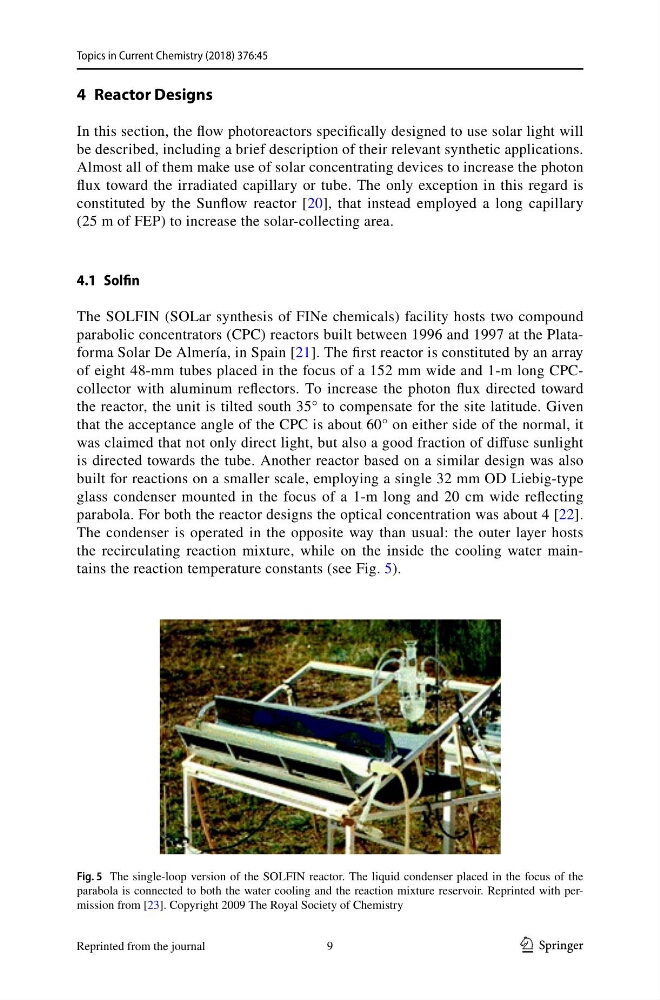
built for reactions on a smaller scale, employing a single 32 mm OD Liebig-type
glass condenser mounted in the focus of a 1-m long and 20 cm wide reflecting
parabola. For both the reactor designs the optical concentration was about 4 [22].
The condenser is operated in the opposite way than usual: the outer layer hosts
the recirculating reaction mixture, while on the inside the cooling water maintains the reaction temperature constants (see Fig. 5).
Fig. 5 The single-loop version of the SOLFIN reactor. The liquid condenser placed in the focus of the
parabola is connected to both the water cooling and the reaction mixture reservoir. Reprinted with permission from [23]. Copyright 2009 The Royal Society of Chemistry
9
Reprinted from the journal
Topics in Current Chemistry (2018) 376:45
4 Reactor Designs
In this section, the flow photoreactors specifically designed to use solar light will
be described, including a brief description of their relevant synthetic applications.
Almost all of them make use of solar concentrating devices to increase the photon
flux toward the irradiated capillary or tube. The only exception in this regard is
constituted by the Sunflow reactor [20], that instead employed a long capillary
(25 m of FEP) to increase the solar-collecting area.
4.1 Solfin
The SOLFIN (SOLar synthesis of FINe chemicals) facility hosts two compound
parabolic concentrators (CPC) reactors built between 1996 and 1997 at the Plataforma Solar De Almería, in Spain [21]. The first reactor is constituted by an array
of eight 48-mm tubes placed in the focus of a 152 mm wide and 1-m long CPCcollector with aluminum reflectors. To increase the photon flux directed toward
the reactor, the unit is tilted south 35° to compensate for the site latitude. Given
that the acceptance angle of the CPC is about 60° on either side of the normal, it
was claimed that not only direct light, but also a good fraction of diffuse sunlight
is directed towards the tube. Another reactor based on a similar design was also
built for reactions on a smaller scale, employing a single 32 mm OD Liebig-type
glass condenser mounted in the focus of a 1-m long and 20 cm wide reflecting
parabola. For both the reactor designs the optical concentration was about 4 [22].
The condenser is operated in the opposite way than usual: the outer layer hosts
the recirculating reaction mixture, while on the inside the cooling water maintains the reaction temperature constants (see Fig. 5).
Fig. 5 The single-loop version of the SOLFIN reactor. The liquid condenser placed in the focus of the
parabola is connected to both the water cooling and the reaction mixture reservoir. Reprinted with permission from [23]. Copyright 2009 The Royal Society of Chemistry
9
Reprinted from the journal