

Topics in Current Chemistry (2018) 376:45
1 3
3.5 Solar Productivity Metrics
Both in the optimization and in the comparison of different solar-powered synthetic
processes, it is important to have metrics to characterize the different parameters.
In fact, not only the reactor design and the process contribute to the reaction performance but also external variables related to the solar irradiance. When possible,
the variability associated with the solar irradiance can be eliminated by comparing different conditions side-by-side, so that the solar irradiance conditions can be
neglected. While in this simplified case any metric related to the reaction progress
would be suitable, the most appropriate parameter is the molar productivity per unit
surface and time (e.g., mol/m
2 hr ) as it allows the comparison between reactors with
a different irradiated area.
Often, comparisons between different solar photochemical syntheses performed
in different locations are needed. The most convenient parameter, in this case, is the
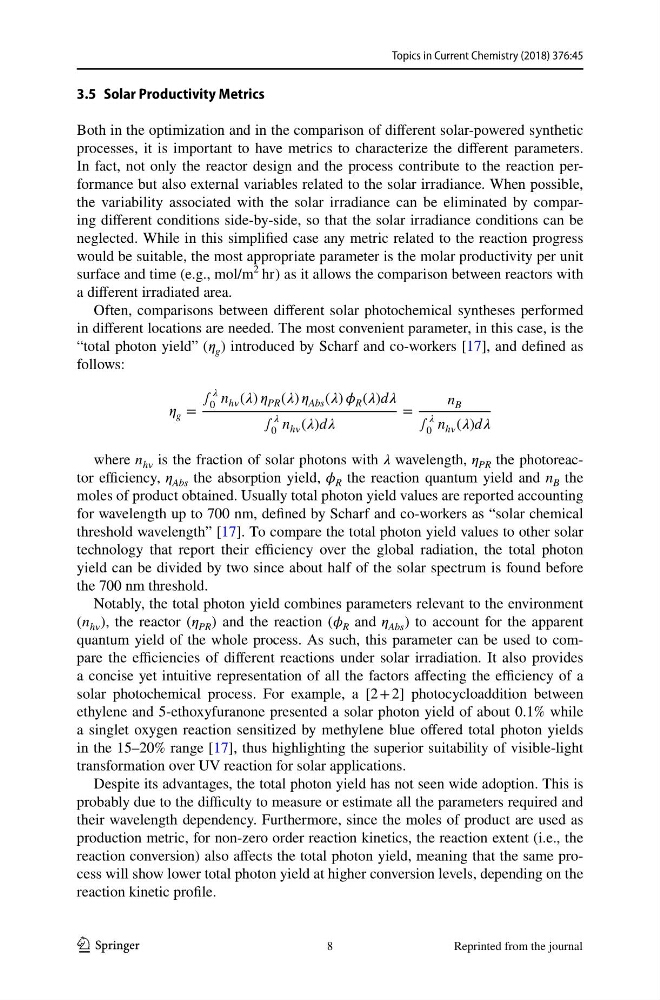
“total photon yield” ( g ) introduced by Scharf and co-workers [17], and defined as
follows:
where n h is the fraction of solar photons with wavelength, PR the photoreactor efficiency, Abs the absorption yield, R the reaction quantum yield and n B the
moles of product obtained. Usually total photon yield values are reported accounting
for wavelength up to 700 nm, defined by Scharf and co-workers as “solar chemical
threshold wavelength” [17]. To compare the total photon yield values to other solar
technology that report their efficiency over the global radiation, the total photon
yield can be divided by two since about half of the solar spectrum is found before
the 700 nm threshold.
Notably, the total photon yield combines parameters relevant to the environment
( n h ), the reactor ( PR ) and the reaction ( R and Abs ) to account for the apparent
quantum yield of the whole process. As such, this parameter can be used to compare the efficiencies of different reactions under solar irradiation. It also provides
a concise yet intuitive representation of all the factors affecting the efficiency of a
solar photochemical process. For example, a [2 + 2] photocycloaddition between
ethylene and 5-ethoxyfuranone presented a solar photon yield of about 0.1% while
a singlet oxygen reaction sensitized by methylene blue offered total photon yields
in the 15–20% range [17], thus highlighting the superior suitability of visible-light
transformation over UV reaction for solar applications.
Despite its advantages, the total photon yield has not seen wide adoption. This is
probably due to the difficulty to measure or estimate all the parameters required and
their wavelength dependency. Furthermore, since the moles of product are used as
production metric, for non-zero order reaction kinetics, the reaction extent (i.e., the
reaction conversion) also affects the total photon yield, meaning that the same process will show lower total photon yield at higher conversion levels, depending on the
reaction kinetic profile.
g =
∫
0 n h () PR () Abs () R ()d
∫
0
n h ()d
=
n B
∫
0
n h ()d
8
Reprinted from the journal
1 3
3.5 Solar Productivity Metrics
Both in the optimization and in the comparison of different solar-powered synthetic
processes, it is important to have metrics to characterize the different parameters.
In fact, not only the reactor design and the process contribute to the reaction performance but also external variables related to the solar irradiance. When possible,
the variability associated with the solar irradiance can be eliminated by comparing different conditions side-by-side, so that the solar irradiance conditions can be
neglected. While in this simplified case any metric related to the reaction progress
would be suitable, the most appropriate parameter is the molar productivity per unit
surface and time (e.g., mol/m
2 hr ) as it allows the comparison between reactors with
a different irradiated area.
Often, comparisons between different solar photochemical syntheses performed
in different locations are needed. The most convenient parameter, in this case, is the
“total photon yield” ( g ) introduced by Scharf and co-workers [17], and defined as
follows:
where n h is the fraction of solar photons with wavelength, PR the photoreactor efficiency, Abs the absorption yield, R the reaction quantum yield and n B the
moles of product obtained. Usually total photon yield values are reported accounting
for wavelength up to 700 nm, defined by Scharf and co-workers as “solar chemical
threshold wavelength” [17]. To compare the total photon yield values to other solar
technology that report their efficiency over the global radiation, the total photon
yield can be divided by two since about half of the solar spectrum is found before
the 700 nm threshold.
Notably, the total photon yield combines parameters relevant to the environment
( n h ), the reactor ( PR ) and the reaction ( R and Abs ) to account for the apparent
quantum yield of the whole process. As such, this parameter can be used to compare the efficiencies of different reactions under solar irradiation. It also provides
a concise yet intuitive representation of all the factors affecting the efficiency of a
solar photochemical process. For example, a [2 + 2] photocycloaddition between
ethylene and 5-ethoxyfuranone presented a solar photon yield of about 0.1% while
a singlet oxygen reaction sensitized by methylene blue offered total photon yields
in the 15–20% range [17], thus highlighting the superior suitability of visible-light
transformation over UV reaction for solar applications.
Despite its advantages, the total photon yield has not seen wide adoption. This is
probably due to the difficulty to measure or estimate all the parameters required and
their wavelength dependency. Furthermore, since the moles of product are used as
production metric, for non-zero order reaction kinetics, the reaction extent (i.e., the
reaction conversion) also affects the total photon yield, meaning that the same process will show lower total photon yield at higher conversion levels, depending on the
reaction kinetic profile.
g =
∫
0 n h () PR () Abs () R ()d
∫
0
n h ()d
=
n B
∫
0
n h ()d
8
Reprinted from the journal