

1 3
Topics in Current Chemistry (2018) 376:45
prevented to reach the reaction mixture (by selective reflection or absorption) or
they are down-converted to longer wavelengths. The latter strategy is evidently
advantageous as it can translate into an increased photon-efficiency and, so far, is
unique to the LSC-PM reactor design [18].
3.4 Diffuse Solar Radiation
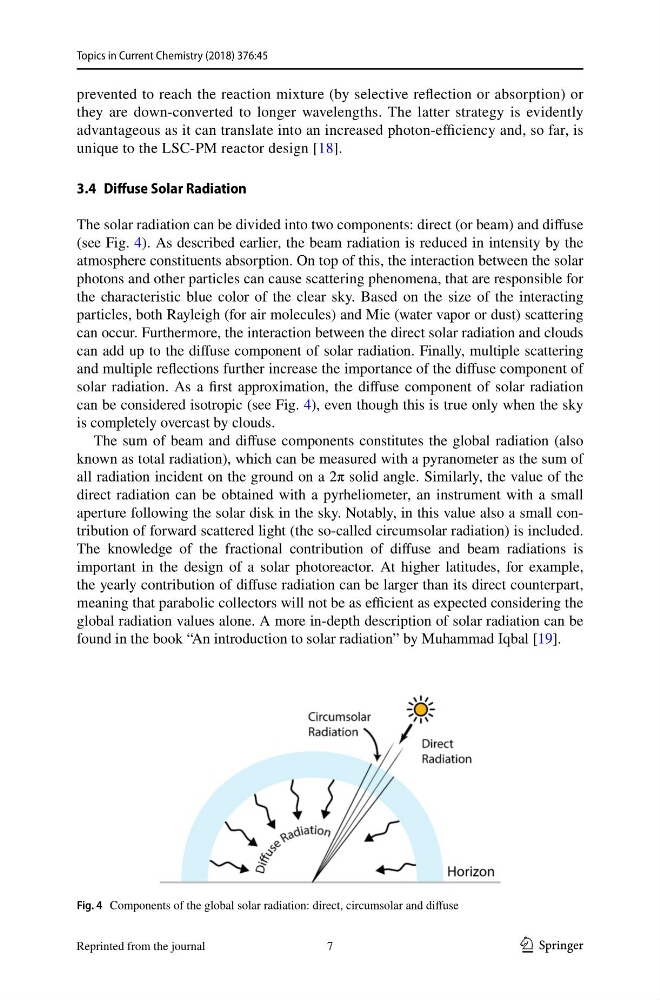
The solar radiation can be divided into two components: direct (or beam) and diffuse
(see Fig. 4). As described earlier, the beam radiation is reduced in intensity by the
atmosphere constituents absorption. On top of this, the interaction between the solar
photons and other particles can cause scattering phenomena, that are responsible for
the characteristic blue color of the clear sky. Based on the size of the interacting
particles, both Rayleigh (for air molecules) and Mie (water vapor or dust) scattering
can occur. Furthermore, the interaction between the direct solar radiation and clouds
can add up to the diffuse component of solar radiation. Finally, multiple scattering
and multiple reflections further increase the importance of the diffuse component of
solar radiation. As a first approximation, the diffuse component of solar radiation
can be considered isotropic (see Fig. 4), even though this is true only when the sky
is completely overcast by clouds.
The sum of beam and diffuse components constitutes the global radiation (also
known as total radiation), which can be measured with a pyranometer as the sum of
all radiation incident on the ground on a 2π solid angle. Similarly, the value of the
direct radiation can be obtained with a pyrheliometer, an instrument with a small
aperture following the solar disk in the sky. Notably, in this value also a small contribution of forward scattered light (the so-called circumsolar radiation) is included.
The knowledge of the fractional contribution of diffuse and beam radiations is
important in the design of a solar photoreactor. At higher latitudes, for example,
the yearly contribution of diffuse radiation can be larger than its direct counterpart,
meaning that parabolic collectors will not be as efficient as expected considering the
global radiation values alone. A more in-depth description of solar radiation can be
found in the book “An introduction to solar radiation” by Muhammad Iqbal [19].
Fig. 4 Components of the global solar radiation: direct, circumsolar and diffuse
7
Reprinted from the journal
Topics in Current Chemistry (2018) 376:45
prevented to reach the reaction mixture (by selective reflection or absorption) or
they are down-converted to longer wavelengths. The latter strategy is evidently
advantageous as it can translate into an increased photon-efficiency and, so far, is
unique to the LSC-PM reactor design [18].
3.4 Diffuse Solar Radiation
The solar radiation can be divided into two components: direct (or beam) and diffuse
(see Fig. 4). As described earlier, the beam radiation is reduced in intensity by the
atmosphere constituents absorption. On top of this, the interaction between the solar
photons and other particles can cause scattering phenomena, that are responsible for
the characteristic blue color of the clear sky. Based on the size of the interacting
particles, both Rayleigh (for air molecules) and Mie (water vapor or dust) scattering
can occur. Furthermore, the interaction between the direct solar radiation and clouds
can add up to the diffuse component of solar radiation. Finally, multiple scattering
and multiple reflections further increase the importance of the diffuse component of
solar radiation. As a first approximation, the diffuse component of solar radiation
can be considered isotropic (see Fig. 4), even though this is true only when the sky
is completely overcast by clouds.
The sum of beam and diffuse components constitutes the global radiation (also
known as total radiation), which can be measured with a pyranometer as the sum of
all radiation incident on the ground on a 2π solid angle. Similarly, the value of the
direct radiation can be obtained with a pyrheliometer, an instrument with a small
aperture following the solar disk in the sky. Notably, in this value also a small contribution of forward scattered light (the so-called circumsolar radiation) is included.
The knowledge of the fractional contribution of diffuse and beam radiations is
important in the design of a solar photoreactor. At higher latitudes, for example,
the yearly contribution of diffuse radiation can be larger than its direct counterpart,
meaning that parabolic collectors will not be as efficient as expected considering the
global radiation values alone. A more in-depth description of solar radiation can be
found in the book “An introduction to solar radiation” by Muhammad Iqbal [19].
Fig. 4 Components of the global solar radiation: direct, circumsolar and diffuse
7
Reprinted from the journal