

Topics in Current Chemistry (2018) 376:45
1 3
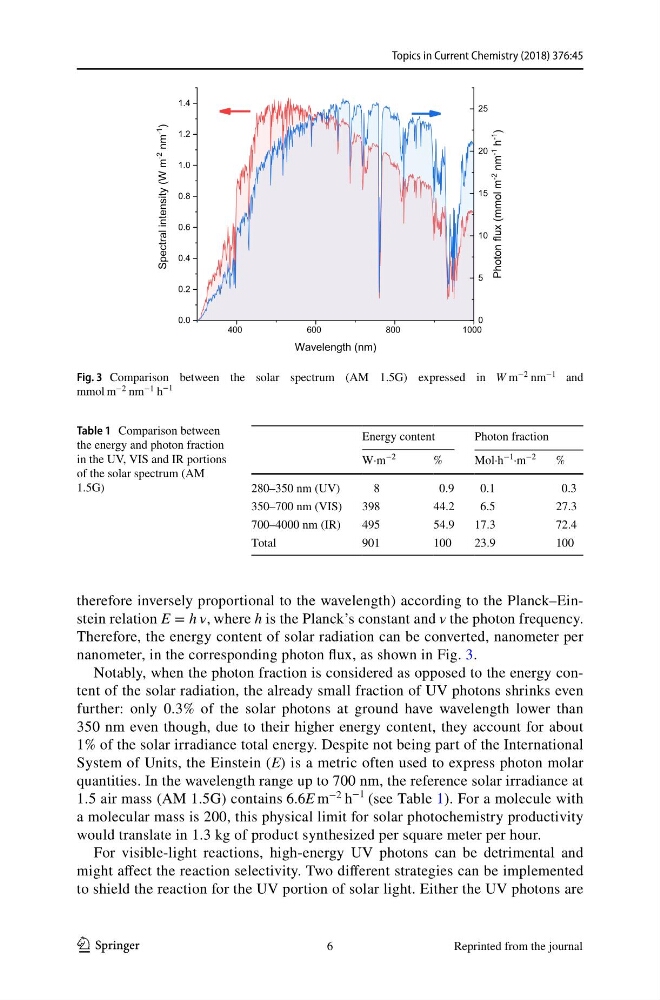
therefore inversely proportional to the wavelength) according to the Planck–Einstein relation E = h , where h is the Planck’s constant and the photon frequency.
Therefore, the energy content of solar radiation can be converted, nanometer per
nanometer, in the corresponding photon flux, as shown in Fig. 3.
Notably, when the photon fraction is considered as opposed to the energy content of the solar radiation, the already small fraction of UV photons shrinks even
further: only 0.3% of the solar photons at ground have wavelength lower than
350 nm even though, due to their higher energy content, they account for about
1% of the solar irradiance total energy. Despite not being part of the International
System of Units, the Einstein (E) is a metric often used to express photon molar
quantities. In the wavelength range up to 700 nm, the reference solar irradiance at
1.5 air mass (AM 1.5G) contains 6.6E m
−2 h
−1
(see Table 1). For a molecule with
a molecular mass is 200, this physical limit for solar photochemistry productivity
would translate in 1.3 kg of product synthesized per square meter per hour.
For visible-light reactions, high-energy UV photons can be detrimental and
might affect the reaction selectivity. Two different strategies can be implemented
to shield the reaction for the UV portion of solar light. Either the UV photons are
400
600
8 00
1000
0.0
0.2
0.4
0.6
0.8
1.0
1.2
1.4
Spectral intensity (W
m
-2
nm
-1
)
Wavelength (nm)
0
5
10
15
20
25
Photon flux (mmol m
-2
nm
-1
h
-1
)
Fig. 3 Comparison between the solar spectrum (AM 1.5G) expressed in W m −2 nm −1 and
mmol m −2 nm −1 h
−1
Table 1 Comparison between
the energy and photon fraction
in the UV, VIS and IR portions
of the solar spectrum (AM
1.5G)
Energy content
Photon fraction
W·m
−2
%
Mol·h
−1
·m
−2
%
280–350 nm (UV)
8
0.9
0.1
0.3
350–700 nm (VIS)
398
44.2
6.5
27.3
700–4000 nm (IR)
495
54.9
17.3
72.4
Total
901
100
23.9
100
6
Reprinted from the journal
1 3
therefore inversely proportional to the wavelength) according to the Planck–Einstein relation E = h , where h is the Planck’s constant and the photon frequency.
Therefore, the energy content of solar radiation can be converted, nanometer per
nanometer, in the corresponding photon flux, as shown in Fig. 3.
Notably, when the photon fraction is considered as opposed to the energy content of the solar radiation, the already small fraction of UV photons shrinks even
further: only 0.3% of the solar photons at ground have wavelength lower than
350 nm even though, due to their higher energy content, they account for about
1% of the solar irradiance total energy. Despite not being part of the International
System of Units, the Einstein (E) is a metric often used to express photon molar
quantities. In the wavelength range up to 700 nm, the reference solar irradiance at
1.5 air mass (AM 1.5G) contains 6.6E m
−2 h
−1
(see Table 1). For a molecule with
a molecular mass is 200, this physical limit for solar photochemistry productivity
would translate in 1.3 kg of product synthesized per square meter per hour.
For visible-light reactions, high-energy UV photons can be detrimental and
might affect the reaction selectivity. Two different strategies can be implemented
to shield the reaction for the UV portion of solar light. Either the UV photons are
400
600
8 00
1000
0.0
0.2
0.4
0.6
0.8
1.0
1.2
1.4
Spectral intensity (W
m
-2
nm
-1
)
Wavelength (nm)
0
5
10
15
20
25
Photon flux (mmol m
-2
nm
-1
h
-1
)
Fig. 3 Comparison between the solar spectrum (AM 1.5G) expressed in W m −2 nm −1 and
mmol m −2 nm −1 h
−1
Table 1 Comparison between
the energy and photon fraction
in the UV, VIS and IR portions
of the solar spectrum (AM
1.5G)
Energy content
Photon fraction
W·m
−2
%
Mol·h
−1
·m
−2
%
280–350 nm (UV)
8
0.9
0.1
0.3
350–700 nm (VIS)
398
44.2
6.5
27.3
700–4000 nm (IR)
495
54.9
17.3
72.4
Total
901
100
23.9
100
6
Reprinted from the journal