

1 3
Topics in Current Chemistry (2018) 376:45
in atmospheric composition with location, elevation and season are limited. More
significant seasonal and location-dependent fluctuation are observed in the precipitable water, i.e., the water contained in a column of unit cross-section extending
from the Earth’s surface to the “top” of the atmosphere. Finally, the last atmospheric
parameter affecting solar irradiance in cloudless conditions is the aerosol, i.e., the
presence of small suspended particles that manifests itself with a reduced visibility
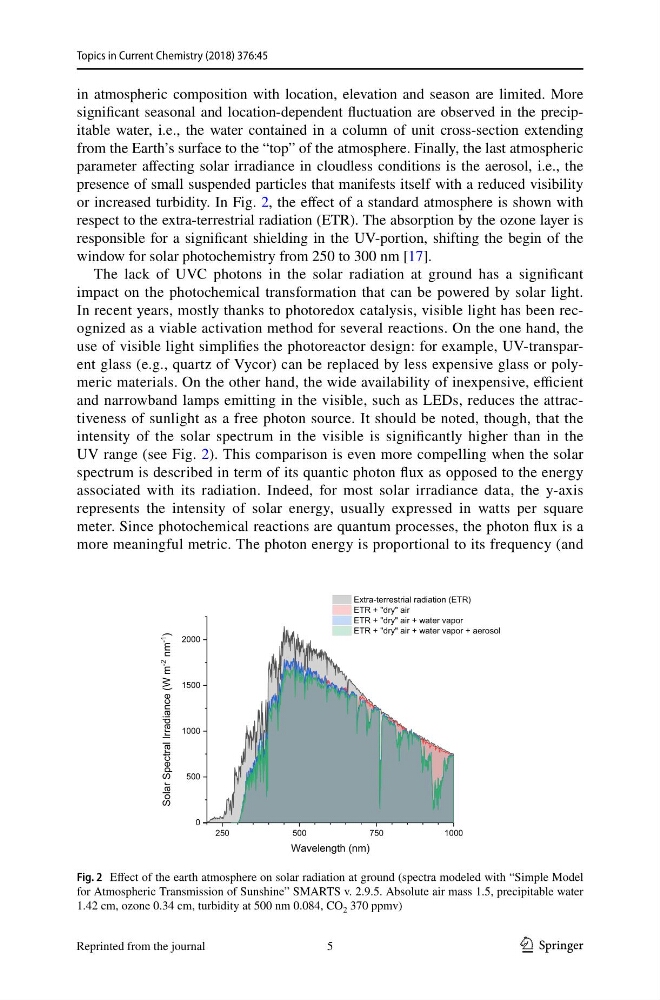
or increased turbidity. In Fig. 2, the effect of a standard atmosphere is shown with
respect to the extra-terrestrial radiation (ETR). The absorption by the ozone layer is
responsible for a significant shielding in the UV-portion, shifting the begin of the
window for solar photochemistry from 250 to 300 nm [17].
The lack of UVC photons in the solar radiation at ground has a significant
impact on the photochemical transformation that can be powered by solar light.
In recent years, mostly thanks to photoredox catalysis, visible light has been recognized as a viable activation method for several reactions. On the one hand, the
use of visible light simplifies the photoreactor design: for example, UV-transparent glass (e.g., quartz of Vycor) can be replaced by less expensive glass or polymeric materials. On the other hand, the wide availability of inexpensive, efficient
and narrowband lamps emitting in the visible, such as LEDs, reduces the attractiveness of sunlight as a free photon source. It should be noted, though, that the
intensity of the solar spectrum in the visible is significantly higher than in the
UV range (see Fig. 2). This comparison is even more compelling when the solar
spectrum is described in term of its quantic photon flux as opposed to the energy
associated with its radiation. Indeed, for most solar irradiance data, the y-axis
represents the intensity of solar energy, usually expressed in watts per square
meter. Since photochemical reactions are quantum processes, the photon flux is a
more meaningful metric. The photon energy is proportional to its frequency (and
250
5 00
750
1000
0
500
1000
1500
2000
Solar Spectral Irradiance (W m
-2
nm
-1
)
Wavelength (nm)
Extra-terrestrial radiation (ETR)
ETR + "dry" air
ETR + "dry" air + water vapor
ETR + "dry" air + water vapor + aerosol
Fig. 2 Effect of the earth atmosphere on solar radiation at ground (spectra modeled with “Simple Model
for Atmospheric Transmission of Sunshine” SMARTS v. 2.9.5. Absolute air mass 1.5, precipitable water
1.42 cm, ozone 0.34 cm, turbidity at 500 nm 0.084, CO 2 370 ppmv)
5
Reprinted from the journal
Topics in Current Chemistry (2018) 376:45
in atmospheric composition with location, elevation and season are limited. More
significant seasonal and location-dependent fluctuation are observed in the precipitable water, i.e., the water contained in a column of unit cross-section extending
from the Earth’s surface to the “top” of the atmosphere. Finally, the last atmospheric
parameter affecting solar irradiance in cloudless conditions is the aerosol, i.e., the
presence of small suspended particles that manifests itself with a reduced visibility
or increased turbidity. In Fig. 2, the effect of a standard atmosphere is shown with
respect to the extra-terrestrial radiation (ETR). The absorption by the ozone layer is
responsible for a significant shielding in the UV-portion, shifting the begin of the
window for solar photochemistry from 250 to 300 nm [17].
The lack of UVC photons in the solar radiation at ground has a significant
impact on the photochemical transformation that can be powered by solar light.
In recent years, mostly thanks to photoredox catalysis, visible light has been recognized as a viable activation method for several reactions. On the one hand, the
use of visible light simplifies the photoreactor design: for example, UV-transparent glass (e.g., quartz of Vycor) can be replaced by less expensive glass or polymeric materials. On the other hand, the wide availability of inexpensive, efficient
and narrowband lamps emitting in the visible, such as LEDs, reduces the attractiveness of sunlight as a free photon source. It should be noted, though, that the
intensity of the solar spectrum in the visible is significantly higher than in the
UV range (see Fig. 2). This comparison is even more compelling when the solar
spectrum is described in term of its quantic photon flux as opposed to the energy
associated with its radiation. Indeed, for most solar irradiance data, the y-axis
represents the intensity of solar energy, usually expressed in watts per square
meter. Since photochemical reactions are quantum processes, the photon flux is a
more meaningful metric. The photon energy is proportional to its frequency (and
250
5 00
750
1000
0
500
1000
1500
2000
Solar Spectral Irradiance (W m
-2
nm
-1
)
Wavelength (nm)
Extra-terrestrial radiation (ETR)
ETR + "dry" air
ETR + "dry" air + water vapor
ETR + "dry" air + water vapor + aerosol
Fig. 2 Effect of the earth atmosphere on solar radiation at ground (spectra modeled with “Simple Model
for Atmospheric Transmission of Sunshine” SMARTS v. 2.9.5. Absolute air mass 1.5, precipitable water
1.42 cm, ozone 0.34 cm, turbidity at 500 nm 0.084, CO 2 370 ppmv)
5
Reprinted from the journal