

Topics in Current Chemistry (2018) 376:45
1 3
The simplest description of the solar spectral irradiance is obtained from Planck’s
law, considering the solar spectrum as a black-body at about 5800 K. While this
approach is oversimplified, it provides a reasonable estimation for the fraction of
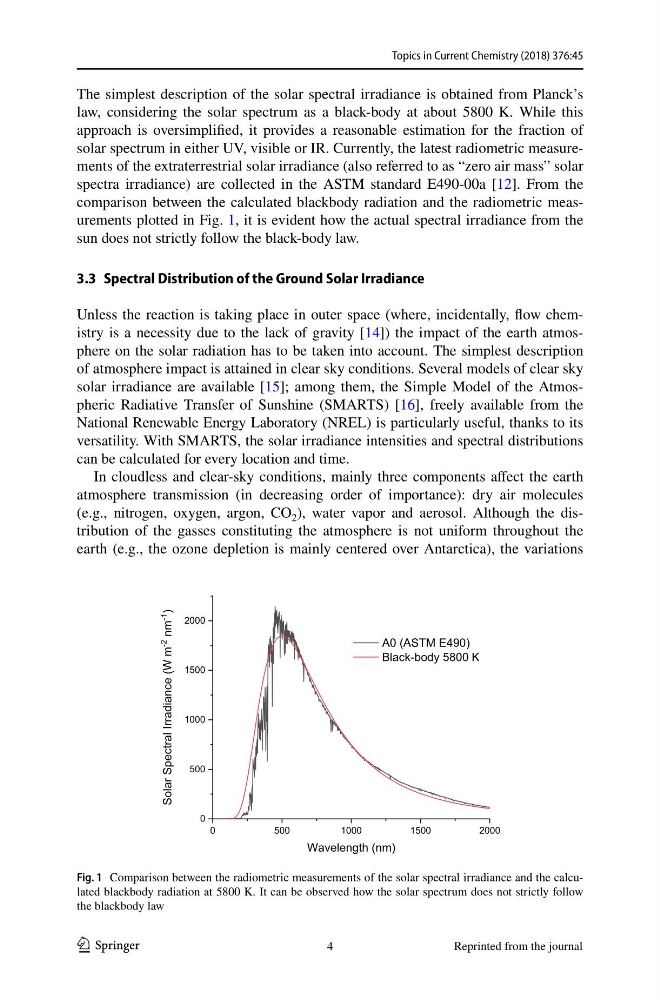
solar spectrum in either UV, visible or IR. Currently, the latest radiometric measurements of the extraterrestrial solar irradiance (also referred to as “zero air mass” solar
spectra irradiance) are collected in the ASTM standard E490-00a [12]. From the
comparison between the calculated blackbody radiation and the radiometric measurements plotted in Fig. 1, it is evident how the actual spectral irradiance from the
sun does not strictly follow the black-body law.
3.3 Spectral Distribution of the Ground Solar Irradiance
Unless the reaction is taking place in outer space (where, incidentally, flow chemistry is a necessity due to the lack of gravity [14]) the impact of the earth atmosphere on the solar radiation has to be taken into account. The simplest description
of atmosphere impact is attained in clear sky conditions. Several models of clear sky
solar irradiance are available [15]; among them, the Simple Model of the Atmospheric Radiative Transfer of Sunshine (SMARTS) [16], freely available from the
National Renewable Energy Laboratory (NREL) is particularly useful, thanks to its
versatility. With SMARTS, the solar irradiance intensities and spectral distributions
can be calculated for every location and time.
In cloudless and clear-sky conditions, mainly three components affect the earth
atmosphere transmission (in decreasing order of importance): dry air molecules
(e.g., nitrogen, oxygen, argon, CO 2 ), water vapor and aerosol. Although the distribution of the gasses constituting the atmosphere is not uniform throughout the
earth (e.g., the ozone depletion is mainly centered over Antarctica), the variations
0
5 00
1000
1500
2000
0
500
1000
1500
2000
Solar Spectral Irradiance (W m
-2
nm
-1
)
Wavelength (nm)
A0 (ASTM E490)
Black-body 5800 K
Fig. 1 Comparison between the radiometric measurements of the solar spectral irradiance and the calculated blackbody radiation at 5800 K. It can be observed how the solar spectrum does not strictly follow
the blackbody law
4
Reprinted from the journal
1 3
The simplest description of the solar spectral irradiance is obtained from Planck’s
law, considering the solar spectrum as a black-body at about 5800 K. While this
approach is oversimplified, it provides a reasonable estimation for the fraction of
solar spectrum in either UV, visible or IR. Currently, the latest radiometric measurements of the extraterrestrial solar irradiance (also referred to as “zero air mass” solar
spectra irradiance) are collected in the ASTM standard E490-00a [12]. From the
comparison between the calculated blackbody radiation and the radiometric measurements plotted in Fig. 1, it is evident how the actual spectral irradiance from the
sun does not strictly follow the black-body law.
3.3 Spectral Distribution of the Ground Solar Irradiance
Unless the reaction is taking place in outer space (where, incidentally, flow chemistry is a necessity due to the lack of gravity [14]) the impact of the earth atmosphere on the solar radiation has to be taken into account. The simplest description
of atmosphere impact is attained in clear sky conditions. Several models of clear sky
solar irradiance are available [15]; among them, the Simple Model of the Atmospheric Radiative Transfer of Sunshine (SMARTS) [16], freely available from the
National Renewable Energy Laboratory (NREL) is particularly useful, thanks to its
versatility. With SMARTS, the solar irradiance intensities and spectral distributions
can be calculated for every location and time.
In cloudless and clear-sky conditions, mainly three components affect the earth
atmosphere transmission (in decreasing order of importance): dry air molecules
(e.g., nitrogen, oxygen, argon, CO 2 ), water vapor and aerosol. Although the distribution of the gasses constituting the atmosphere is not uniform throughout the
earth (e.g., the ozone depletion is mainly centered over Antarctica), the variations
0
5 00
1000
1500
2000
0
500
1000
1500
2000
Solar Spectral Irradiance (W m
-2
nm
-1
)
Wavelength (nm)
A0 (ASTM E490)
Black-body 5800 K
Fig. 1 Comparison between the radiometric measurements of the solar spectral irradiance and the calculated blackbody radiation at 5800 K. It can be observed how the solar spectrum does not strictly follow
the blackbody law
4
Reprinted from the journal