

Topics in Current Chemistry (2018) 376:44
1 3
the thermal conductivity. After reaching a certain value, it cannot be ignored since
it shows the existence of a radial temperature gradient inside the capillary microreactor. Such radial temperature gradient (∆T > 0.5 °C) will possibly deteriorate the
polymerization performance, and larger values of PDI will be obtained. Moreover,
microreactors constructed by materials with large thermal conductivities (e.g., stainless steel and silicon) should be applied if strict temperature control is essential for
the polymerization.
Notably, the increase of fluid viscosity results in large pressure drop increase in the
capillary microreactor leading to high energy consumption. An energy balance analysis
for the polymerization in microreactors can be conducted, in which the energy carried
by fluid at both upstream and downstream positions, the heat produced by the polymerization, the heat removed through the exchange with the microreactor wall, and the
energy consumption by the friction between fluid and the capillary wall are involved.
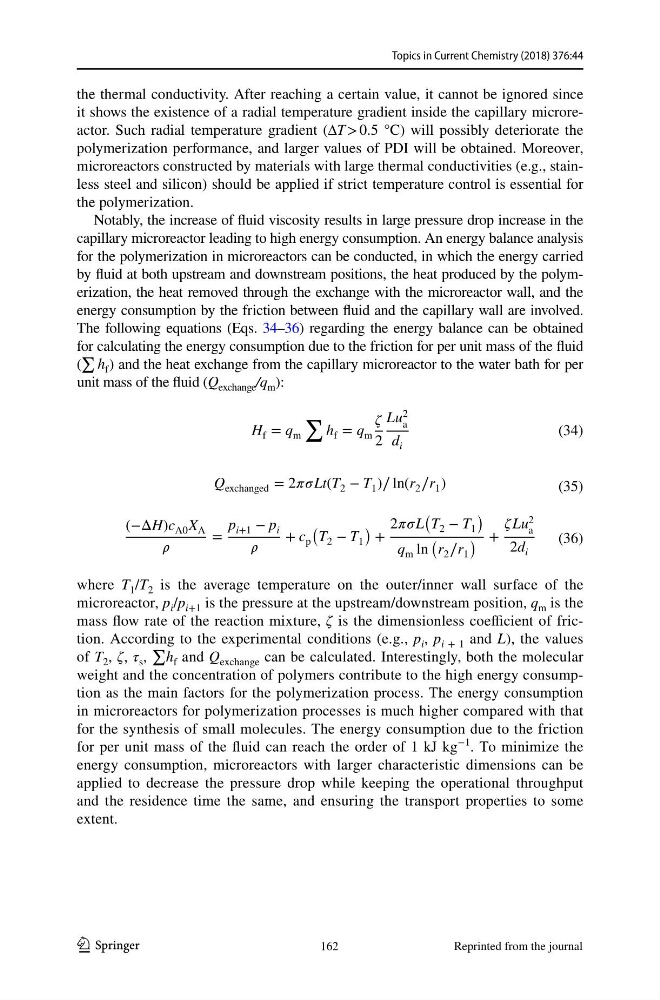
The following equations (Eqs. 34–36) regarding the energy balance can be obtained
for calculating the energy consumption due to the friction for per unit mass of the fluid
(
∑
h f ) and the heat exchange from the capillary microreactor to the water bath for per
unit mass of the fluid (Q exchange /q m ):
where T 1 /T 2 is the average temperature on the outer/inner wall surface of the
microreactor, p i /p i+1 is the pressure at the upstream/downstream position, q m is the
mass flow rate of the reaction mixture, ζ is the dimensionless coefficient of friction. According to the experimental conditions (e.g., p i , p i + 1 and L), the values
of T 2 , ζ, τ s , ∑h f and Q exchange can be calculated. Interestingly, both the molecular
weight and the concentration of polymers contribute to the high energy consumption as the main factors for the polymerization process. The energy consumption
in microreactors for polymerization processes is much higher compared with that
for the synthesis of small molecules. The energy consumption due to the friction
for per unit mass of the fluid can reach the order of 1 kJ kg
−1
. To minimize the
energy consumption, microreactors with larger characteristic dimensions can be
applied to decrease the pressure drop while keeping the operational throughput
and the residence time the same, and ensuring the transport properties to some
extent.
(34)
H f = q m
∑
h f = q m
2
Lu 2
a
d i
(35)
Q exchanged = 2Lt(T 2 − T 1 )∕ ln(r 2 ∕r 1 )
(36)
(−ΔH)c A0 X A
=
p i+1 − p i
+ c p
T 2 − T 1
+
2L
T 2 − T 1
q m ln
r 2 ∕r 1
+
Lu 2
a
2d i
162
Reprinted from the journal
1 3
the thermal conductivity. After reaching a certain value, it cannot be ignored since
it shows the existence of a radial temperature gradient inside the capillary microreactor. Such radial temperature gradient (∆T > 0.5 °C) will possibly deteriorate the
polymerization performance, and larger values of PDI will be obtained. Moreover,
microreactors constructed by materials with large thermal conductivities (e.g., stainless steel and silicon) should be applied if strict temperature control is essential for
the polymerization.
Notably, the increase of fluid viscosity results in large pressure drop increase in the
capillary microreactor leading to high energy consumption. An energy balance analysis
for the polymerization in microreactors can be conducted, in which the energy carried
by fluid at both upstream and downstream positions, the heat produced by the polymerization, the heat removed through the exchange with the microreactor wall, and the
energy consumption by the friction between fluid and the capillary wall are involved.
The following equations (Eqs. 34–36) regarding the energy balance can be obtained
for calculating the energy consumption due to the friction for per unit mass of the fluid
(
∑
h f ) and the heat exchange from the capillary microreactor to the water bath for per
unit mass of the fluid (Q exchange /q m ):
where T 1 /T 2 is the average temperature on the outer/inner wall surface of the
microreactor, p i /p i+1 is the pressure at the upstream/downstream position, q m is the
mass flow rate of the reaction mixture, ζ is the dimensionless coefficient of friction. According to the experimental conditions (e.g., p i , p i + 1 and L), the values
of T 2 , ζ, τ s , ∑h f and Q exchange can be calculated. Interestingly, both the molecular
weight and the concentration of polymers contribute to the high energy consumption as the main factors for the polymerization process. The energy consumption
in microreactors for polymerization processes is much higher compared with that
for the synthesis of small molecules. The energy consumption due to the friction
for per unit mass of the fluid can reach the order of 1 kJ kg
−1
. To minimize the
energy consumption, microreactors with larger characteristic dimensions can be
applied to decrease the pressure drop while keeping the operational throughput
and the residence time the same, and ensuring the transport properties to some
extent.
(34)
H f = q m
∑
h f = q m
2
Lu 2
a
d i
(35)
Q exchanged = 2Lt(T 2 − T 1 )∕ ln(r 2 ∕r 1 )
(36)
(−ΔH)c A0 X A
=
p i+1 − p i
+ c p
T 2 − T 1
+
2L
T 2 − T 1
q m ln
r 2 ∕r 1
+
Lu 2
a
2d i
162
Reprinted from the journal