

1 3
Topics in Current Chemistry (2018) 376:44
where a out is the ratio of the outer reactor surface to the inner reactor volume, and a m
is a configuration parameter related to the outer and inner diameters of a tube. The
resistance between the channel wall and the reaction mixture, the resistance of the
channel wall, and the resistance between the outer wall and the cooling/heating fluid
are respectively represented by the first, second, and third items in the right side of
Eq. (31). The convective heat-transfer coefficients (h in and h out ) are strongly dependent on the fluid thermal conductivity (λ fluid ), the hydrodynamics, and the hydraulic
diameter of reactors, which can be calculated through the Nusselt number (Nu) [101,
102]:
where d h is the characteristic dimension of the reactor, and Pr is the Prandtl number.
From Eq. (32) it can be seen that the increase of Reynolds number and the decrease
of characteristic reactor dimensions will be beneficial for the improvement of the
convective heat transfer. However, the Reynolds number decreases significantly
because of the increase of fluid viscosity during polymerization. It is rather difficult
to obtain analytic solutions for the temperature profile in the microreactor applied
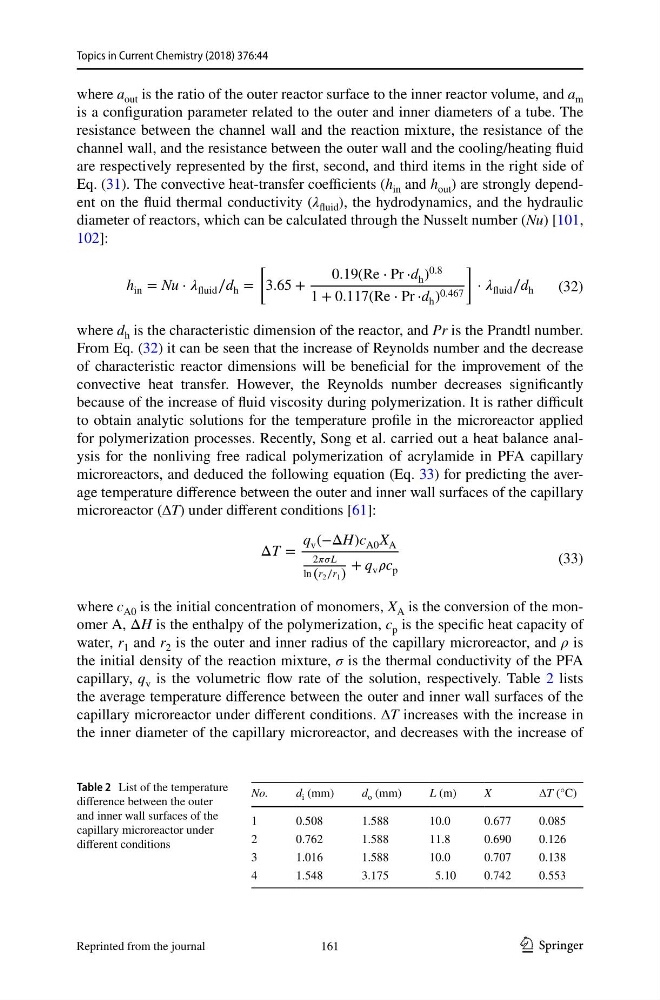
for polymerization processes. Recently, Song et al. carried out a heat balance analysis for the nonliving free radical polymerization of acrylamide in PFA capillary
microreactors, and deduced the following equation (Eq. 33) for predicting the average temperature difference between the outer and inner wall surfaces of the capillary
microreactor (∆T) under different conditions [61]:
where c A0 is the initial concentration of monomers, X A is the conversion of the monomer A, ΔH is the enthalpy of the polymerization, c p is the specific heat capacity of
water, r 1 and r 2 is the outer and inner radius of the capillary microreactor, and ρ is
the initial density of the reaction mixture, σ is the thermal conductivity of the PFA
capillary, q v is the volumetric flow rate of the solution, respectively. Table 2 lists
the average temperature difference between the outer and inner wall surfaces of the
capillary microreactor under different conditions. ∆T increases with the increase in
the inner diameter of the capillary microreactor, and decreases with the increase of
(32)
h in = Nu ⋅ fluid ∕d h =
3.65 +
0.19(Re ⋅ Pr ⋅d h )
0.8
1 + 0.117(Re ⋅ Pr ⋅d h ) 0.467
⋅ fluid ∕d h
(33)
ΔT =
q v (−ΔH)c A0 X A
2L
ln (r2∕r1)
+ q v c p
Table 2 List of the temperature
difference between the outer
and inner wall surfaces of the
capillary microreactor under
different conditions
No.
d i (mm)
d o (mm)
L (m)
X
∆T (°C)
1
0.508
1.588
10.0
0.677
0.085
2
0.762
1.588
11.8
0.690
0.126
3
1.016
1.588
10.0
0.707
0.138
4
1.548
3.175
5.10
0.742
0.553
161
Reprinted from the journal
Topics in Current Chemistry (2018) 376:44
where a out is the ratio of the outer reactor surface to the inner reactor volume, and a m
is a configuration parameter related to the outer and inner diameters of a tube. The
resistance between the channel wall and the reaction mixture, the resistance of the
channel wall, and the resistance between the outer wall and the cooling/heating fluid
are respectively represented by the first, second, and third items in the right side of
Eq. (31). The convective heat-transfer coefficients (h in and h out ) are strongly dependent on the fluid thermal conductivity (λ fluid ), the hydrodynamics, and the hydraulic
diameter of reactors, which can be calculated through the Nusselt number (Nu) [101,
102]:
where d h is the characteristic dimension of the reactor, and Pr is the Prandtl number.
From Eq. (32) it can be seen that the increase of Reynolds number and the decrease
of characteristic reactor dimensions will be beneficial for the improvement of the
convective heat transfer. However, the Reynolds number decreases significantly
because of the increase of fluid viscosity during polymerization. It is rather difficult
to obtain analytic solutions for the temperature profile in the microreactor applied
for polymerization processes. Recently, Song et al. carried out a heat balance analysis for the nonliving free radical polymerization of acrylamide in PFA capillary
microreactors, and deduced the following equation (Eq. 33) for predicting the average temperature difference between the outer and inner wall surfaces of the capillary
microreactor (∆T) under different conditions [61]:
where c A0 is the initial concentration of monomers, X A is the conversion of the monomer A, ΔH is the enthalpy of the polymerization, c p is the specific heat capacity of
water, r 1 and r 2 is the outer and inner radius of the capillary microreactor, and ρ is
the initial density of the reaction mixture, σ is the thermal conductivity of the PFA
capillary, q v is the volumetric flow rate of the solution, respectively. Table 2 lists
the average temperature difference between the outer and inner wall surfaces of the
capillary microreactor under different conditions. ∆T increases with the increase in
the inner diameter of the capillary microreactor, and decreases with the increase of
(32)
h in = Nu ⋅ fluid ∕d h =
3.65 +
0.19(Re ⋅ Pr ⋅d h )
0.8
1 + 0.117(Re ⋅ Pr ⋅d h ) 0.467
⋅ fluid ∕d h
(33)
ΔT =
q v (−ΔH)c A0 X A
2L
ln (r2∕r1)
+ q v c p
Table 2 List of the temperature
difference between the outer
and inner wall surfaces of the
capillary microreactor under
different conditions
No.
d i (mm)
d o (mm)
L (m)
X
∆T (°C)
1
0.508
1.588
10.0
0.677
0.085
2
0.762
1.588
11.8
0.690
0.126
3
1.016
1.588
10.0
0.707
0.138
4
1.548
3.175
5.10
0.742
0.553
161
Reprinted from the journal