

Topics in Current Chemistry (2018) 376:44
1 3
reactors was reported to be interfacial polymerization [96–99]. The transformation
of heterogeneous polymerization from the interface to the bulk phase is easily realized with the use of microreactors, providing more uniform reaction conditions for
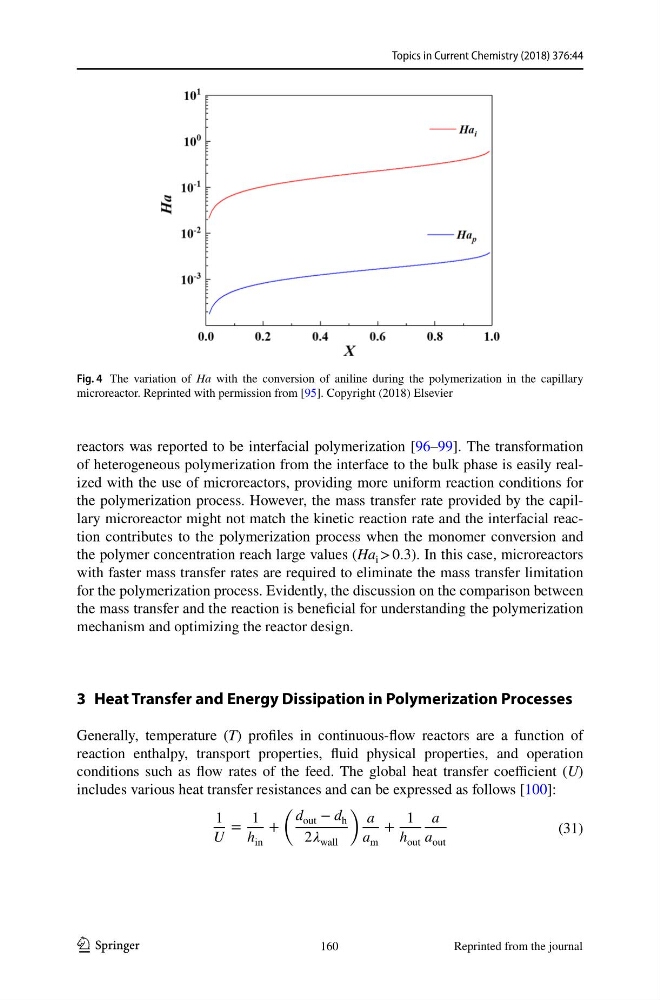
the polymerization process. However, the mass transfer rate provided by the capillary microreactor might not match the kinetic reaction rate and the interfacial reaction contributes to the polymerization process when the monomer conversion and
the polymer concentration reach large values (Ha i > 0.3). In this case, microreactors
with faster mass transfer rates are required to eliminate the mass transfer limitation
for the polymerization process. Evidently, the discussion on the comparison between
the mass transfer and the reaction is beneficial for understanding the polymerization
mechanism and optimizing the reactor design.
3 Heat Transfer and Energy Dissipation in Polymerization Processes
Generally, temperature (T) profiles in continuous-flow reactors are a function of
reaction enthalpy, transport properties, fluid physical properties, and operation
conditions such as flow rates of the feed. The global heat transfer coefficient (U)
includes various heat transfer resistances and can be expressed as follows [100]:
(31)
1
U
=
1
h in
+
d out − d h
2 wall
a
a m
+
1
h out
a
a out
Fig. 4 The variation of Ha with the conversion of aniline during the polymerization in the capillary
microreactor. Reprinted with permission from [95]. Copyright (2018) Elsevier
160
Reprinted from the journal
1 3
reactors was reported to be interfacial polymerization [96–99]. The transformation
of heterogeneous polymerization from the interface to the bulk phase is easily realized with the use of microreactors, providing more uniform reaction conditions for
the polymerization process. However, the mass transfer rate provided by the capillary microreactor might not match the kinetic reaction rate and the interfacial reaction contributes to the polymerization process when the monomer conversion and
the polymer concentration reach large values (Ha i > 0.3). In this case, microreactors
with faster mass transfer rates are required to eliminate the mass transfer limitation
for the polymerization process. Evidently, the discussion on the comparison between
the mass transfer and the reaction is beneficial for understanding the polymerization
mechanism and optimizing the reactor design.
3 Heat Transfer and Energy Dissipation in Polymerization Processes
Generally, temperature (T) profiles in continuous-flow reactors are a function of
reaction enthalpy, transport properties, fluid physical properties, and operation
conditions such as flow rates of the feed. The global heat transfer coefficient (U)
includes various heat transfer resistances and can be expressed as follows [100]:
(31)
1
U
=
1
h in
+
d out − d h
2 wall
a
a m
+
1
h out
a
a out
Fig. 4 The variation of Ha with the conversion of aniline during the polymerization in the capillary
microreactor. Reprinted with permission from [95]. Copyright (2018) Elsevier
160
Reprinted from the journal