

1 3
Topics in Current Chemistry (2018) 376:44
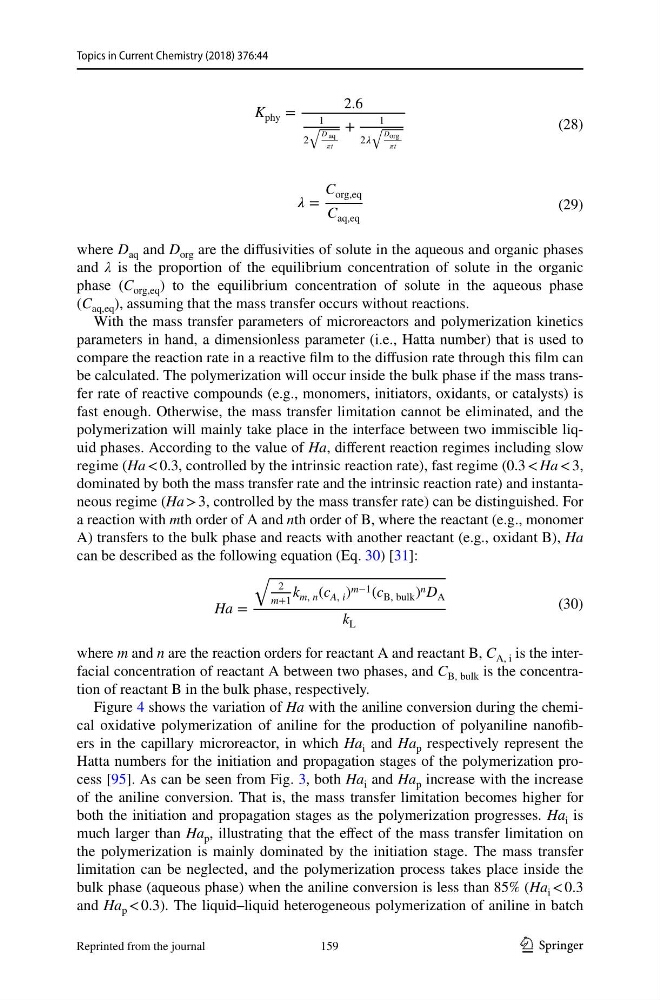
where D aq and D org are the diffusivities of solute in the aqueous and organic phases
and λ is the proportion of the equilibrium concentration of solute in the organic
phase (C org,eq ) to the equilibrium concentration of solute in the aqueous phase
(C aq,eq ), assuming that the mass transfer occurs without reactions.
With the mass transfer parameters of microreactors and polymerization kinetics
parameters in hand, a dimensionless parameter (i.e., Hatta number) that is used to
compare the reaction rate in a reactive film to the diffusion rate through this film can
be calculated. The polymerization will occur inside the bulk phase if the mass transfer rate of reactive compounds (e.g., monomers, initiators, oxidants, or catalysts) is
fast enough. Otherwise, the mass transfer limitation cannot be eliminated, and the
polymerization will mainly take place in the interface between two immiscible liquid phases. According to the value of Ha, different reaction regimes including slow
regime (Ha < 0.3, controlled by the intrinsic reaction rate), fast regime (0.3 < Ha < 3,
dominated by both the mass transfer rate and the intrinsic reaction rate) and instantaneous regime (Ha > 3, controlled by the mass transfer rate) can be distinguished. For
a reaction with mth order of A and nth order of B, where the reactant (e.g., monomer
A) transfers to the bulk phase and reacts with another reactant (e.g., oxidant B), Ha
can be described as the following equation (Eq. 30) [31]:
where m and n are the reaction orders for reactant A and reactant B, C A, i is the interfacial concentration of reactant A between two phases, and C B, bulk is the concentration of reactant B in the bulk phase, respectively.
Figure 4 shows the variation of Ha with the aniline conversion during the chemical oxidative polymerization of aniline for the production of polyaniline nanofibers in the capillary microreactor, in which Ha i and Ha p respectively represent the
Hatta numbers for the initiation and propagation stages of the polymerization process [95]. As can be seen from Fig. 3, both Ha i and Ha p increase with the increase
of the aniline conversion. That is, the mass transfer limitation becomes higher for
both the initiation and propagation stages as the polymerization progresses. Ha i is
much larger than Ha p , illustrating that the effect of the mass transfer limitation on
the polymerization is mainly dominated by the initiation stage. The mass transfer
limitation can be neglected, and the polymerization process takes place inside the
bulk phase (aqueous phase) when the aniline conversion is less than 85% (Ha i < 0.3
and Ha p < 0.3). The liquid–liquid heterogeneous polymerization of aniline in batch
(28)
K phy =
2.6
1
2
√
D aq
t
+
1
2
√
D org
t
(29)
=
C org,eq
C aq,eq
(30)
Ha =
√
2
m+1
k m, n (c A, i ) m−1 (c B, bulk ) n D A
k L
159
Reprinted from the journal
Topics in Current Chemistry (2018) 376:44
where D aq and D org are the diffusivities of solute in the aqueous and organic phases
and λ is the proportion of the equilibrium concentration of solute in the organic
phase (C org,eq ) to the equilibrium concentration of solute in the aqueous phase
(C aq,eq ), assuming that the mass transfer occurs without reactions.
With the mass transfer parameters of microreactors and polymerization kinetics
parameters in hand, a dimensionless parameter (i.e., Hatta number) that is used to
compare the reaction rate in a reactive film to the diffusion rate through this film can
be calculated. The polymerization will occur inside the bulk phase if the mass transfer rate of reactive compounds (e.g., monomers, initiators, oxidants, or catalysts) is
fast enough. Otherwise, the mass transfer limitation cannot be eliminated, and the
polymerization will mainly take place in the interface between two immiscible liquid phases. According to the value of Ha, different reaction regimes including slow
regime (Ha < 0.3, controlled by the intrinsic reaction rate), fast regime (0.3 < Ha < 3,
dominated by both the mass transfer rate and the intrinsic reaction rate) and instantaneous regime (Ha > 3, controlled by the mass transfer rate) can be distinguished. For
a reaction with mth order of A and nth order of B, where the reactant (e.g., monomer
A) transfers to the bulk phase and reacts with another reactant (e.g., oxidant B), Ha
can be described as the following equation (Eq. 30) [31]:
where m and n are the reaction orders for reactant A and reactant B, C A, i is the interfacial concentration of reactant A between two phases, and C B, bulk is the concentration of reactant B in the bulk phase, respectively.
Figure 4 shows the variation of Ha with the aniline conversion during the chemical oxidative polymerization of aniline for the production of polyaniline nanofibers in the capillary microreactor, in which Ha i and Ha p respectively represent the
Hatta numbers for the initiation and propagation stages of the polymerization process [95]. As can be seen from Fig. 3, both Ha i and Ha p increase with the increase
of the aniline conversion. That is, the mass transfer limitation becomes higher for
both the initiation and propagation stages as the polymerization progresses. Ha i is
much larger than Ha p , illustrating that the effect of the mass transfer limitation on
the polymerization is mainly dominated by the initiation stage. The mass transfer
limitation can be neglected, and the polymerization process takes place inside the
bulk phase (aqueous phase) when the aniline conversion is less than 85% (Ha i < 0.3
and Ha p < 0.3). The liquid–liquid heterogeneous polymerization of aniline in batch
(28)
K phy =
2.6
1
2
√
D aq
t
+
1
2
√
D org
t
(29)
=
C org,eq
C aq,eq
(30)
Ha =
√
2
m+1
k m, n (c A, i ) m−1 (c B, bulk ) n D A
k L
159
Reprinted from the journal