

1 3
Topics in Current Chemistry (2018) 376:44
In fact, the specific energy dissipation is widely used to evaluate energy utilization
efficiency for various reactors, and it can be respectively calculated by the following
equations (Eqs. 37 and 38) for microreactors and batch reactors [48, 103]:
where ΔP is the pressure drop, V is the reactor volume, N is the rotational stirring
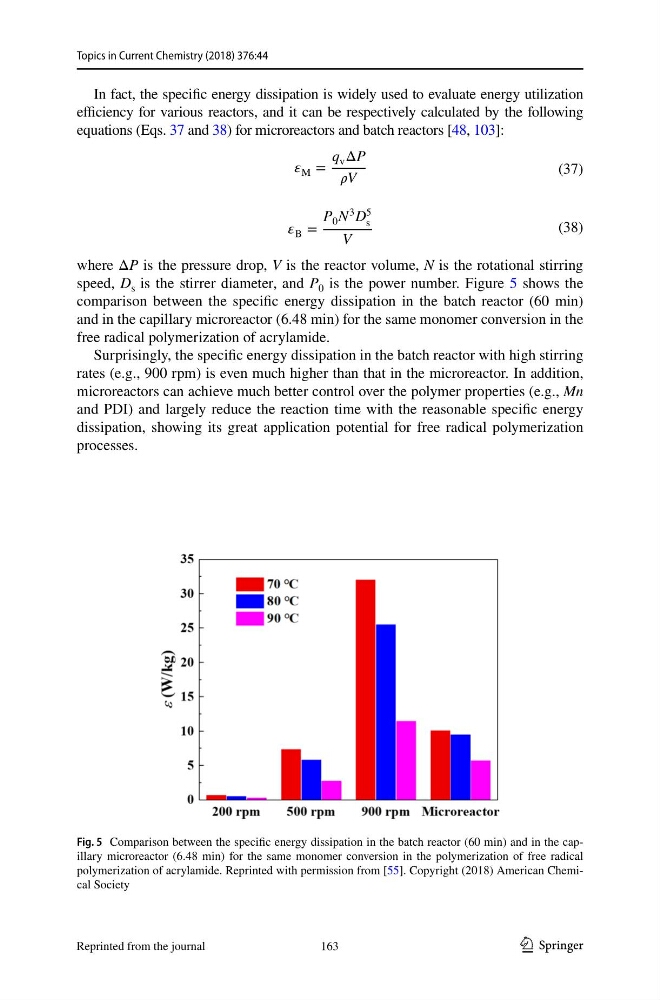
speed, D s is the stirrer diameter, and P 0 is the power number. Figure 5 shows the
comparison between the specific energy dissipation in the batch reactor (60 min)
and in the capillary microreactor (6.48 min) for the same monomer conversion in the
free radical polymerization of acrylamide.
Surprisingly, the specific energy dissipation in the batch reactor with high stirring
rates (e.g., 900 rpm) is even much higher than that in the microreactor. In addition,
microreactors can achieve much better control over the polymer properties (e.g., Mn
and PDI) and largely reduce the reaction time with the reasonable specific energy
dissipation, showing its great application potential for free radical polymerization
processes.
(37)
M =
q v ΔP
V
(38)
B =
P 0 N
3 D
5
s
V
Fig. 5 Comparison between the specific energy dissipation in the batch reactor (60 min) and in the capillary microreactor (6.48 min) for the same monomer conversion in the polymerization of free radical
polymerization of acrylamide. Reprinted with permission from [55]. Copyright (2018) American Chemical Society
163
Reprinted from the journal
Topics in Current Chemistry (2018) 376:44
In fact, the specific energy dissipation is widely used to evaluate energy utilization
efficiency for various reactors, and it can be respectively calculated by the following
equations (Eqs. 37 and 38) for microreactors and batch reactors [48, 103]:
where ΔP is the pressure drop, V is the reactor volume, N is the rotational stirring
speed, D s is the stirrer diameter, and P 0 is the power number. Figure 5 shows the
comparison between the specific energy dissipation in the batch reactor (60 min)
and in the capillary microreactor (6.48 min) for the same monomer conversion in the
free radical polymerization of acrylamide.
Surprisingly, the specific energy dissipation in the batch reactor with high stirring
rates (e.g., 900 rpm) is even much higher than that in the microreactor. In addition,
microreactors can achieve much better control over the polymer properties (e.g., Mn
and PDI) and largely reduce the reaction time with the reasonable specific energy
dissipation, showing its great application potential for free radical polymerization
processes.
(37)
M =
q v ΔP
V
(38)
B =
P 0 N
3 D
5
s
V
Fig. 5 Comparison between the specific energy dissipation in the batch reactor (60 min) and in the capillary microreactor (6.48 min) for the same monomer conversion in the polymerization of free radical
polymerization of acrylamide. Reprinted with permission from [55]. Copyright (2018) American Chemical Society
163
Reprinted from the journal