

1 3
Topics in Current Chemistry (2018) 376:44
2.2 Mass Transfer in Heterogeneous Polymerization Processes
Heterogeneous polymerization typically includes dispersion, emulsion, precipitation, miniemulsion, and suspension polymerization processes. In these polymerization processes, two immiscible liquid phases (i.e., organic phase and aqueous phase)
are involved, and monomers, initiators, or catalysts need to transport from one phase
to the other phase. Therefore, the mass transfer between two immiscible liquid
phases might be the rate-controlling step, depending on the polymerization kinetics and the mass transfer rate [11, 26]. Compared with the homogeneous polymerization, the heterogeneous polymerization has advantages on controllable synthesis
of polymeric nanoparticles/microparticles, vesicles, and hydrogels with uniform
and special structures for numerous applications [80, 81], including drug delivery,
diagnostic imaging, and confined microreaction. For example, heterogeneous freeradical polymerization methods have been developed for the preparation of microgels and nanogels, such as inverse microemulsion, inverse miniemulsion, precipitation process, dispersion polymerization, and heterogeneous controlled/living radical
polymerization [82, 83]. Moreover, polymerization processes involving the use of
solid catalysts can be categorized into heterogeneous polymerization.
For many heterogeneous polymerization processes, the overall performance is
strongly dependent on the dispersion and the mass transfer between two immiscible
liquid phases since they are kinetically fast and deserve to be controlled precisely. Conventional batch reactors are hard to provide defined and enough interfacial contact
areas between two immiscible liquid phases, and the mass transfer rate is not sufficient
for the fast heterogeneous polymerization processes. The mass transfer characteristics
in microreactors exhibit its great application potential on heterogeneous polymerization. It was reported that the values of the overall volumetric mass-transfer coefficient
(Ka) in microchannels or microreactors can reach at least one to two orders of magnitude higher than those obtained in conventional reactors or contactors. Resulting from
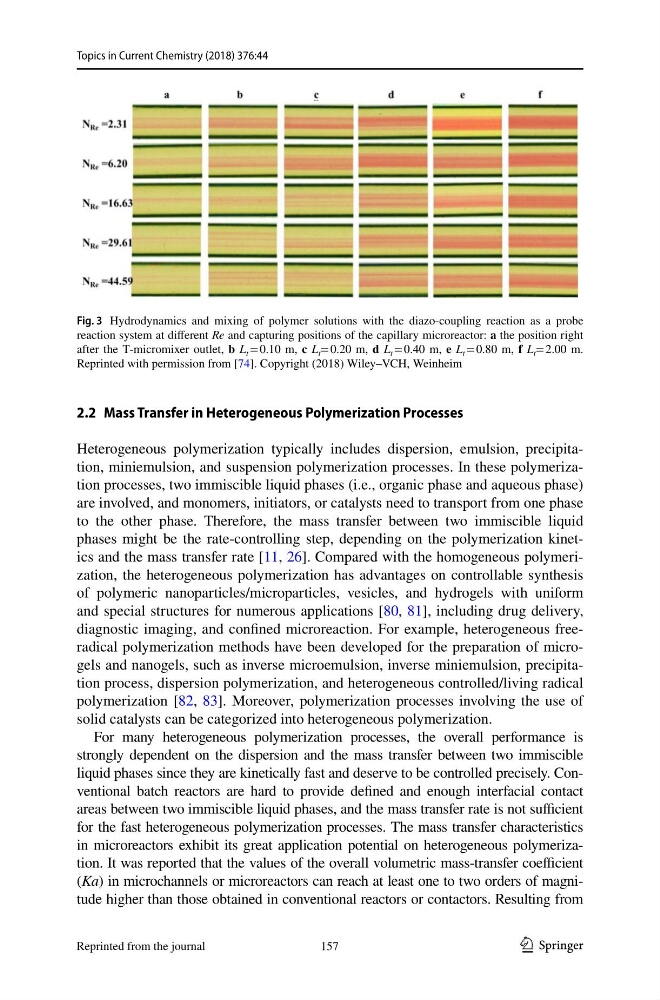
Fig. 3 Hydrodynamics and mixing of polymer solutions with the diazo-coupling reaction as a probe
reaction system at different Re and capturing positions of the capillary microreactor: a the position right
after the T-micromixer outlet, b L t = 0.10 m, c L t = 0.20 m, d L t = 0.40 m, e L t = 0.80 m, f L t = 2.00 m.
Reprinted with permission from [74]. Copyright (2018) Wiley–VCH, Weinheim
157
Reprinted from the journal
Topics in Current Chemistry (2018) 376:44
2.2 Mass Transfer in Heterogeneous Polymerization Processes
Heterogeneous polymerization typically includes dispersion, emulsion, precipitation, miniemulsion, and suspension polymerization processes. In these polymerization processes, two immiscible liquid phases (i.e., organic phase and aqueous phase)
are involved, and monomers, initiators, or catalysts need to transport from one phase
to the other phase. Therefore, the mass transfer between two immiscible liquid
phases might be the rate-controlling step, depending on the polymerization kinetics and the mass transfer rate [11, 26]. Compared with the homogeneous polymerization, the heterogeneous polymerization has advantages on controllable synthesis
of polymeric nanoparticles/microparticles, vesicles, and hydrogels with uniform
and special structures for numerous applications [80, 81], including drug delivery,
diagnostic imaging, and confined microreaction. For example, heterogeneous freeradical polymerization methods have been developed for the preparation of microgels and nanogels, such as inverse microemulsion, inverse miniemulsion, precipitation process, dispersion polymerization, and heterogeneous controlled/living radical
polymerization [82, 83]. Moreover, polymerization processes involving the use of
solid catalysts can be categorized into heterogeneous polymerization.
For many heterogeneous polymerization processes, the overall performance is
strongly dependent on the dispersion and the mass transfer between two immiscible
liquid phases since they are kinetically fast and deserve to be controlled precisely. Conventional batch reactors are hard to provide defined and enough interfacial contact
areas between two immiscible liquid phases, and the mass transfer rate is not sufficient
for the fast heterogeneous polymerization processes. The mass transfer characteristics
in microreactors exhibit its great application potential on heterogeneous polymerization. It was reported that the values of the overall volumetric mass-transfer coefficient
(Ka) in microchannels or microreactors can reach at least one to two orders of magnitude higher than those obtained in conventional reactors or contactors. Resulting from
Fig. 3 Hydrodynamics and mixing of polymer solutions with the diazo-coupling reaction as a probe
reaction system at different Re and capturing positions of the capillary microreactor: a the position right
after the T-micromixer outlet, b L t = 0.10 m, c L t = 0.20 m, d L t = 0.40 m, e L t = 0.80 m, f L t = 2.00 m.
Reprinted with permission from [74]. Copyright (2018) Wiley–VCH, Weinheim
157
Reprinted from the journal