

Topics in Current Chemistry (2018) 376:44
1 3
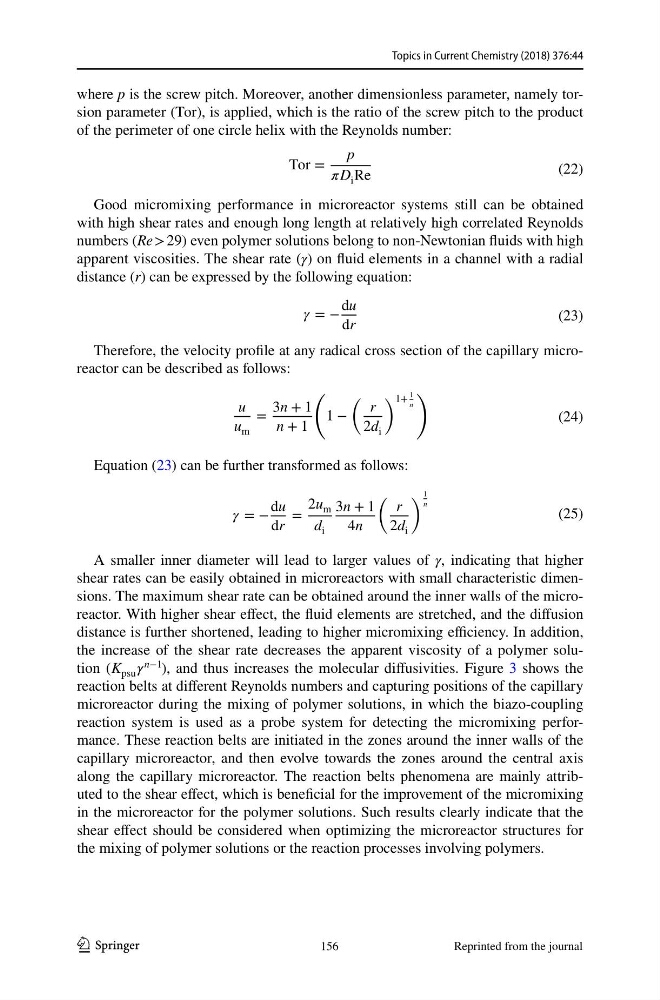
where p is the screw pitch. Moreover, another dimensionless parameter, namely torsion parameter (Tor), is applied, which is the ratio of the screw pitch to the product
of the perimeter of one circle helix with the Reynolds number:
Good micromixing performance in microreactor systems still can be obtained
with high shear rates and enough long length at relatively high correlated Reynolds
numbers (Re > 29) even polymer solutions belong to non-Newtonian fluids with high
apparent viscosities. The shear rate (γ) on fluid elements in a channel with a radial
distance (r) can be expressed by the following equation:
Therefore, the velocity profile at any radical cross section of the capillary microreactor can be described as follows:
Equation (23) can be further transformed as follows:
A smaller inner diameter will lead to larger values of γ, indicating that higher
shear rates can be easily obtained in microreactors with small characteristic dimensions. The maximum shear rate can be obtained around the inner walls of the microreactor. With higher shear effect, the fluid elements are stretched, and the diffusion
distance is further shortened, leading to higher micromixing efficiency. In addition,
the increase of the shear rate decreases the apparent viscosity of a polymer solution ( K psu
n−1 ), and thus increases the molecular diffusivities. Figure 3 shows the
reaction belts at different Reynolds numbers and capturing positions of the capillary
microreactor during the mixing of polymer solutions, in which the biazo-coupling
reaction system is used as a probe system for detecting the micromixing performance. These reaction belts are initiated in the zones around the inner walls of the
capillary microreactor, and then evolve towards the zones around the central axis
along the capillary microreactor. The reaction belts phenomena are mainly attributed to the shear effect, which is beneficial for the improvement of the micromixing
in the microreactor for the polymer solutions. Such results clearly indicate that the
shear effect should be considered when optimizing the microreactor structures for
the mixing of polymer solutions or the reaction processes involving polymers.
(22)
Tor =
p
D i Re
(23)
= −
du
dr
(24)
u
u m
=
3n + 1
n + 1
1 −
r
2d i
1+
1
n
(25)
= −
du
dr
=
2u m
d i
3n + 1
4n
r
2d i
1
n
156
Reprinted from the journal
1 3
where p is the screw pitch. Moreover, another dimensionless parameter, namely torsion parameter (Tor), is applied, which is the ratio of the screw pitch to the product
of the perimeter of one circle helix with the Reynolds number:
Good micromixing performance in microreactor systems still can be obtained
with high shear rates and enough long length at relatively high correlated Reynolds
numbers (Re > 29) even polymer solutions belong to non-Newtonian fluids with high
apparent viscosities. The shear rate (γ) on fluid elements in a channel with a radial
distance (r) can be expressed by the following equation:
Therefore, the velocity profile at any radical cross section of the capillary microreactor can be described as follows:
Equation (23) can be further transformed as follows:
A smaller inner diameter will lead to larger values of γ, indicating that higher
shear rates can be easily obtained in microreactors with small characteristic dimensions. The maximum shear rate can be obtained around the inner walls of the microreactor. With higher shear effect, the fluid elements are stretched, and the diffusion
distance is further shortened, leading to higher micromixing efficiency. In addition,
the increase of the shear rate decreases the apparent viscosity of a polymer solution ( K psu
n−1 ), and thus increases the molecular diffusivities. Figure 3 shows the
reaction belts at different Reynolds numbers and capturing positions of the capillary
microreactor during the mixing of polymer solutions, in which the biazo-coupling
reaction system is used as a probe system for detecting the micromixing performance. These reaction belts are initiated in the zones around the inner walls of the
capillary microreactor, and then evolve towards the zones around the central axis
along the capillary microreactor. The reaction belts phenomena are mainly attributed to the shear effect, which is beneficial for the improvement of the micromixing
in the microreactor for the polymer solutions. Such results clearly indicate that the
shear effect should be considered when optimizing the microreactor structures for
the mixing of polymer solutions or the reaction processes involving polymers.
(22)
Tor =
p
D i Re
(23)
= −
du
dr
(24)
u
u m
=
3n + 1
n + 1
1 −
r
2d i
1+
1
n
(25)
= −
du
dr
=
2u m
d i
3n + 1
4n
r
2d i
1
n
156
Reprinted from the journal