

1 3
Topics in Current Chemistry (2018) 376:44
where q v is the volumetric flow rate, l is the hydraulic diameter of the microreactor,
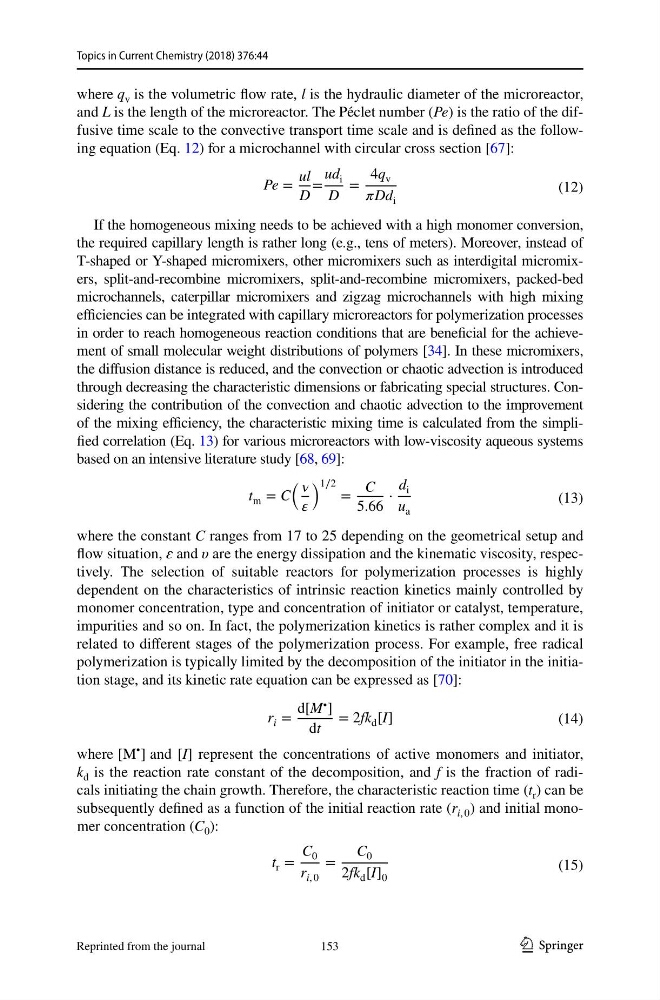
and L is the length of the microreactor. The Péclet number (Pe) is the ratio of the diffusive time scale to the convective transport time scale and is defined as the following equation (Eq. 12) for a microchannel with circular cross section [67]:
If the homogeneous mixing needs to be achieved with a high monomer conversion,
the required capillary length is rather long (e.g., tens of meters). Moreover, instead of
T-shaped or Y-shaped micromixers, other micromixers such as interdigital micromixers, split-and-recombine micromixers, split-and-recombine micromixers, packed-bed
microchannels, caterpillar micromixers and zigzag microchannels with high mixing
efficiencies can be integrated with capillary microreactors for polymerization processes
in order to reach homogeneous reaction conditions that are beneficial for the achievement of small molecular weight distributions of polymers [34]. In these micromixers,
the diffusion distance is reduced, and the convection or chaotic advection is introduced
through decreasing the characteristic dimensions or fabricating special structures. Considering the contribution of the convection and chaotic advection to the improvement
of the mixing efficiency, the characteristic mixing time is calculated from the simplified correlation (Eq. 13) for various microreactors with low-viscosity aqueous systems
based on an intensive literature study [68, 69]:
where the constant C ranges from 17 to 25 depending on the geometrical setup and
flow situation, ɛ and υ are the energy dissipation and the kinematic viscosity, respectively. The selection of suitable reactors for polymerization processes is highly
dependent on the characteristics of intrinsic reaction kinetics mainly controlled by
monomer concentration, type and concentration of initiator or catalyst, temperature,
impurities and so on. In fact, the polymerization kinetics is rather complex and it is
related to different stages of the polymerization process. For example, free radical
polymerization is typically limited by the decomposition of the initiator in the initiation stage, and its kinetic rate equation can be expressed as [70]:
where [M
∙ ] and [I] represent the concentrations of active monomers and initiator,
k d is the reaction rate constant of the decomposition, and f is the fraction of radicals initiating the chain growth. Therefore, the characteristic reaction time (t r ) can be
subsequently defined as a function of the initial reaction rate ( r i, 0 ) and initial monomer concentration (C 0 ):
(12)
Pe =
ul
D
=
ud i
D
=
4q v
Dd i
(13)
t m = C
1∕2
=
C
5.66
⋅
d i
u a
(14)
r i =
d[M ∙ ]
dt
= 2fk d [I]
(15)
t r =
C 0
r i, 0
=
C 0
2fk d [I] 0
153
Reprinted from the journal
Topics in Current Chemistry (2018) 376:44
where q v is the volumetric flow rate, l is the hydraulic diameter of the microreactor,
and L is the length of the microreactor. The Péclet number (Pe) is the ratio of the diffusive time scale to the convective transport time scale and is defined as the following equation (Eq. 12) for a microchannel with circular cross section [67]:
If the homogeneous mixing needs to be achieved with a high monomer conversion,
the required capillary length is rather long (e.g., tens of meters). Moreover, instead of
T-shaped or Y-shaped micromixers, other micromixers such as interdigital micromixers, split-and-recombine micromixers, split-and-recombine micromixers, packed-bed
microchannels, caterpillar micromixers and zigzag microchannels with high mixing
efficiencies can be integrated with capillary microreactors for polymerization processes
in order to reach homogeneous reaction conditions that are beneficial for the achievement of small molecular weight distributions of polymers [34]. In these micromixers,
the diffusion distance is reduced, and the convection or chaotic advection is introduced
through decreasing the characteristic dimensions or fabricating special structures. Considering the contribution of the convection and chaotic advection to the improvement
of the mixing efficiency, the characteristic mixing time is calculated from the simplified correlation (Eq. 13) for various microreactors with low-viscosity aqueous systems
based on an intensive literature study [68, 69]:
where the constant C ranges from 17 to 25 depending on the geometrical setup and
flow situation, ɛ and υ are the energy dissipation and the kinematic viscosity, respectively. The selection of suitable reactors for polymerization processes is highly
dependent on the characteristics of intrinsic reaction kinetics mainly controlled by
monomer concentration, type and concentration of initiator or catalyst, temperature,
impurities and so on. In fact, the polymerization kinetics is rather complex and it is
related to different stages of the polymerization process. For example, free radical
polymerization is typically limited by the decomposition of the initiator in the initiation stage, and its kinetic rate equation can be expressed as [70]:
where [M
∙ ] and [I] represent the concentrations of active monomers and initiator,
k d is the reaction rate constant of the decomposition, and f is the fraction of radicals initiating the chain growth. Therefore, the characteristic reaction time (t r ) can be
subsequently defined as a function of the initial reaction rate ( r i, 0 ) and initial monomer concentration (C 0 ):
(12)
Pe =
ul
D
=
ud i
D
=
4q v
Dd i
(13)
t m = C
1∕2
=
C
5.66
⋅
d i
u a
(14)
r i =
d[M ∙ ]
dt
= 2fk d [I]
(15)
t r =
C 0
r i, 0
=
C 0
2fk d [I] 0
153
Reprinted from the journal