

Topics in Current Chemistry (2018) 376:44
1 3
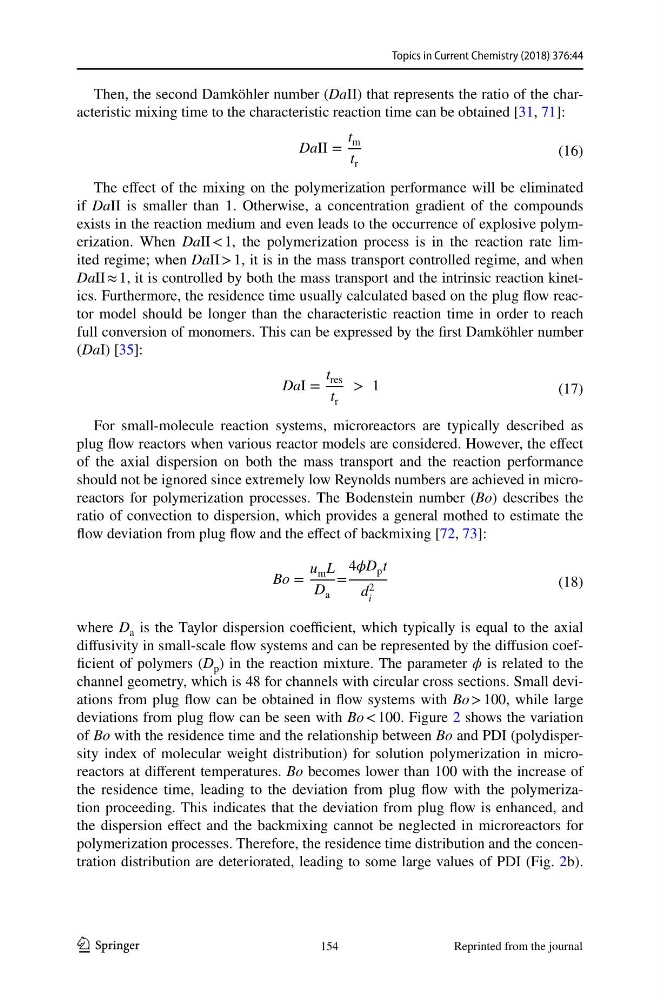
Then, the second Damköhler number (DaII) that represents the ratio of the characteristic mixing time to the characteristic reaction time can be obtained [31, 71]:
The effect of the mixing on the polymerization performance will be eliminated
if DaII is smaller than 1. Otherwise, a concentration gradient of the compounds
exists in the reaction medium and even leads to the occurrence of explosive polymerization. When DaII < 1, the polymerization process is in the reaction rate limited regime; when DaII > 1, it is in the mass transport controlled regime, and when
DaII ≈ 1, it is controlled by both the mass transport and the intrinsic reaction kinetics. Furthermore, the residence time usually calculated based on the plug flow reactor model should be longer than the characteristic reaction time in order to reach
full conversion of monomers. This can be expressed by the first Damköhler number
(DaI) [35]:
For small-molecule reaction systems, microreactors are typically described as
plug flow reactors when various reactor models are considered. However, the effect
of the axial dispersion on both the mass transport and the reaction performance
should not be ignored since extremely low Reynolds numbers are achieved in microreactors for polymerization processes. The Bodenstein number (Bo) describes the
ratio of convection to dispersion, which provides a general mothed to estimate the
flow deviation from plug flow and the effect of backmixing [72, 73]:
where D a is the Taylor dispersion coefficient, which typically is equal to the axial
diffusivity in small-scale flow systems and can be represented by the diffusion coefficient of polymers (D p ) in the reaction mixture. The parameter ϕ is related to the
channel geometry, which is 48 for channels with circular cross sections. Small deviations from plug flow can be obtained in flow systems with Bo > 100, while large
deviations from plug flow can be seen with Bo < 100. Figure 2 shows the variation
of Bo with the residence time and the relationship between Bo and PDI (polydispersity index of molecular weight distribution) for solution polymerization in microreactors at different temperatures. Bo becomes lower than 100 with the increase of
the residence time, leading to the deviation from plug flow with the polymerization proceeding. This indicates that the deviation from plug flow is enhanced, and
the dispersion effect and the backmixing cannot be neglected in microreactors for
polymerization processes. Therefore, the residence time distribution and the concentration distribution are deteriorated, leading to some large values of PDI (Fig. 2b).
(16)
DaII =
t m
t r
(17)
DaI =
t res
t r
> 1
(18)
Bo =
u m L
D a
=
4D p t
d
2
i
154
Reprinted from the journal
1 3
Then, the second Damköhler number (DaII) that represents the ratio of the characteristic mixing time to the characteristic reaction time can be obtained [31, 71]:
The effect of the mixing on the polymerization performance will be eliminated
if DaII is smaller than 1. Otherwise, a concentration gradient of the compounds
exists in the reaction medium and even leads to the occurrence of explosive polymerization. When DaII < 1, the polymerization process is in the reaction rate limited regime; when DaII > 1, it is in the mass transport controlled regime, and when
DaII ≈ 1, it is controlled by both the mass transport and the intrinsic reaction kinetics. Furthermore, the residence time usually calculated based on the plug flow reactor model should be longer than the characteristic reaction time in order to reach
full conversion of monomers. This can be expressed by the first Damköhler number
(DaI) [35]:
For small-molecule reaction systems, microreactors are typically described as
plug flow reactors when various reactor models are considered. However, the effect
of the axial dispersion on both the mass transport and the reaction performance
should not be ignored since extremely low Reynolds numbers are achieved in microreactors for polymerization processes. The Bodenstein number (Bo) describes the
ratio of convection to dispersion, which provides a general mothed to estimate the
flow deviation from plug flow and the effect of backmixing [72, 73]:
where D a is the Taylor dispersion coefficient, which typically is equal to the axial
diffusivity in small-scale flow systems and can be represented by the diffusion coefficient of polymers (D p ) in the reaction mixture. The parameter ϕ is related to the
channel geometry, which is 48 for channels with circular cross sections. Small deviations from plug flow can be obtained in flow systems with Bo > 100, while large
deviations from plug flow can be seen with Bo < 100. Figure 2 shows the variation
of Bo with the residence time and the relationship between Bo and PDI (polydispersity index of molecular weight distribution) for solution polymerization in microreactors at different temperatures. Bo becomes lower than 100 with the increase of
the residence time, leading to the deviation from plug flow with the polymerization proceeding. This indicates that the deviation from plug flow is enhanced, and
the dispersion effect and the backmixing cannot be neglected in microreactors for
polymerization processes. Therefore, the residence time distribution and the concentration distribution are deteriorated, leading to some large values of PDI (Fig. 2b).
(16)
DaII =
t m
t r
(17)
DaI =
t res
t r
> 1
(18)
Bo =
u m L
D a
=
4D p t
d
2
i
154
Reprinted from the journal