

Topics in Current Chemistry (2018) 376:44
1 3
where V mo is the molar volume of the monomer at its normal boiling point (cm
3
/
mol).
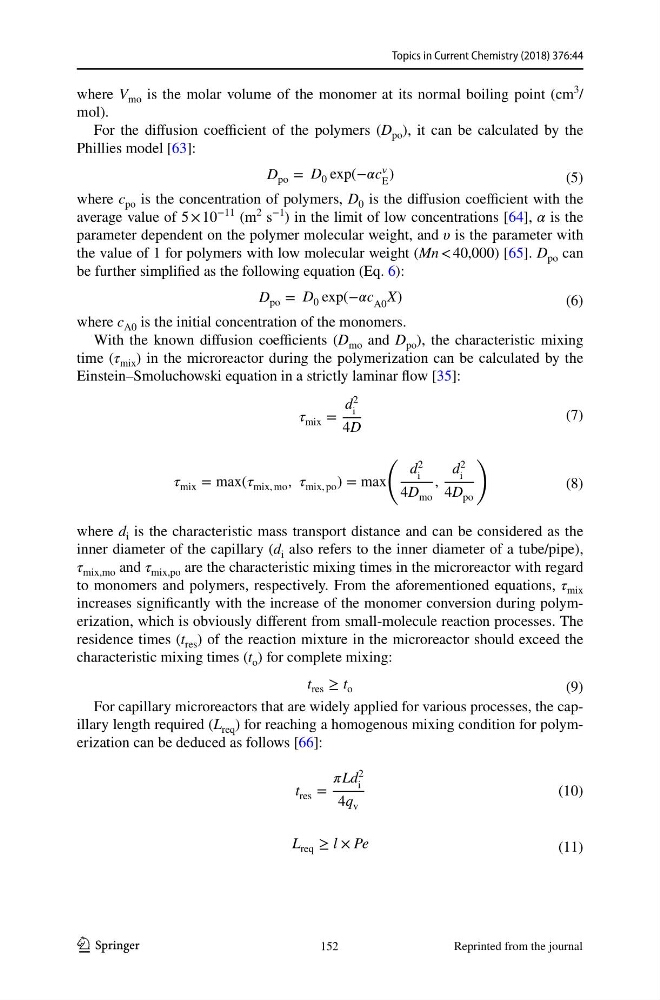
For the diffusion coefficient of the polymers (D po ), it can be calculated by the
Phillies model [63]:
where c po is the concentration of polymers, D 0 is the diffusion coefficient with the
average value of 5 × 10
−11
(m
2
s
−1
) in the limit of low concentrations [64], α is the
parameter dependent on the polymer molecular weight, and υ is the parameter with
the value of 1 for polymers with low molecular weight (Mn < 40,000) [65]. D po can
be further simplified as the following equation (Eq. 6):
where c A0 is the initial concentration of the monomers.
With the known diffusion coefficients (D mo and D po ), the characteristic mixing
time (τ mix ) in the microreactor during the polymerization can be calculated by the
Einstein–Smoluchowski equation in a strictly laminar flow [35]:
where d i is the characteristic mass transport distance and can be considered as the
inner diameter of the capillary (d i also refers to the inner diameter of a tube/pipe),
τ mix,mo and τ mix,po are the characteristic mixing times in the microreactor with regard
to monomers and polymers, respectively. From the aforementioned equations, τ mix
increases significantly with the increase of the monomer conversion during polymerization, which is obviously different from small-molecule reaction processes. The
residence times (t res ) of the reaction mixture in the microreactor should exceed the
characteristic mixing times (t o ) for complete mixing:
For capillary microreactors that are widely applied for various processes, the capillary length required (L req ) for reaching a homogenous mixing condition for polymerization can be deduced as follows [66]:
(5)
D po = D 0 exp(−c
E
)
(6)
D po = D 0 exp(−c A0 X)
(7)
mix =
d
2
i
4D
(8)
mix = max( mix, mo , mix, po ) = max
d
2
i
4D mo
,
d
2
i
4D po
(9)
t res ≥ t o
(10)
t res =
Ld
2
i
4q v
(11)
L req ≥ l × Pe
152
Reprinted from the journal
1 3
where V mo is the molar volume of the monomer at its normal boiling point (cm
3
/
mol).
For the diffusion coefficient of the polymers (D po ), it can be calculated by the
Phillies model [63]:
where c po is the concentration of polymers, D 0 is the diffusion coefficient with the
average value of 5 × 10
−11
(m
2
s
−1
) in the limit of low concentrations [64], α is the
parameter dependent on the polymer molecular weight, and υ is the parameter with
the value of 1 for polymers with low molecular weight (Mn < 40,000) [65]. D po can
be further simplified as the following equation (Eq. 6):
where c A0 is the initial concentration of the monomers.
With the known diffusion coefficients (D mo and D po ), the characteristic mixing
time (τ mix ) in the microreactor during the polymerization can be calculated by the
Einstein–Smoluchowski equation in a strictly laminar flow [35]:
where d i is the characteristic mass transport distance and can be considered as the
inner diameter of the capillary (d i also refers to the inner diameter of a tube/pipe),
τ mix,mo and τ mix,po are the characteristic mixing times in the microreactor with regard
to monomers and polymers, respectively. From the aforementioned equations, τ mix
increases significantly with the increase of the monomer conversion during polymerization, which is obviously different from small-molecule reaction processes. The
residence times (t res ) of the reaction mixture in the microreactor should exceed the
characteristic mixing times (t o ) for complete mixing:
For capillary microreactors that are widely applied for various processes, the capillary length required (L req ) for reaching a homogenous mixing condition for polymerization can be deduced as follows [66]:
(5)
D po = D 0 exp(−c
E
)
(6)
D po = D 0 exp(−c A0 X)
(7)
mix =
d
2
i
4D
(8)
mix = max( mix, mo , mix, po ) = max
d
2
i
4D mo
,
d
2
i
4D po
(9)
t res ≥ t o
(10)
t res =
Ld
2
i
4q v
(11)
L req ≥ l × Pe
152
Reprinted from the journal