

1 3
Topics in Current Chemistry (2018) 376:44
where φ is the pre-exponential factor, α, β, and γ are the exponents with respect to
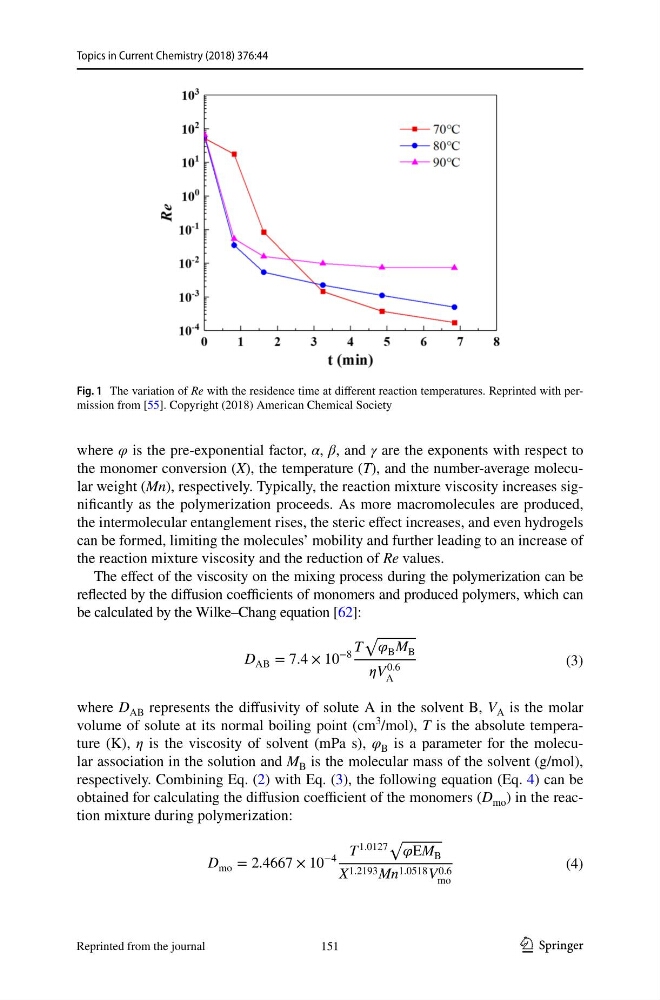
the monomer conversion (X), the temperature (T), and the number-average molecular weight (Mn), respectively. Typically, the reaction mixture viscosity increases significantly as the polymerization proceeds. As more macromolecules are produced,
the intermolecular entanglement rises, the steric effect increases, and even hydrogels
can be formed, limiting the molecules’ mobility and further leading to an increase of
the reaction mixture viscosity and the reduction of Re values.
The effect of the viscosity on the mixing process during the polymerization can be
reflected by the diffusion coefficients of monomers and produced polymers, which can
be calculated by the Wilke–Chang equation [62]:
where D AB represents the diffusivity of solute A in the solvent B, V A is the molar
volume of solute at its normal boiling point (cm
3
/mol), T is the absolute temperature (K), η is the viscosity of solvent (mPa s), φ B is a parameter for the molecular association in the solution and M B is the molecular mass of the solvent (g/mol),
respectively. Combining Eq. (2) with Eq. (3), the following equation (Eq. 4) can be
obtained for calculating the diffusion coefficient of the monomers (D mo ) in the reaction mixture during polymerization:
(3)
D AB = 7.4 × 10
−8
T
√
B M B
V
0.6
A
(4)
D mo = 2.4667 × 10
−4
T 1.0127 √
EM B
X 1.2193 Mn 1.0518 V 0.6
mo
Fig. 1 The variation of Re with the residence time at different reaction temperatures. Reprinted with permission from [55]. Copyright (2018) American Chemical Society
151
Reprinted from the journal
Topics in Current Chemistry (2018) 376:44
where φ is the pre-exponential factor, α, β, and γ are the exponents with respect to
the monomer conversion (X), the temperature (T), and the number-average molecular weight (Mn), respectively. Typically, the reaction mixture viscosity increases significantly as the polymerization proceeds. As more macromolecules are produced,
the intermolecular entanglement rises, the steric effect increases, and even hydrogels
can be formed, limiting the molecules’ mobility and further leading to an increase of
the reaction mixture viscosity and the reduction of Re values.
The effect of the viscosity on the mixing process during the polymerization can be
reflected by the diffusion coefficients of monomers and produced polymers, which can
be calculated by the Wilke–Chang equation [62]:
where D AB represents the diffusivity of solute A in the solvent B, V A is the molar
volume of solute at its normal boiling point (cm
3
/mol), T is the absolute temperature (K), η is the viscosity of solvent (mPa s), φ B is a parameter for the molecular association in the solution and M B is the molecular mass of the solvent (g/mol),
respectively. Combining Eq. (2) with Eq. (3), the following equation (Eq. 4) can be
obtained for calculating the diffusion coefficient of the monomers (D mo ) in the reaction mixture during polymerization:
(3)
D AB = 7.4 × 10
−8
T
√
B M B
V
0.6
A
(4)
D mo = 2.4667 × 10
−4
T 1.0127 √
EM B
X 1.2193 Mn 1.0518 V 0.6
mo
Fig. 1 The variation of Re with the residence time at different reaction temperatures. Reprinted with permission from [55]. Copyright (2018) American Chemical Society
151
Reprinted from the journal