

Topics in Current Chemistry (2018) 376:44
1 3
and accordingly an overview is given. Furthermore, the remaining challenges to enable
the application of microreactor technology for polymerization processes and remarking
conclusions are presented.
2 Mass Transport Phenomena in Polymerization Processes
2.1 Mixing Characteristics in Homogeneous Polymerization Processes
The transport characteristics inside the reactors should match the reaction kinetics of
polymerization when choosing proper reactors for polymer synthesis [48]. Moreover,
the transport characteristics in microreactors are highly dependent on the hydrodynamics [49–53]. For homogeneous processes, the Reynolds number (Re), which is the ratio
between the inertial and viscous forces, is usually used to describe flow profiles and
mixing mechanisms. In conventional batch reactors with a macroscale, mixing is typically achieved by inducing a turbulent flow regime with mechanical stirring at high
Reynolds numbers (i.e., Re > 2500) [54]. However, the flow in microreactors or microchannels typically belongs to a laminar flow profile owing to its small characteristic
dimensions. When complex rheological phenomena occur during polymerization processes conducted in microreactors with the monomer conversion reaching a certain
degree, the reactive fluids will change from Newtonian fluids to non-Newtonian fluids
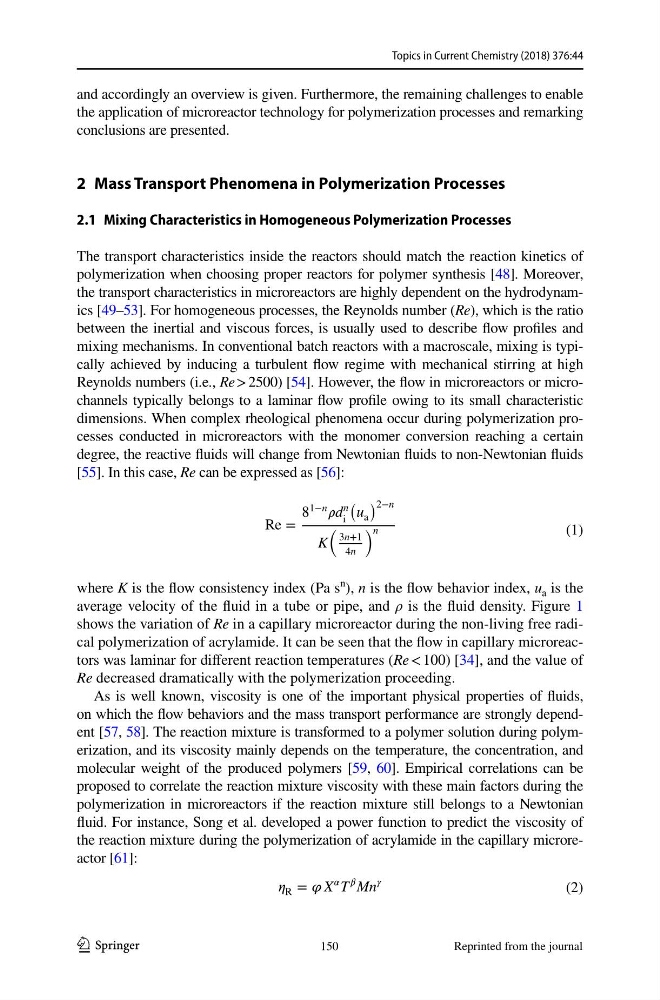
[55]. In this case, Re can be expressed as [56]:
where K is the flow consistency index (Pa s
n
), n is the flow behavior index, u a is the
average velocity of the fluid in a tube or pipe, and ρ is the fluid density. Figure 1
shows the variation of Re in a capillary microreactor during the non-living free radical polymerization of acrylamide. It can be seen that the flow in capillary microreactors was laminar for different reaction temperatures (Re < 100) [34], and the value of
Re decreased dramatically with the polymerization proceeding.
As is well known, viscosity is one of the important physical properties of fluids,
on which the flow behaviors and the mass transport performance are strongly dependent [57, 58]. The reaction mixture is transformed to a polymer solution during polymerization, and its viscosity mainly depends on the temperature, the concentration, and
molecular weight of the produced polymers [59, 60]. Empirical correlations can be
proposed to correlate the reaction mixture viscosity with these main factors during the
polymerization in microreactors if the reaction mixture still belongs to a Newtonian
fluid. For instance, Song et al. developed a power function to predict the viscosity of
the reaction mixture during the polymerization of acrylamide in the capillary microreactor [61]:
(1)
Re =
8
1−n d
n
i
u a
2−n
K
3n+1
4n
n
(2)
R = X
T
Mn
150
Reprinted from the journal
1 3
and accordingly an overview is given. Furthermore, the remaining challenges to enable
the application of microreactor technology for polymerization processes and remarking
conclusions are presented.
2 Mass Transport Phenomena in Polymerization Processes
2.1 Mixing Characteristics in Homogeneous Polymerization Processes
The transport characteristics inside the reactors should match the reaction kinetics of
polymerization when choosing proper reactors for polymer synthesis [48]. Moreover,
the transport characteristics in microreactors are highly dependent on the hydrodynamics [49–53]. For homogeneous processes, the Reynolds number (Re), which is the ratio
between the inertial and viscous forces, is usually used to describe flow profiles and
mixing mechanisms. In conventional batch reactors with a macroscale, mixing is typically achieved by inducing a turbulent flow regime with mechanical stirring at high
Reynolds numbers (i.e., Re > 2500) [54]. However, the flow in microreactors or microchannels typically belongs to a laminar flow profile owing to its small characteristic
dimensions. When complex rheological phenomena occur during polymerization processes conducted in microreactors with the monomer conversion reaching a certain
degree, the reactive fluids will change from Newtonian fluids to non-Newtonian fluids
[55]. In this case, Re can be expressed as [56]:
where K is the flow consistency index (Pa s
n
), n is the flow behavior index, u a is the
average velocity of the fluid in a tube or pipe, and ρ is the fluid density. Figure 1
shows the variation of Re in a capillary microreactor during the non-living free radical polymerization of acrylamide. It can be seen that the flow in capillary microreactors was laminar for different reaction temperatures (Re < 100) [34], and the value of
Re decreased dramatically with the polymerization proceeding.
As is well known, viscosity is one of the important physical properties of fluids,
on which the flow behaviors and the mass transport performance are strongly dependent [57, 58]. The reaction mixture is transformed to a polymer solution during polymerization, and its viscosity mainly depends on the temperature, the concentration, and
molecular weight of the produced polymers [59, 60]. Empirical correlations can be
proposed to correlate the reaction mixture viscosity with these main factors during the
polymerization in microreactors if the reaction mixture still belongs to a Newtonian
fluid. For instance, Song et al. developed a power function to predict the viscosity of
the reaction mixture during the polymerization of acrylamide in the capillary microreactor [61]:
(1)
Re =
8
1−n d
n
i
u a
2−n
K
3n+1
4n
n
(2)
R = X
T
Mn
150
Reprinted from the journal