

1 3
Topics in Current Chemistry (2019) 377:1
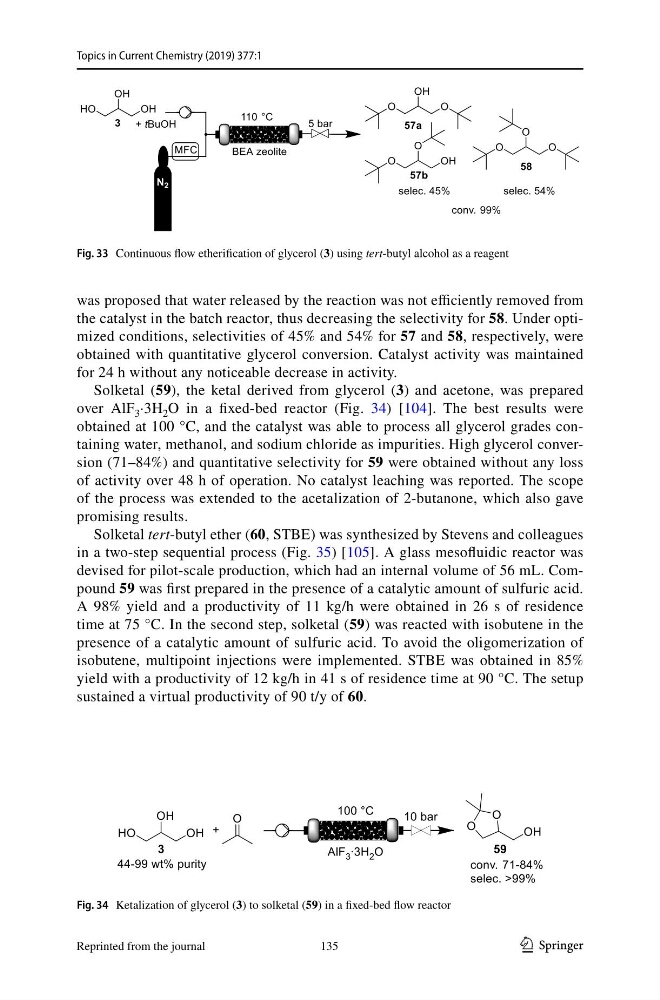
was proposed that water released by the reaction was not efficiently removed from
the catalyst in the batch reactor, thus decreasing the selectivity for 58. Under opti‑
mized conditions, selectivities of 45% and 54% for 57 and 58, respectively, were
obtained with quantitative glycerol conversion. Catalyst activity was maintained
for 24 h without any noticeable decrease in activity.
Solketal (59), the ketal derived from glycerol (3) and acetone, was prepared
over AlF 3 ·3H 2 O in a fixed‑bed reactor (Fig. 34) [104]. The best results were
obtained at 100 °C, and the catalyst was able to process all glycerol grades con‑
taining water, methanol, and sodium chloride as impurities. High glycerol conver‑
sion (71–84%) and quantitative selectivity for 59 were obtained without any loss
of activity over 48 h of operation. No catalyst leaching was reported. The scope
of the process was extended to the acetalization of 2‑butanone, which also gave
promising results.
Solketal tert‑butyl ether (60, STBE) was synthesized by Stevens and colleagues
in a two‑step sequential process (Fig. 35) [105]. A glass mesofluidic reactor was
devised for pilot‑scale production, which had an internal volume of 56 mL. Com‑
pound 59 was first prepared in the presence of a catalytic amount of sulfuric acid.
A 98% yield and a productivity of 11 kg/h were obtained in 26 s of residence
time at 75 °C. In the second step, solketal (59) was reacted with isobutene in the
presence of a catalytic amount of sulfuric acid. To avoid the oligomerization of
isobutene, multipoint injections were implemented. STBE was obtained in 85%
yield with a productivity of 12 kg/h in 41 s of residence time at 90 °C. The setup
sustained a virtual productivity of 90 t/y of 60.
Fig. 33 Continuous flow etherification of glycerol (3) using tert‑butyl alcohol as a reagent
Fig. 34 Ketalization of glycerol (3) to solketal (59) in a fixed‑bed flow reactor
135
Reprinted from the journal
Topics in Current Chemistry (2019) 377:1
was proposed that water released by the reaction was not efficiently removed from
the catalyst in the batch reactor, thus decreasing the selectivity for 58. Under opti‑
mized conditions, selectivities of 45% and 54% for 57 and 58, respectively, were
obtained with quantitative glycerol conversion. Catalyst activity was maintained
for 24 h without any noticeable decrease in activity.
Solketal (59), the ketal derived from glycerol (3) and acetone, was prepared
over AlF 3 ·3H 2 O in a fixed‑bed reactor (Fig. 34) [104]. The best results were
obtained at 100 °C, and the catalyst was able to process all glycerol grades con‑
taining water, methanol, and sodium chloride as impurities. High glycerol conver‑
sion (71–84%) and quantitative selectivity for 59 were obtained without any loss
of activity over 48 h of operation. No catalyst leaching was reported. The scope
of the process was extended to the acetalization of 2‑butanone, which also gave
promising results.
Solketal tert‑butyl ether (60, STBE) was synthesized by Stevens and colleagues
in a two‑step sequential process (Fig. 35) [105]. A glass mesofluidic reactor was
devised for pilot‑scale production, which had an internal volume of 56 mL. Com‑
pound 59 was first prepared in the presence of a catalytic amount of sulfuric acid.
A 98% yield and a productivity of 11 kg/h were obtained in 26 s of residence
time at 75 °C. In the second step, solketal (59) was reacted with isobutene in the
presence of a catalytic amount of sulfuric acid. To avoid the oligomerization of
isobutene, multipoint injections were implemented. STBE was obtained in 85%
yield with a productivity of 12 kg/h in 41 s of residence time at 90 °C. The setup
sustained a virtual productivity of 90 t/y of 60.
Fig. 33 Continuous flow etherification of glycerol (3) using tert‑butyl alcohol as a reagent
Fig. 34 Ketalization of glycerol (3) to solketal (59) in a fixed‑bed flow reactor
135
Reprinted from the journal