

Topics in Current Chemistry (2019) 377:1
1 3
4 Fuels and Additives
4.1 Derivatives of Glycerol
Glycerol‑derived esters, ethers, and ketals have emerged as promising biobased fuel
additives [101]. Fuel additives are blended with gasoline or diesel for different pur‑
poses: to increase engine and fuel performances, reduce the emission of harmful
gases and particles, and to protect engines from corrosion.
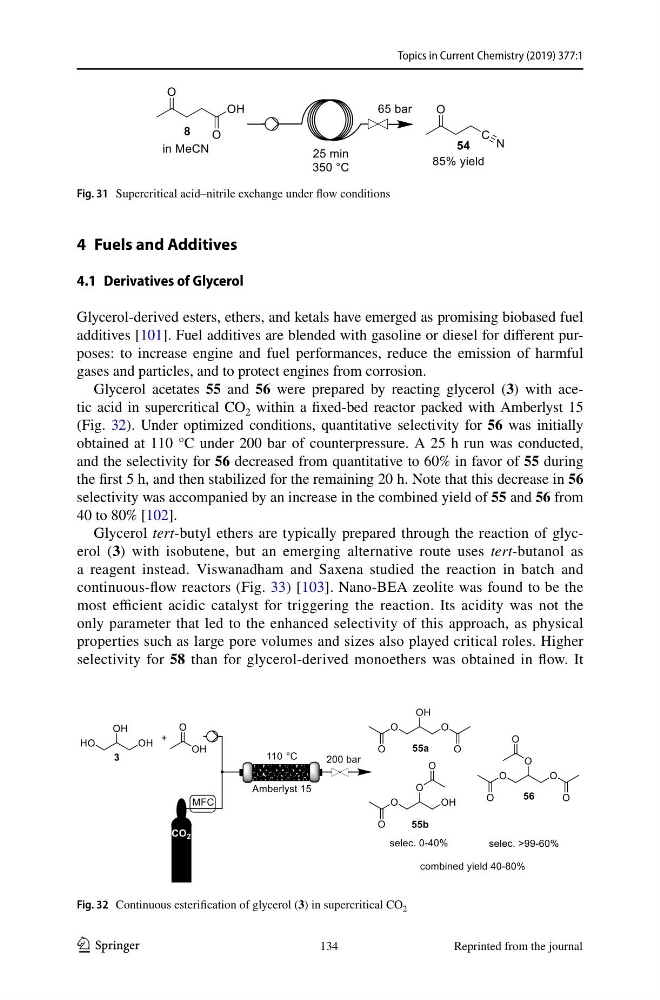
Glycerol acetates 55 and 56 were prepared by reacting glycerol (3) with ace‑
tic acid in supercritical CO 2 within a fixed‑bed reactor packed with Amberlyst 15
(Fig. 32). Under optimized conditions, quantitative selectivity for 56 was initially
obtained at 110 °C under 200 bar of counterpressure. A 25 h run was conducted,
and the selectivity for 56 decreased from quantitative to 60% in favor of 55 during
the first 5 h, and then stabilized for the remaining 20 h. Note that this decrease in 56
selectivity was accompanied by an increase in the combined yield of 55 and 56 from
40 to 80% [102].
Glycerol tert‑butyl ethers are typically prepared through the reaction of glyc‑
erol (3) with isobutene, but an emerging alternative route uses tert‑butanol as
a reagent instead. Viswanadham and Saxena studied the reaction in batch and
continuous‑flow reactors (Fig. 33) [103]. Nano‑BEA zeolite was found to be the
most efficient acidic catalyst for triggering the reaction. Its acidity was not the
only parameter that led to the enhanced selectivity of this approach, as physical
properties such as large pore volumes and sizes also played critical roles. Higher
selectivity for 58 than for glycerol‑derived monoethers was obtained in flow. It
Fig. 31 Supercritical acid–nitrile exchange under flow conditions
Fig. 32 Continuous esterification of glycerol (3) in supercritical CO 2
134
Reprinted from the journal
1 3
4 Fuels and Additives
4.1 Derivatives of Glycerol
Glycerol‑derived esters, ethers, and ketals have emerged as promising biobased fuel
additives [101]. Fuel additives are blended with gasoline or diesel for different pur‑
poses: to increase engine and fuel performances, reduce the emission of harmful
gases and particles, and to protect engines from corrosion.
Glycerol acetates 55 and 56 were prepared by reacting glycerol (3) with ace‑
tic acid in supercritical CO 2 within a fixed‑bed reactor packed with Amberlyst 15
(Fig. 32). Under optimized conditions, quantitative selectivity for 56 was initially
obtained at 110 °C under 200 bar of counterpressure. A 25 h run was conducted,
and the selectivity for 56 decreased from quantitative to 60% in favor of 55 during
the first 5 h, and then stabilized for the remaining 20 h. Note that this decrease in 56
selectivity was accompanied by an increase in the combined yield of 55 and 56 from
40 to 80% [102].
Glycerol tert‑butyl ethers are typically prepared through the reaction of glyc‑
erol (3) with isobutene, but an emerging alternative route uses tert‑butanol as
a reagent instead. Viswanadham and Saxena studied the reaction in batch and
continuous‑flow reactors (Fig. 33) [103]. Nano‑BEA zeolite was found to be the
most efficient acidic catalyst for triggering the reaction. Its acidity was not the
only parameter that led to the enhanced selectivity of this approach, as physical
properties such as large pore volumes and sizes also played critical roles. Higher
selectivity for 58 than for glycerol‑derived monoethers was obtained in flow. It
Fig. 31 Supercritical acid–nitrile exchange under flow conditions
Fig. 32 Continuous esterification of glycerol (3) in supercritical CO 2
134
Reprinted from the journal