

1 3
Topics in Current Chemistry (2019) 377:1
3.3 Other High Value‑Added Targets
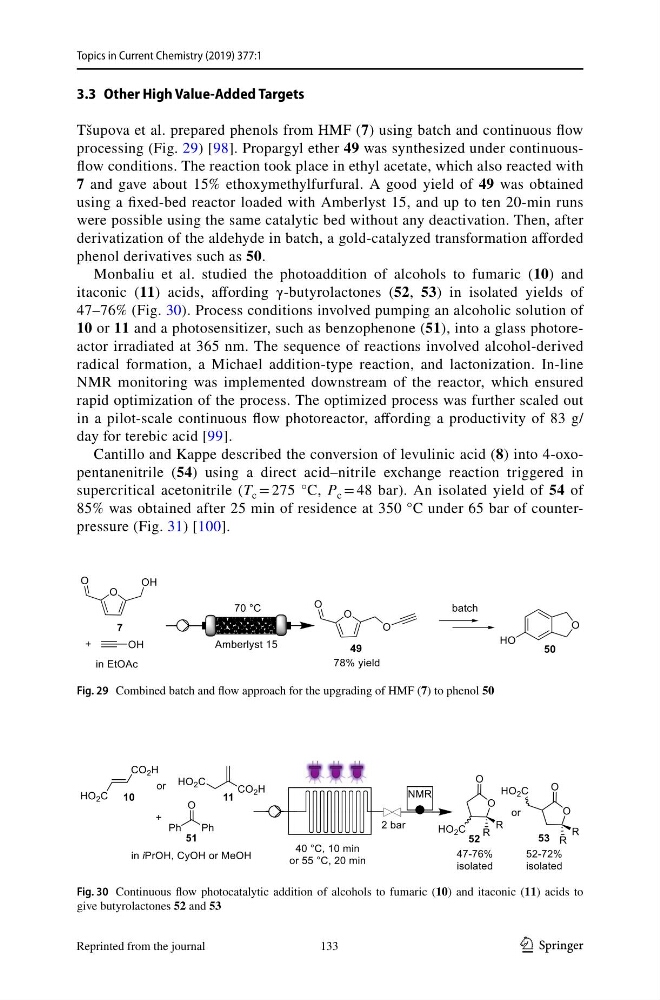
Tšupova et al. prepared phenols from HMF (7) using batch and continuous flow
processing (Fig. 29) [98]. Propargyl ether 49 was synthesized under continuous‑
flow conditions. The reaction took place in ethyl acetate, which also reacted with
7 and gave about 15% ethoxymethylfurfural. A good yield of 49 was obtained
using a fixed‑bed reactor loaded with Amberlyst 15, and up to ten 20‑min runs
were possible using the same catalytic bed without any deactivation. Then, after
derivatization of the aldehyde in batch, a gold‑catalyzed transformation afforded
phenol derivatives such as 50.
Monbaliu et al. studied the photoaddition of alcohols to fumaric (10) and
itaconic (11) acids, affording γ‑butyrolactones (52, 53) in isolated yields of
47–76% (Fig. 30). Process conditions involved pumping an alcoholic solution of
10 or 11 and a photosensitizer, such as benzophenone (51), into a glass photore‑
actor irradiated at 365 nm. The sequence of reactions involved alcohol‑derived
radical formation, a Michael addition‑type reaction, and lactonization. In‑line
NMR monitoring was implemented downstream of the reactor, which ensured
rapid optimization of the process. The optimized process was further scaled out
in a pilot‑scale continuous flow photoreactor, affording a productivity of 83 g/
day for terebic acid [99].
Cantillo and Kappe described the conversion of levulinic acid (8) into 4‑oxo‑
pentanenitrile (54) using a direct acid–nitrile exchange reaction triggered in
supercritical acetonitrile (T c = 275 °C, P c = 48 bar). An isolated yield of 54 of
85% was obtained after 25 min of residence at 350 °C under 65 bar of counter‑
pressure (Fig. 31) [100].
Fig. 29 Combined batch and flow approach for the upgrading of HMF (7) to phenol 50
Fig. 30 Continuous flow photocatalytic addition of alcohols to fumaric (10) and itaconic (11) acids to
give butyrolactones 52 and 53
133
Reprinted from the journal
Topics in Current Chemistry (2019) 377:1
3.3 Other High Value‑Added Targets
Tšupova et al. prepared phenols from HMF (7) using batch and continuous flow
processing (Fig. 29) [98]. Propargyl ether 49 was synthesized under continuous‑
flow conditions. The reaction took place in ethyl acetate, which also reacted with
7 and gave about 15% ethoxymethylfurfural. A good yield of 49 was obtained
using a fixed‑bed reactor loaded with Amberlyst 15, and up to ten 20‑min runs
were possible using the same catalytic bed without any deactivation. Then, after
derivatization of the aldehyde in batch, a gold‑catalyzed transformation afforded
phenol derivatives such as 50.
Monbaliu et al. studied the photoaddition of alcohols to fumaric (10) and
itaconic (11) acids, affording γ‑butyrolactones (52, 53) in isolated yields of
47–76% (Fig. 30). Process conditions involved pumping an alcoholic solution of
10 or 11 and a photosensitizer, such as benzophenone (51), into a glass photore‑
actor irradiated at 365 nm. The sequence of reactions involved alcohol‑derived
radical formation, a Michael addition‑type reaction, and lactonization. In‑line
NMR monitoring was implemented downstream of the reactor, which ensured
rapid optimization of the process. The optimized process was further scaled out
in a pilot‑scale continuous flow photoreactor, affording a productivity of 83 g/
day for terebic acid [99].
Cantillo and Kappe described the conversion of levulinic acid (8) into 4‑oxo‑
pentanenitrile (54) using a direct acid–nitrile exchange reaction triggered in
supercritical acetonitrile (T c = 275 °C, P c = 48 bar). An isolated yield of 54 of
85% was obtained after 25 min of residence at 350 °C under 65 bar of counter‑
pressure (Fig. 31) [100].
Fig. 29 Combined batch and flow approach for the upgrading of HMF (7) to phenol 50
Fig. 30 Continuous flow photocatalytic addition of alcohols to fumaric (10) and itaconic (11) acids to
give butyrolactones 52 and 53
133
Reprinted from the journal