

Topics in Current Chemistry (2019) 377:1
1 3
mesopores enabled improved diffusion and therefore more efficient removal of coke
precursors from the catalytic sites. Quantitative glycerol conversion was maintained
for 50 h at 320 °C under atmospheric pressure, with 82% acrolein selectivity [84].
Allyl alcohol (36) is a starting material for the preparation of important build‑
ing blocks/monomers such as glycidol, allyl ethers, and allyl esters [85]. Monba‑
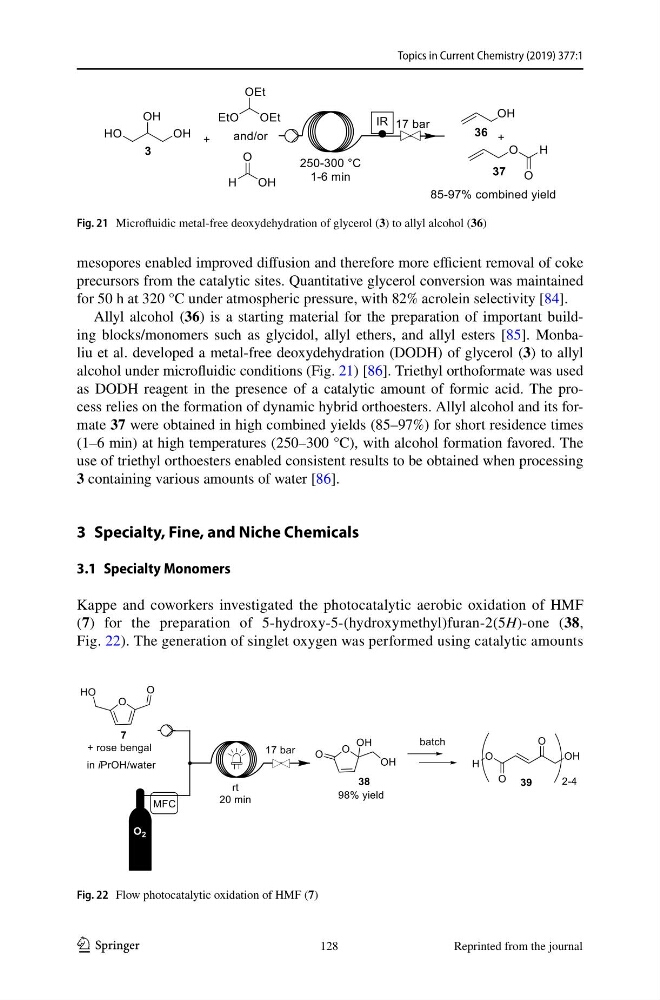
liu et al. developed a metal‑free deoxydehydration (DODH) of glycerol (3) to allyl
alcohol under microfluidic conditions (Fig. 21) [86]. Triethyl orthoformate was used
as DODH reagent in the presence of a catalytic amount of formic acid. The pro‑
cess relies on the formation of dynamic hybrid orthoesters. Allyl alcohol and its for‑
mate 37 were obtained in high combined yields (85–97%) for short residence times
(1–6 min) at high temperatures (250–300 °C), with alcohol formation favored. The
use of triethyl orthoesters enabled consistent results to be obtained when processing
3 containing various amounts of water [86].
3 Specialty, Fine, and Niche Chemicals
3.1 Specialty Monomers
Kappe and coworkers investigated the photocatalytic aerobic oxidation of HMF
(7) for the preparation of 5‑hydroxy‑5‑(hydroxymethyl)furan‑2(5H)‑one (38,
Fig. 22). The generation of singlet oxygen was performed using catalytic amounts
Fig. 21 Microfluidic metal‑free deoxydehydration of glycerol (3) to allyl alcohol (36)
Fig. 22 Flow photocatalytic oxidation of HMF (7)
128
Reprinted from the journal
1 3
mesopores enabled improved diffusion and therefore more efficient removal of coke
precursors from the catalytic sites. Quantitative glycerol conversion was maintained
for 50 h at 320 °C under atmospheric pressure, with 82% acrolein selectivity [84].
Allyl alcohol (36) is a starting material for the preparation of important build‑
ing blocks/monomers such as glycidol, allyl ethers, and allyl esters [85]. Monba‑
liu et al. developed a metal‑free deoxydehydration (DODH) of glycerol (3) to allyl
alcohol under microfluidic conditions (Fig. 21) [86]. Triethyl orthoformate was used
as DODH reagent in the presence of a catalytic amount of formic acid. The pro‑
cess relies on the formation of dynamic hybrid orthoesters. Allyl alcohol and its for‑
mate 37 were obtained in high combined yields (85–97%) for short residence times
(1–6 min) at high temperatures (250–300 °C), with alcohol formation favored. The
use of triethyl orthoesters enabled consistent results to be obtained when processing
3 containing various amounts of water [86].
3 Specialty, Fine, and Niche Chemicals
3.1 Specialty Monomers
Kappe and coworkers investigated the photocatalytic aerobic oxidation of HMF
(7) for the preparation of 5‑hydroxy‑5‑(hydroxymethyl)furan‑2(5H)‑one (38,
Fig. 22). The generation of singlet oxygen was performed using catalytic amounts
Fig. 21 Microfluidic metal‑free deoxydehydration of glycerol (3) to allyl alcohol (36)
Fig. 22 Flow photocatalytic oxidation of HMF (7)
128
Reprinted from the journal