

1 3
Topics in Current Chemistry (2019) 377:1
widely used for the synthesis of polyethylene terephthalate (PET) [72]. Researchers
developed a cost‑efficient continuous flow procedure using heterogeneous catalysis
for the highly selective aerobic oxidation of 7 to 35 (Fig. 19). Quantitative HMF
conversion and 95–99% selectivity for FDCA were obtained over a Pt/C catalyst at
moderate temperature (100 °C) and pressure (10 bar), under alkaline conditions, and
using air as an oxidant [78].
2.3 Other Important Olefinic Building Blocks
Acrolein (26) is used as starting material for the preparation of racemic methionine
and pyridine bases, and can also be converted into acrylic acid (28, see Sect. 2.2.1).
26 is currently manufactured through the oxidation of propene, although the gas‑
phase catalytic dehydration of aqueous glycerol (3) has stimulated considerable
research over the last decade [79, 80]. The main challenge associated with the latter
route is that some reaction intermediates tend to form carbonaceous deposits on the
catalyst surface (coking), ultimately leading to its deactivation. The widely accepted
mechanism for 26 formation involves a double dehydration of 3 at Brønsted acidic
sites, while Lewis acidic sites tend to trigger the formation of hydroxyacetone.
Ueda et al. reported excellent results with an iron phosphate catalyst as pack‑
ing material in a fixed‑bed reactor. Elevated conversion (99–95%) and selectivity
(96–90%) were maintained over 20 h of operation at 320 °C under atmospheric
pressure [81]. A hierarchical meso/macroporous silica functionalized with sulfonic
acid moieties was developed by Yi and colleagues [82]. The hierarchical structure
of the catalyst was found to enhance its catalytic stability, as pore clogging by coke
deposition was reduced in this system. As a result, the catalyst remained stable for
a 50 h run at 250 °C under atmospheric pressure, with quantitative glycerol conver‑
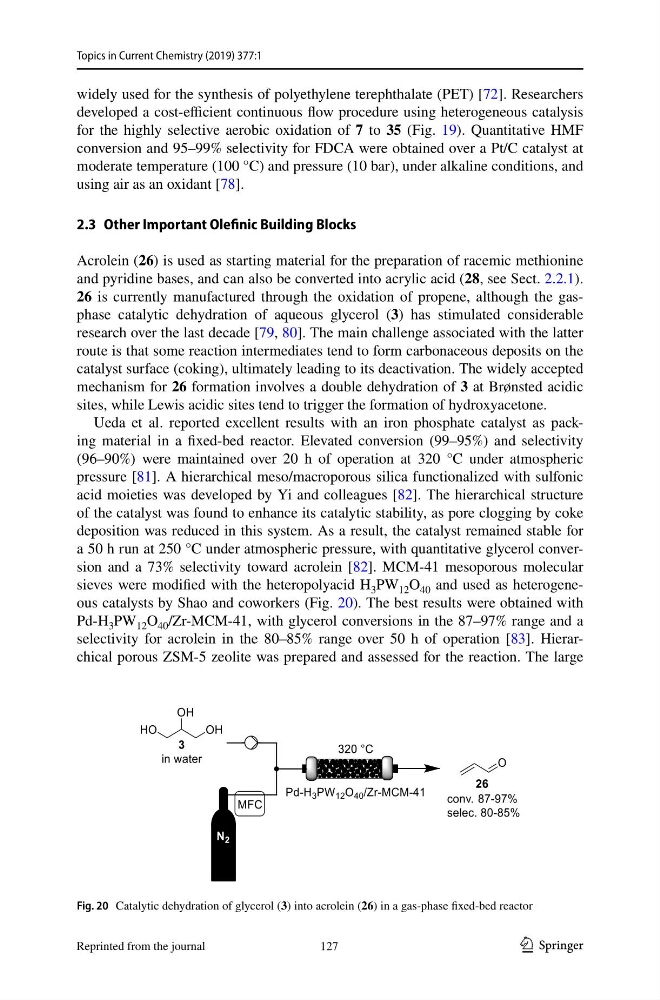
sion and a 73% selectivity toward acrolein [82]. MCM‑41 mesoporous molecular
sieves were modified with the heteropolyacid H 3 PW 12 O 40 and used as heterogene‑
ous catalysts by Shao and coworkers (Fig. 20). The best results were obtained with
Pd‑H 3 PW 12 O 40 /Zr‑MCM‑41, with glycerol conversions in the 87–97% range and a
selectivity for acrolein in the 80–85% range over 50 h of operation [83]. Hierar‑
chical porous ZSM‑5 zeolite was prepared and assessed for the reaction. The large
Fig. 20 Catalytic dehydration of glycerol (3) into acrolein (26) in a gas‑phase fixed‑bed reactor
127
Reprinted from the journal
Topics in Current Chemistry (2019) 377:1
widely used for the synthesis of polyethylene terephthalate (PET) [72]. Researchers
developed a cost‑efficient continuous flow procedure using heterogeneous catalysis
for the highly selective aerobic oxidation of 7 to 35 (Fig. 19). Quantitative HMF
conversion and 95–99% selectivity for FDCA were obtained over a Pt/C catalyst at
moderate temperature (100 °C) and pressure (10 bar), under alkaline conditions, and
using air as an oxidant [78].
2.3 Other Important Olefinic Building Blocks
Acrolein (26) is used as starting material for the preparation of racemic methionine
and pyridine bases, and can also be converted into acrylic acid (28, see Sect. 2.2.1).
26 is currently manufactured through the oxidation of propene, although the gas‑
phase catalytic dehydration of aqueous glycerol (3) has stimulated considerable
research over the last decade [79, 80]. The main challenge associated with the latter
route is that some reaction intermediates tend to form carbonaceous deposits on the
catalyst surface (coking), ultimately leading to its deactivation. The widely accepted
mechanism for 26 formation involves a double dehydration of 3 at Brønsted acidic
sites, while Lewis acidic sites tend to trigger the formation of hydroxyacetone.
Ueda et al. reported excellent results with an iron phosphate catalyst as pack‑
ing material in a fixed‑bed reactor. Elevated conversion (99–95%) and selectivity
(96–90%) were maintained over 20 h of operation at 320 °C under atmospheric
pressure [81]. A hierarchical meso/macroporous silica functionalized with sulfonic
acid moieties was developed by Yi and colleagues [82]. The hierarchical structure
of the catalyst was found to enhance its catalytic stability, as pore clogging by coke
deposition was reduced in this system. As a result, the catalyst remained stable for
a 50 h run at 250 °C under atmospheric pressure, with quantitative glycerol conver‑
sion and a 73% selectivity toward acrolein [82]. MCM‑41 mesoporous molecular
sieves were modified with the heteropolyacid H 3 PW 12 O 40 and used as heterogene‑
ous catalysts by Shao and coworkers (Fig. 20). The best results were obtained with
Pd‑H 3 PW 12 O 40 /Zr‑MCM‑41, with glycerol conversions in the 87–97% range and a
selectivity for acrolein in the 80–85% range over 50 h of operation [83]. Hierar‑
chical porous ZSM‑5 zeolite was prepared and assessed for the reaction. The large
Fig. 20 Catalytic dehydration of glycerol (3) into acrolein (26) in a gas‑phase fixed‑bed reactor
127
Reprinted from the journal