

Topics in Current Chemistry (2019) 377:1
1 3
and continuous water or lactide (34) elimination are required. Additionally, only
moderate selectivity is typically obtained [68, 72]. Alternatively, l‑lactic acid can
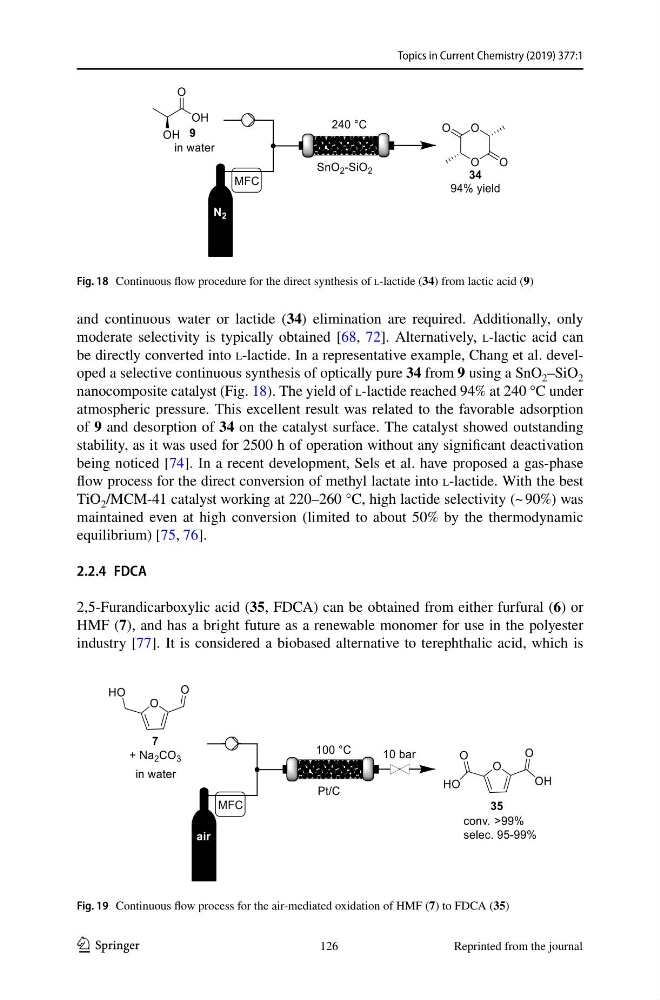
be directly converted into l‑lactide. In a representative example, Chang et al. devel‑
oped a selective continuous synthesis of optically pure 34 from 9 using a SnO 2 –SiO 2
nanocomposite catalyst (Fig. 18). The yield of l‑lactide reached 94% at 240 °C under
atmospheric pressure. This excellent result was related to the favorable adsorption
of 9 and desorption of 34 on the catalyst surface. The catalyst showed outstanding
stability, as it was used for 2500 h of operation without any significant deactivation
being noticed [74]. In a recent development, Sels et al. have proposed a gas‑phase
flow process for the direct conversion of methyl lactate into l‑lactide. With the best
TiO 2 /MCM‑41 catalyst working at 220–260 °C, high lactide selectivity (~ 90%) was
maintained even at high conversion (limited to about 50% by the thermodynamic
equilibrium) [75, 76].
2.2.4 FDCA
2,5‑Furandicarboxylic acid (35, FDCA) can be obtained from either furfural (6) or
HMF (7), and has a bright future as a renewable monomer for use in the polyester
industry [77]. It is considered a biobased alternative to terephthalic acid, which is
Fig. 18 Continuous flow procedure for the direct synthesis of l‑lactide (34) from lactic acid (9)
Fig. 19 Continuous flow process for the air‑mediated oxidation of HMF (7) to FDCA (35)
126
Reprinted from the journal
1 3
and continuous water or lactide (34) elimination are required. Additionally, only
moderate selectivity is typically obtained [68, 72]. Alternatively, l‑lactic acid can
be directly converted into l‑lactide. In a representative example, Chang et al. devel‑
oped a selective continuous synthesis of optically pure 34 from 9 using a SnO 2 –SiO 2
nanocomposite catalyst (Fig. 18). The yield of l‑lactide reached 94% at 240 °C under
atmospheric pressure. This excellent result was related to the favorable adsorption
of 9 and desorption of 34 on the catalyst surface. The catalyst showed outstanding
stability, as it was used for 2500 h of operation without any significant deactivation
being noticed [74]. In a recent development, Sels et al. have proposed a gas‑phase
flow process for the direct conversion of methyl lactate into l‑lactide. With the best
TiO 2 /MCM‑41 catalyst working at 220–260 °C, high lactide selectivity (~ 90%) was
maintained even at high conversion (limited to about 50% by the thermodynamic
equilibrium) [75, 76].
2.2.4 FDCA
2,5‑Furandicarboxylic acid (35, FDCA) can be obtained from either furfural (6) or
HMF (7), and has a bright future as a renewable monomer for use in the polyester
industry [77]. It is considered a biobased alternative to terephthalic acid, which is
Fig. 18 Continuous flow procedure for the direct synthesis of l‑lactide (34) from lactic acid (9)
Fig. 19 Continuous flow process for the air‑mediated oxidation of HMF (7) to FDCA (35)
126
Reprinted from the journal