

1 3
Topics in Current Chemistry (2019) 377:1
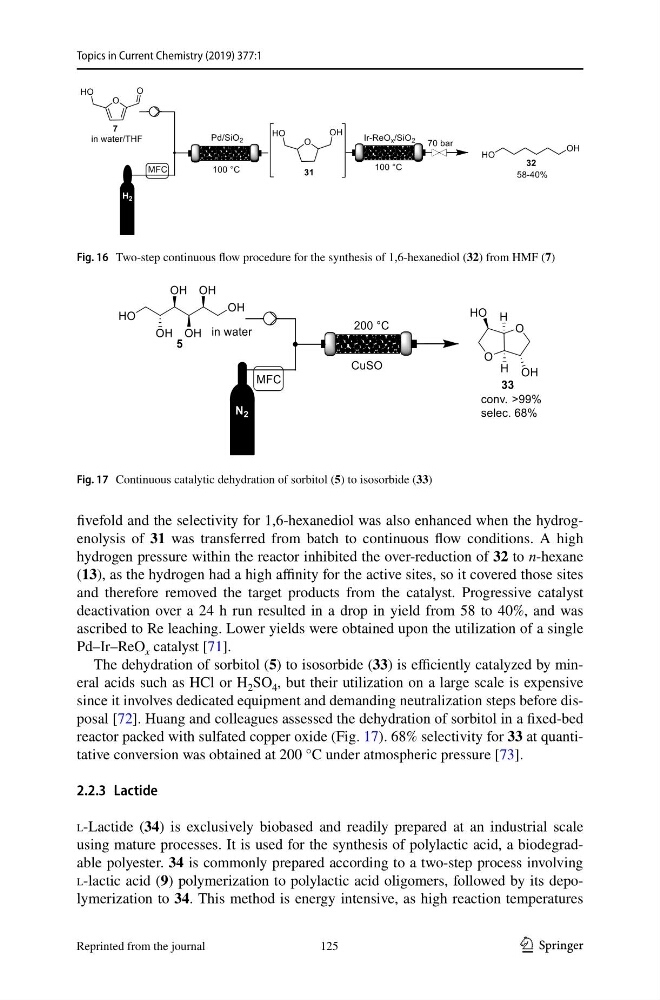
fivefold and the selectivity for 1,6‑hexanediol was also enhanced when the hydrog‑
enolysis of 31 was transferred from batch to continuous flow conditions. A high
hydrogen pressure within the reactor inhibited the over‑reduction of 32 to n‑hexane
(13), as the hydrogen had a high affinity for the active sites, so it covered those sites
and therefore removed the target products from the catalyst. Progressive catalyst
deactivation over a 24 h run resulted in a drop in yield from 58 to 40%, and was
ascribed to Re leaching. Lower yields were obtained upon the utilization of a single
Pd–Ir–ReO x catalyst [71].
The dehydration of sorbitol (5) to isosorbide (33) is efficiently catalyzed by min‑
eral acids such as HCl or H 2 SO 4 , but their utilization on a large scale is expensive
since it involves dedicated equipment and demanding neutralization steps before dis‑
posal [72]. Huang and colleagues assessed the dehydration of sorbitol in a fixed‑bed
reactor packed with sulfated copper oxide (Fig. 17). 68% selectivity for 33 at quanti‑
tative conversion was obtained at 200 °C under atmospheric pressure [73].
2.2.3 Lactide
l‑Lactide (34) is exclusively biobased and readily prepared at an industrial scale
using mature processes. It is used for the synthesis of polylactic acid, a biodegrad‑
able polyester. 34 is commonly prepared according to a two‑step process involving
l‑lactic acid (9) polymerization to polylactic acid oligomers, followed by its depo‑
lymerization to 34. This method is energy intensive, as high reaction temperatures
Fig. 16 Two‑step continuous flow procedure for the synthesis of 1,6‑hexanediol (32) from HMF (7)
Fig. 17 Continuous catalytic dehydration of sorbitol (5) to isosorbide (33)
125
Reprinted from the journal
Topics in Current Chemistry (2019) 377:1
fivefold and the selectivity for 1,6‑hexanediol was also enhanced when the hydrog‑
enolysis of 31 was transferred from batch to continuous flow conditions. A high
hydrogen pressure within the reactor inhibited the over‑reduction of 32 to n‑hexane
(13), as the hydrogen had a high affinity for the active sites, so it covered those sites
and therefore removed the target products from the catalyst. Progressive catalyst
deactivation over a 24 h run resulted in a drop in yield from 58 to 40%, and was
ascribed to Re leaching. Lower yields were obtained upon the utilization of a single
Pd–Ir–ReO x catalyst [71].
The dehydration of sorbitol (5) to isosorbide (33) is efficiently catalyzed by min‑
eral acids such as HCl or H 2 SO 4 , but their utilization on a large scale is expensive
since it involves dedicated equipment and demanding neutralization steps before dis‑
posal [72]. Huang and colleagues assessed the dehydration of sorbitol in a fixed‑bed
reactor packed with sulfated copper oxide (Fig. 17). 68% selectivity for 33 at quanti‑
tative conversion was obtained at 200 °C under atmospheric pressure [73].
2.2.3 Lactide
l‑Lactide (34) is exclusively biobased and readily prepared at an industrial scale
using mature processes. It is used for the synthesis of polylactic acid, a biodegrad‑
able polyester. 34 is commonly prepared according to a two‑step process involving
l‑lactic acid (9) polymerization to polylactic acid oligomers, followed by its depo‑
lymerization to 34. This method is energy intensive, as high reaction temperatures
Fig. 16 Two‑step continuous flow procedure for the synthesis of 1,6‑hexanediol (32) from HMF (7)
Fig. 17 Continuous catalytic dehydration of sorbitol (5) to isosorbide (33)
125
Reprinted from the journal