

Topics in Current Chemistry (2019) 377:1
1 3
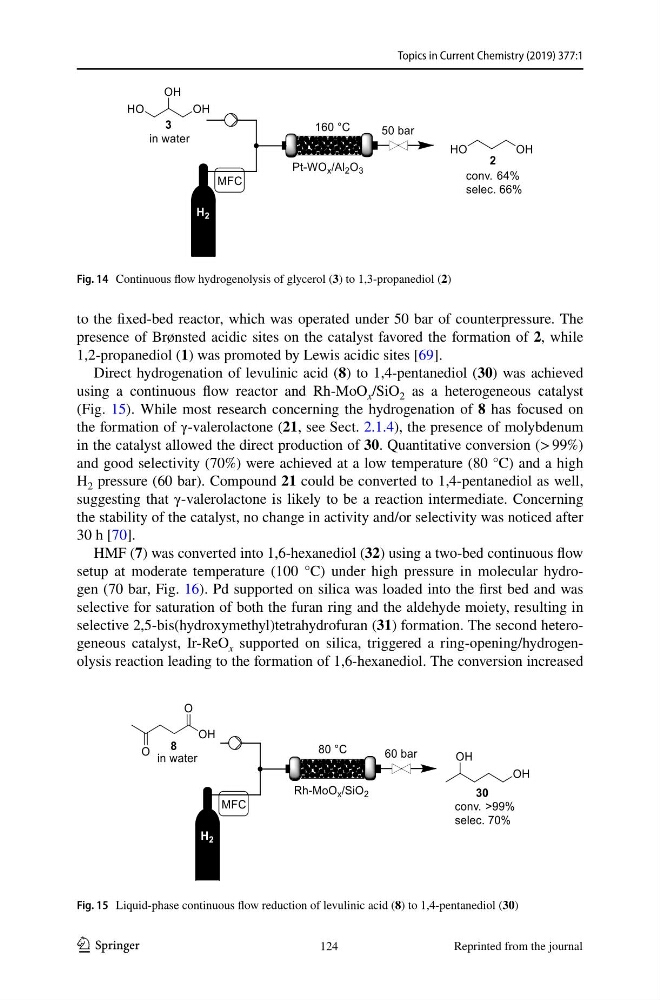
to the fixed‑bed reactor, which was operated under 50 bar of counterpressure. The
presence of Brønsted acidic sites on the catalyst favored the formation of 2, while
1,2‑propanediol (1) was promoted by Lewis acidic sites [69].
Direct hydrogenation of levulinic acid (8) to 1,4‑pentanediol (30) was achieved
using a continuous flow reactor and Rh‑MoO x /SiO 2 as a heterogeneous catalyst
(Fig. 15). While most research concerning the hydrogenation of 8 has focused on
the formation of γ‑valerolactone (21, see Sect. 2.1.4), the presence of molybdenum
in the catalyst allowed the direct production of 30. Quantitative conversion (> 99%)
and good selectivity (70%) were achieved at a low temperature (80 °C) and a high
H 2 pressure (60 bar). Compound 21 could be converted to 1,4‑pentanediol as well,
suggesting that γ‑valerolactone is likely to be a reaction intermediate. Concerning
the stability of the catalyst, no change in activity and/or selectivity was noticed after
30 h [70].
HMF (7) was converted into 1,6‑hexanediol (32) using a two‑bed continuous flow
setup at moderate temperature (100 °C) under high pressure in molecular hydro‑
gen (70 bar, Fig. 16). Pd supported on silica was loaded into the first bed and was
selective for saturation of both the furan ring and the aldehyde moiety, resulting in
selective 2,5‑bis(hydroxymethyl)tetrahydrofuran (31) formation. The second hetero‑
geneous catalyst, Ir‑ReO x supported on silica, triggered a ring‑opening/hydrogen‑
olysis reaction leading to the formation of 1,6‑hexanediol. The conversion increased
Fig. 14 Continuous flow hydrogenolysis of glycerol (3) to 1,3‑propanediol (2)
Fig. 15 Liquid‑phase continuous flow reduction of levulinic acid (8) to 1,4‑pentanediol (30)
124
Reprinted from the journal
1 3
to the fixed‑bed reactor, which was operated under 50 bar of counterpressure. The
presence of Brønsted acidic sites on the catalyst favored the formation of 2, while
1,2‑propanediol (1) was promoted by Lewis acidic sites [69].
Direct hydrogenation of levulinic acid (8) to 1,4‑pentanediol (30) was achieved
using a continuous flow reactor and Rh‑MoO x /SiO 2 as a heterogeneous catalyst
(Fig. 15). While most research concerning the hydrogenation of 8 has focused on
the formation of γ‑valerolactone (21, see Sect. 2.1.4), the presence of molybdenum
in the catalyst allowed the direct production of 30. Quantitative conversion (> 99%)
and good selectivity (70%) were achieved at a low temperature (80 °C) and a high
H 2 pressure (60 bar). Compound 21 could be converted to 1,4‑pentanediol as well,
suggesting that γ‑valerolactone is likely to be a reaction intermediate. Concerning
the stability of the catalyst, no change in activity and/or selectivity was noticed after
30 h [70].
HMF (7) was converted into 1,6‑hexanediol (32) using a two‑bed continuous flow
setup at moderate temperature (100 °C) under high pressure in molecular hydro‑
gen (70 bar, Fig. 16). Pd supported on silica was loaded into the first bed and was
selective for saturation of both the furan ring and the aldehyde moiety, resulting in
selective 2,5‑bis(hydroxymethyl)tetrahydrofuran (31) formation. The second hetero‑
geneous catalyst, Ir‑ReO x supported on silica, triggered a ring‑opening/hydrogen‑
olysis reaction leading to the formation of 1,6‑hexanediol. The conversion increased
Fig. 14 Continuous flow hydrogenolysis of glycerol (3) to 1,3‑propanediol (2)
Fig. 15 Liquid‑phase continuous flow reduction of levulinic acid (8) to 1,4‑pentanediol (30)
124
Reprinted from the journal