

1 3
Topics in Current Chemistry (2019) 377:1
(Fig. 12b). A yield of 81% was initially obtained at 400 °C under atmospheric pres‑
sure, with only mild deactivation observed after 24 h time‑on‑stream. Major deac‑
tivation occurred when the operational time was extended, but elimination of the
carbonaceous deposits on the surface of the catalyst by calcination fully regenerated
the activity [65].
Maleic anhydride (29) is industrially manufactured through the catalytic oxi‑
dation of benzene (23) or n‑butane. It is an important bulk chemical with various
applications ranging from the preparation of unsaturated polyesters to the production
of more specialized chemicals such as agrochemicals and surfactants [66]. Chemists
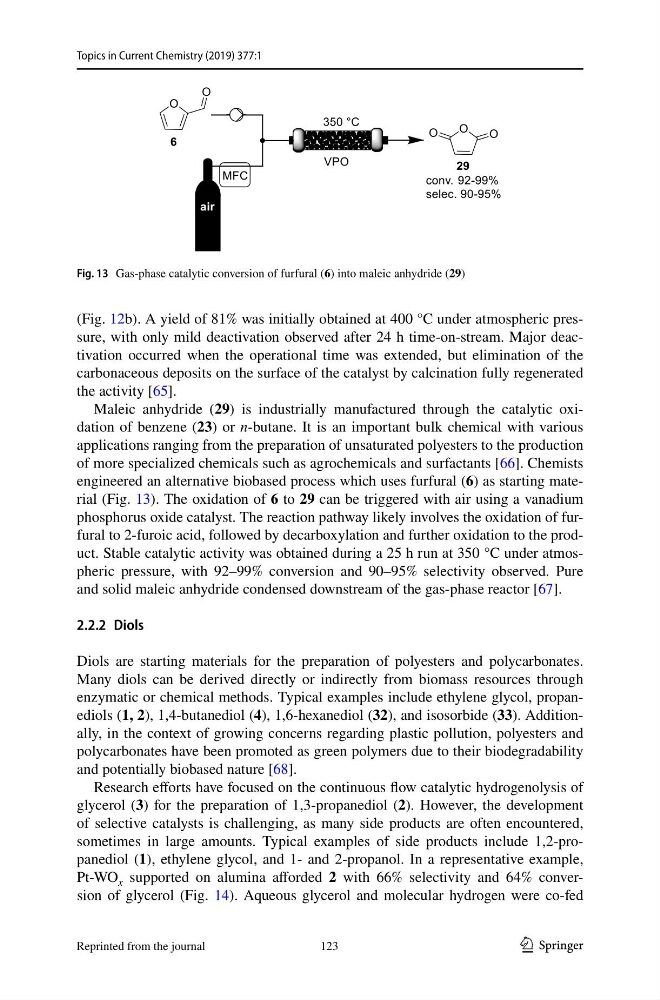
engineered an alternative biobased process which uses furfural (6) as starting mate‑
rial (Fig. 13). The oxidation of 6 to 29 can be triggered with air using a vanadium
phosphorus oxide catalyst. The reaction pathway likely involves the oxidation of fur‑
fural to 2‑furoic acid, followed by decarboxylation and further oxidation to the prod‑
uct. Stable catalytic activity was obtained during a 25 h run at 350 °C under atmos‑
pheric pressure, with 92–99% conversion and 90–95% selectivity observed. Pure
and solid maleic anhydride condensed downstream of the gas‑phase reactor [67].
2.2.2 Diols
Diols are starting materials for the preparation of polyesters and polycarbonates.
Many diols can be derived directly or indirectly from biomass resources through
enzymatic or chemical methods. Typical examples include ethylene glycol, propan‑
ediols (1, 2), 1,4‑butanediol (4), 1,6‑hexanediol (32), and isosorbide (33). Addition‑
ally, in the context of growing concerns regarding plastic pollution, polyesters and
polycarbonates have been promoted as green polymers due to their biodegradability
and potentially biobased nature [68].
Research efforts have focused on the continuous flow catalytic hydrogenolysis of
glycerol (3) for the preparation of 1,3‑propanediol (2). However, the development
of selective catalysts is challenging, as many side products are often encountered,
sometimes in large amounts. Typical examples of side products include 1,2‑pro‑
panediol (1), ethylene glycol, and 1‑ and 2‑propanol. In a representative example,
Pt‑WO x supported on alumina afforded 2 with 66% selectivity and 64% conver‑
sion of glycerol (Fig. 14). Aqueous glycerol and molecular hydrogen were co‑fed
Fig. 13 Gas‑phase catalytic conversion of furfural (6) into maleic anhydride (29)
123
Reprinted from the journal
Topics in Current Chemistry (2019) 377:1
(Fig. 12b). A yield of 81% was initially obtained at 400 °C under atmospheric pres‑
sure, with only mild deactivation observed after 24 h time‑on‑stream. Major deac‑
tivation occurred when the operational time was extended, but elimination of the
carbonaceous deposits on the surface of the catalyst by calcination fully regenerated
the activity [65].
Maleic anhydride (29) is industrially manufactured through the catalytic oxi‑
dation of benzene (23) or n‑butane. It is an important bulk chemical with various
applications ranging from the preparation of unsaturated polyesters to the production
of more specialized chemicals such as agrochemicals and surfactants [66]. Chemists
engineered an alternative biobased process which uses furfural (6) as starting mate‑
rial (Fig. 13). The oxidation of 6 to 29 can be triggered with air using a vanadium
phosphorus oxide catalyst. The reaction pathway likely involves the oxidation of fur‑
fural to 2‑furoic acid, followed by decarboxylation and further oxidation to the prod‑
uct. Stable catalytic activity was obtained during a 25 h run at 350 °C under atmos‑
pheric pressure, with 92–99% conversion and 90–95% selectivity observed. Pure
and solid maleic anhydride condensed downstream of the gas‑phase reactor [67].
2.2.2 Diols
Diols are starting materials for the preparation of polyesters and polycarbonates.
Many diols can be derived directly or indirectly from biomass resources through
enzymatic or chemical methods. Typical examples include ethylene glycol, propan‑
ediols (1, 2), 1,4‑butanediol (4), 1,6‑hexanediol (32), and isosorbide (33). Addition‑
ally, in the context of growing concerns regarding plastic pollution, polyesters and
polycarbonates have been promoted as green polymers due to their biodegradability
and potentially biobased nature [68].
Research efforts have focused on the continuous flow catalytic hydrogenolysis of
glycerol (3) for the preparation of 1,3‑propanediol (2). However, the development
of selective catalysts is challenging, as many side products are often encountered,
sometimes in large amounts. Typical examples of side products include 1,2‑pro‑
panediol (1), ethylene glycol, and 1‑ and 2‑propanol. In a representative example,
Pt‑WO x supported on alumina afforded 2 with 66% selectivity and 64% conver‑
sion of glycerol (Fig. 14). Aqueous glycerol and molecular hydrogen were co‑fed
Fig. 13 Gas‑phase catalytic conversion of furfural (6) into maleic anhydride (29)
123
Reprinted from the journal