

Topics in Current Chemistry (2019) 377:1
1 3
oxygen. The yield in 28 decreased from 51 to 42% after 28 h of operation but then
remained steady for the next 40 h [60]. A bifunctional Cs(VO) 0.2 (PMo) 0.25 (PW) 0.75
catalyst was reported by Li and Zhang and gave excellent results at 340 °C under
atmospheric pressure. Aqueous 3 and oxygen were continuously fed into the reactor
and gave an initial yield of 60% for 28; however, the yield started to decrease after
10 h time‑on‑stream, reaching 38% after 56 h of operation [61]. A sequential contin‑
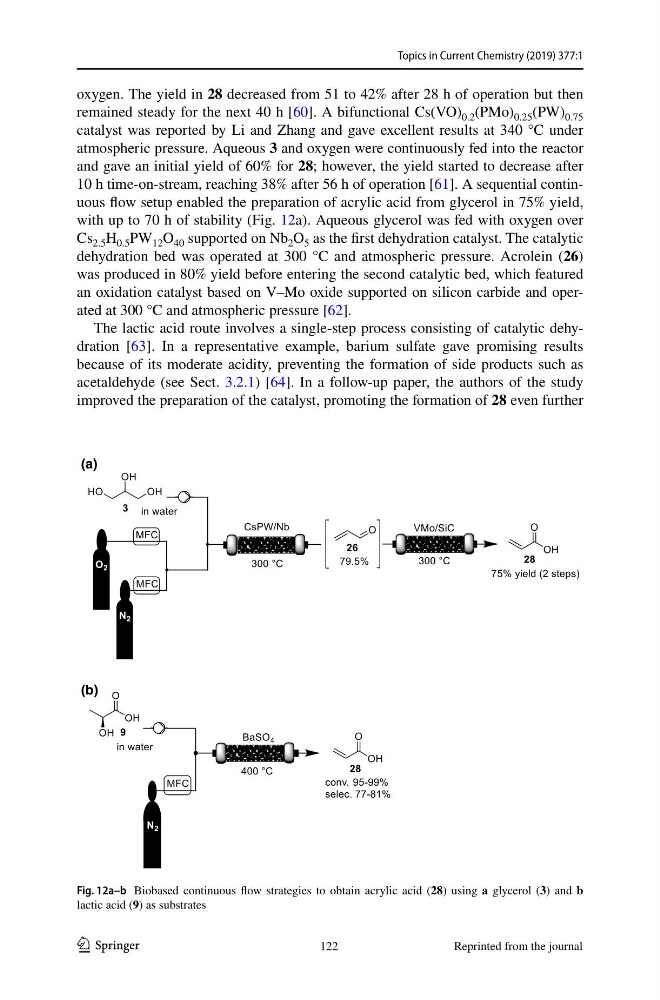
uous flow setup enabled the preparation of acrylic acid from glycerol in 75% yield,
with up to 70 h of stability (Fig. 12a). Aqueous glycerol was fed with oxygen over
Cs 2.5 H 0.5 PW 12 O 40 supported on Nb 2 O 5 as the first dehydration catalyst. The catalytic
dehydration bed was operated at 300 °C and atmospheric pressure. Acrolein (26)
was produced in 80% yield before entering the second catalytic bed, which featured
an oxidation catalyst based on V–Mo oxide supported on silicon carbide and oper‑
ated at 300 °C and atmospheric pressure [62].
The lactic acid route involves a single‑step process consisting of catalytic dehy‑
dration [63]. In a representative example, barium sulfate gave promising results
because of its moderate acidity, preventing the formation of side products such as
acetaldehyde (see Sect. 3.2.1) [64]. In a follow‑up paper, the authors of the study
improved the preparation of the catalyst, promoting the formation of 28 even further
(a)
(b)
Fig. 12a–b Biobased continuous flow strategies to obtain acrylic acid (28) using a glycerol (3) and b
lactic acid (9) as substrates
122
Reprinted from the journal
1 3
oxygen. The yield in 28 decreased from 51 to 42% after 28 h of operation but then
remained steady for the next 40 h [60]. A bifunctional Cs(VO) 0.2 (PMo) 0.25 (PW) 0.75
catalyst was reported by Li and Zhang and gave excellent results at 340 °C under
atmospheric pressure. Aqueous 3 and oxygen were continuously fed into the reactor
and gave an initial yield of 60% for 28; however, the yield started to decrease after
10 h time‑on‑stream, reaching 38% after 56 h of operation [61]. A sequential contin‑
uous flow setup enabled the preparation of acrylic acid from glycerol in 75% yield,
with up to 70 h of stability (Fig. 12a). Aqueous glycerol was fed with oxygen over
Cs 2.5 H 0.5 PW 12 O 40 supported on Nb 2 O 5 as the first dehydration catalyst. The catalytic
dehydration bed was operated at 300 °C and atmospheric pressure. Acrolein (26)
was produced in 80% yield before entering the second catalytic bed, which featured
an oxidation catalyst based on V–Mo oxide supported on silicon carbide and oper‑
ated at 300 °C and atmospheric pressure [62].
The lactic acid route involves a single‑step process consisting of catalytic dehy‑
dration [63]. In a representative example, barium sulfate gave promising results
because of its moderate acidity, preventing the formation of side products such as
acetaldehyde (see Sect. 3.2.1) [64]. In a follow‑up paper, the authors of the study
improved the preparation of the catalyst, promoting the formation of 28 even further
(a)
(b)
Fig. 12a–b Biobased continuous flow strategies to obtain acrylic acid (28) using a glycerol (3) and b
lactic acid (9) as substrates
122
Reprinted from the journal