

1 3
Topics in Current Chemistry (2019) 377:1
In addition, no deactivation was observed during 24 h of operation. The proposed
mechanistic pathway involved hydroxyacetone, 1,2‑propanediol (1), and 2‑propanol
as reaction intermediates [55].
Acrylonitrile (27) is widely used as a monomer for the preparation of polyacry‑
lonitrile and the copolymer acrylonitrile–butadiene–styrene (ABS), as well as for
the synthesis of acrylamide. It is manufactured industrially via the ammoxidation of
petrobased propene [56]. Guerrero‐Pérez and Bañares studied an alternative cascade
continuous flow process involving the dehydration of glycerol (3) into acrolein (26)
followed by its ammoxidation into acrylonitrile (27). V–Sb–Nb oxide supported
on alumina triggered the formation of 27 upon feeding the reactor with 3, oxygen,
and ammonia and operating the system at 400 °C and atmospheric pressure. 83%
glycerol conversion and 58% acrylonitrile selectivity were obtained after 30 min of
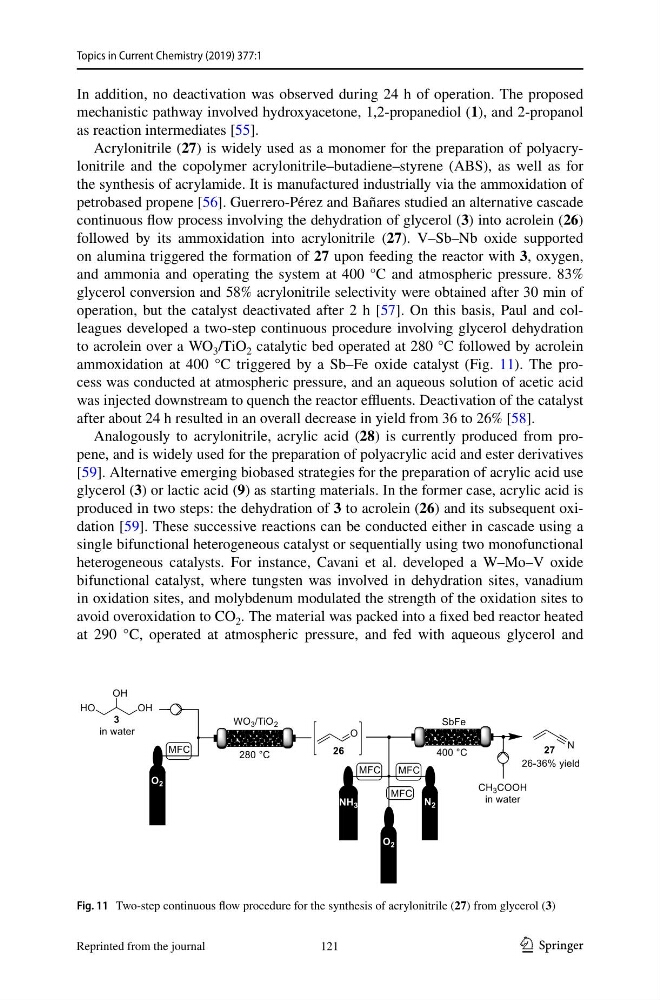
operation, but the catalyst deactivated after 2 h [57]. On this basis, Paul and col‑
leagues developed a two‑step continuous procedure involving glycerol dehydration
to acrolein over a WO 3 /TiO 2 catalytic bed operated at 280 °C followed by acrolein
ammoxidation at 400 °C triggered by a Sb–Fe oxide catalyst (Fig. 11). The pro‑
cess was conducted at atmospheric pressure, and an aqueous solution of acetic acid
was injected downstream to quench the reactor effluents. Deactivation of the catalyst
after about 24 h resulted in an overall decrease in yield from 36 to 26% [58].
Analogously to acrylonitrile, acrylic acid (28) is currently produced from pro‑
pene, and is widely used for the preparation of polyacrylic acid and ester derivatives
[59]. Alternative emerging biobased strategies for the preparation of acrylic acid use
glycerol (3) or lactic acid (9) as starting materials. In the former case, acrylic acid is
produced in two steps: the dehydration of 3 to acrolein (26) and its subsequent oxi‑
dation [59]. These successive reactions can be conducted either in cascade using a
single bifunctional heterogeneous catalyst or sequentially using two monofunctional
heterogeneous catalysts. For instance, Cavani et al. developed a W–Mo–V oxide
bifunctional catalyst, where tungsten was involved in dehydration sites, vanadium
in oxidation sites, and molybdenum modulated the strength of the oxidation sites to
avoid overoxidation to CO 2 . The material was packed into a fixed bed reactor heated
at 290 °C, operated at atmospheric pressure, and fed with aqueous glycerol and
Fig. 11 Two‑step continuous flow procedure for the synthesis of acrylonitrile (27) from glycerol (3)
121
Reprinted from the journal
Topics in Current Chemistry (2019) 377:1
In addition, no deactivation was observed during 24 h of operation. The proposed
mechanistic pathway involved hydroxyacetone, 1,2‑propanediol (1), and 2‑propanol
as reaction intermediates [55].
Acrylonitrile (27) is widely used as a monomer for the preparation of polyacry‑
lonitrile and the copolymer acrylonitrile–butadiene–styrene (ABS), as well as for
the synthesis of acrylamide. It is manufactured industrially via the ammoxidation of
petrobased propene [56]. Guerrero‐Pérez and Bañares studied an alternative cascade
continuous flow process involving the dehydration of glycerol (3) into acrolein (26)
followed by its ammoxidation into acrylonitrile (27). V–Sb–Nb oxide supported
on alumina triggered the formation of 27 upon feeding the reactor with 3, oxygen,
and ammonia and operating the system at 400 °C and atmospheric pressure. 83%
glycerol conversion and 58% acrylonitrile selectivity were obtained after 30 min of
operation, but the catalyst deactivated after 2 h [57]. On this basis, Paul and col‑
leagues developed a two‑step continuous procedure involving glycerol dehydration
to acrolein over a WO 3 /TiO 2 catalytic bed operated at 280 °C followed by acrolein
ammoxidation at 400 °C triggered by a Sb–Fe oxide catalyst (Fig. 11). The pro‑
cess was conducted at atmospheric pressure, and an aqueous solution of acetic acid
was injected downstream to quench the reactor effluents. Deactivation of the catalyst
after about 24 h resulted in an overall decrease in yield from 36 to 26% [58].
Analogously to acrylonitrile, acrylic acid (28) is currently produced from pro‑
pene, and is widely used for the preparation of polyacrylic acid and ester derivatives
[59]. Alternative emerging biobased strategies for the preparation of acrylic acid use
glycerol (3) or lactic acid (9) as starting materials. In the former case, acrylic acid is
produced in two steps: the dehydration of 3 to acrolein (26) and its subsequent oxi‑
dation [59]. These successive reactions can be conducted either in cascade using a
single bifunctional heterogeneous catalyst or sequentially using two monofunctional
heterogeneous catalysts. For instance, Cavani et al. developed a W–Mo–V oxide
bifunctional catalyst, where tungsten was involved in dehydration sites, vanadium
in oxidation sites, and molybdenum modulated the strength of the oxidation sites to
avoid overoxidation to CO 2 . The material was packed into a fixed bed reactor heated
at 290 °C, operated at atmospheric pressure, and fed with aqueous glycerol and
Fig. 11 Two‑step continuous flow procedure for the synthesis of acrylonitrile (27) from glycerol (3)
121
Reprinted from the journal