

1 3
Topics in Current Chemistry (2019) 377:1
of rose bengal as photosensitizer. Solvent optimization revealed that an i‑PrOH/
water mixture was the most suitable system for avoiding acetalization, which was
typically encountered when using methanol. Under optimized conditions, a 98%
yield of 38 was obtained in 20 min of residence time. Isomerization of the result‑
ing diol 38 was conducted in batch and gave 5‑hydroxy‑4‑keto‑pentenoic acid
oligomers (39), highlighting the potential of 38 for the preparation of biobased
polyesters [87].
3.2 Building Blocks for the Agrochemical and Pharmaceutical Industries
3.2.1 Carbonyls
Pyruvic acid (40) and its derivatives are useful synthons for the preparation of
more elaborate scaffolds that are relevant to both the pharmaceutical and agro‑
chemical industries. Examples include l‑tyrosine and (R)‑phenylacetylcarbinol,
which are conveniently synthesized from pyruvate using biotechnologies. Com‑
pound 40 can be prepared from the catalytic oxidation of lactic acid (9), although
biochemical methods have also been reported [63]. Hermans et al. reported a
catalytic system based on silica‑supported TEMPO for the aerobic oxidation of
lactic acid to pyruvic acid [88]. A short contact time with the catalyst (15 s) as
well as a mild process temperature (55 °C) and a low O 2 pressure (5 bar) ena‑
bled the preparation of 40 with 98% selectivity and 98% lactic acid conversion.
Compound 9 was co‑fed into the reactor, along with oxygen, as a dichloroeth‑
ane solution in the presence of 5 mol% HNO 3 over the catalytic bed. Hensen and
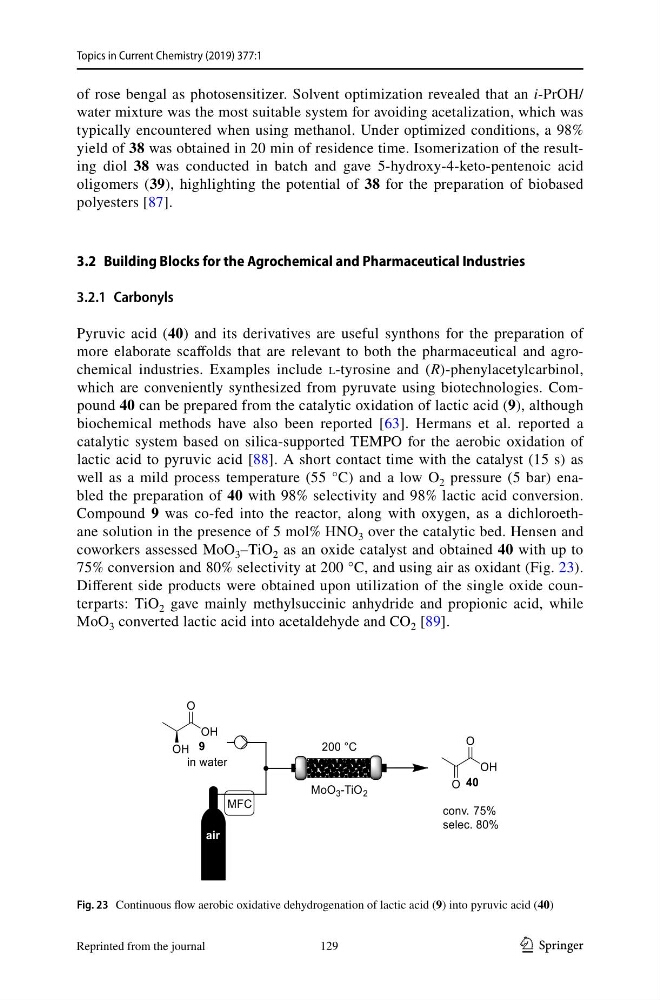
coworkers assessed MoO 3 –TiO 2 as an oxide catalyst and obtained 40 with up to
75% conversion and 80% selectivity at 200 °C, and using air as oxidant (Fig. 23).
Different side products were obtained upon utilization of the single oxide coun‑
terparts: TiO 2 gave mainly methylsuccinic anhydride and propionic acid, while
MoO 3 converted lactic acid into acetaldehyde and CO 2 [89].
Fig. 23 Continuous flow aerobic oxidative dehydrogenation of lactic acid (9) into pyruvic acid (40)
129
Reprinted from the journal
Topics in Current Chemistry (2019) 377:1
of rose bengal as photosensitizer. Solvent optimization revealed that an i‑PrOH/
water mixture was the most suitable system for avoiding acetalization, which was
typically encountered when using methanol. Under optimized conditions, a 98%
yield of 38 was obtained in 20 min of residence time. Isomerization of the result‑
ing diol 38 was conducted in batch and gave 5‑hydroxy‑4‑keto‑pentenoic acid
oligomers (39), highlighting the potential of 38 for the preparation of biobased
polyesters [87].
3.2 Building Blocks for the Agrochemical and Pharmaceutical Industries
3.2.1 Carbonyls
Pyruvic acid (40) and its derivatives are useful synthons for the preparation of
more elaborate scaffolds that are relevant to both the pharmaceutical and agro‑
chemical industries. Examples include l‑tyrosine and (R)‑phenylacetylcarbinol,
which are conveniently synthesized from pyruvate using biotechnologies. Com‑
pound 40 can be prepared from the catalytic oxidation of lactic acid (9), although
biochemical methods have also been reported [63]. Hermans et al. reported a
catalytic system based on silica‑supported TEMPO for the aerobic oxidation of
lactic acid to pyruvic acid [88]. A short contact time with the catalyst (15 s) as
well as a mild process temperature (55 °C) and a low O 2 pressure (5 bar) ena‑
bled the preparation of 40 with 98% selectivity and 98% lactic acid conversion.
Compound 9 was co‑fed into the reactor, along with oxygen, as a dichloroeth‑
ane solution in the presence of 5 mol% HNO 3 over the catalytic bed. Hensen and
coworkers assessed MoO 3 –TiO 2 as an oxide catalyst and obtained 40 with up to
75% conversion and 80% selectivity at 200 °C, and using air as oxidant (Fig. 23).
Different side products were obtained upon utilization of the single oxide coun‑
terparts: TiO 2 gave mainly methylsuccinic anhydride and propionic acid, while
MoO 3 converted lactic acid into acetaldehyde and CO 2 [89].
Fig. 23 Continuous flow aerobic oxidative dehydrogenation of lactic acid (9) into pyruvic acid (40)
129
Reprinted from the journal