

1 3
Topics in Current Chemistry (2019) 377:1
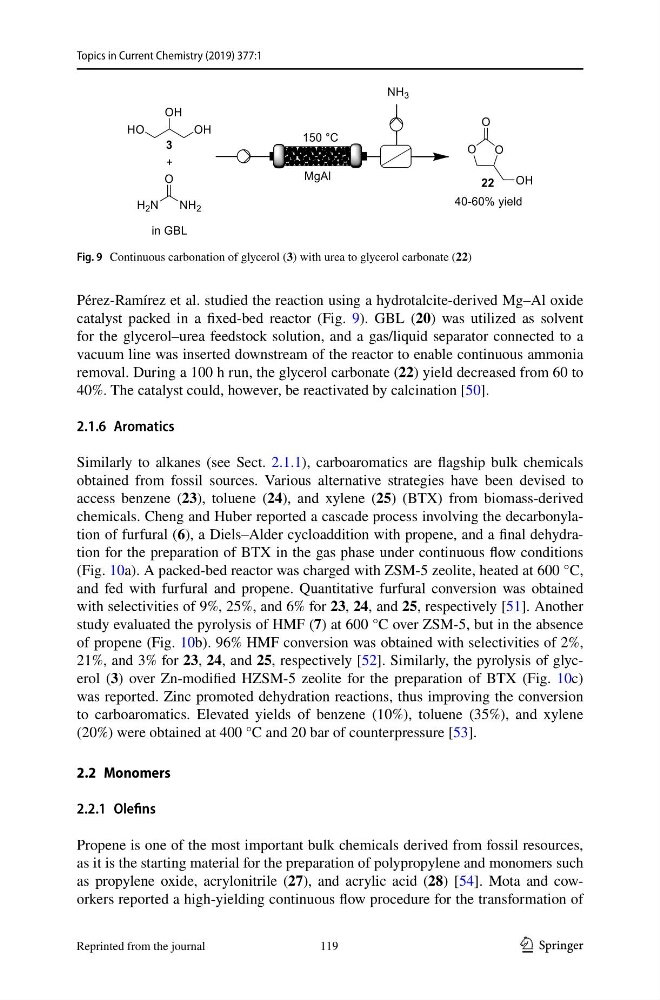
Pérez‑Ramírez et al. studied the reaction using a hydrotalcite‑derived Mg–Al oxide
catalyst packed in a fixed‑bed reactor (Fig. 9). GBL (20) was utilized as solvent
for the glycerol–urea feedstock solution, and a gas/liquid separator connected to a
vacuum line was inserted downstream of the reactor to enable continuous ammonia
removal. During a 100 h run, the glycerol carbonate (22) yield decreased from 60 to
40%. The catalyst could, however, be reactivated by calcination [50].
2.1.6 Aromatics
Similarly to alkanes (see Sect. 2.1.1), carboaromatics are flagship bulk chemicals
obtained from fossil sources. Various alternative strategies have been devised to
access benzene (23), toluene (24), and xylene (25) (BTX) from biomass‑derived
chemicals. Cheng and Huber reported a cascade process involving the decarbonyla‑
tion of furfural (6), a Diels–Alder cycloaddition with propene, and a final dehydra‑
tion for the preparation of BTX in the gas phase under continuous flow conditions
(Fig. 10a). A packed‑bed reactor was charged with ZSM‑5 zeolite, heated at 600 °C,
and fed with furfural and propene. Quantitative furfural conversion was obtained
with selectivities of 9%, 25%, and 6% for 23, 24, and 25, respectively [51]. Another
study evaluated the pyrolysis of HMF (7) at 600 °C over ZSM‑5, but in the absence
of propene (Fig. 10b). 96% HMF conversion was obtained with selectivities of 2%,
21%, and 3% for 23, 24, and 25, respectively [52]. Similarly, the pyrolysis of glyc‑
erol (3) over Zn‑modified HZSM‑5 zeolite for the preparation of BTX (Fig. 10c)
was reported. Zinc promoted dehydration reactions, thus improving the conversion
to carboaromatics. Elevated yields of benzene (10%), toluene (35%), and xylene
(20%) were obtained at 400 °C and 20 bar of counterpressure [53].
2.2 Monomers
2.2.1 Olefins
Propene is one of the most important bulk chemicals derived from fossil resources,
as it is the starting material for the preparation of polypropylene and monomers such
as propylene oxide, acrylonitrile (27), and acrylic acid (28) [54]. Mota and cow‑
orkers reported a high‑yielding continuous flow procedure for the transformation of
Fig. 9 Continuous carbonation of glycerol (3) with urea to glycerol carbonate (22)
119
Reprinted from the journal
Topics in Current Chemistry (2019) 377:1
Pérez‑Ramírez et al. studied the reaction using a hydrotalcite‑derived Mg–Al oxide
catalyst packed in a fixed‑bed reactor (Fig. 9). GBL (20) was utilized as solvent
for the glycerol–urea feedstock solution, and a gas/liquid separator connected to a
vacuum line was inserted downstream of the reactor to enable continuous ammonia
removal. During a 100 h run, the glycerol carbonate (22) yield decreased from 60 to
40%. The catalyst could, however, be reactivated by calcination [50].
2.1.6 Aromatics
Similarly to alkanes (see Sect. 2.1.1), carboaromatics are flagship bulk chemicals
obtained from fossil sources. Various alternative strategies have been devised to
access benzene (23), toluene (24), and xylene (25) (BTX) from biomass‑derived
chemicals. Cheng and Huber reported a cascade process involving the decarbonyla‑
tion of furfural (6), a Diels–Alder cycloaddition with propene, and a final dehydra‑
tion for the preparation of BTX in the gas phase under continuous flow conditions
(Fig. 10a). A packed‑bed reactor was charged with ZSM‑5 zeolite, heated at 600 °C,
and fed with furfural and propene. Quantitative furfural conversion was obtained
with selectivities of 9%, 25%, and 6% for 23, 24, and 25, respectively [51]. Another
study evaluated the pyrolysis of HMF (7) at 600 °C over ZSM‑5, but in the absence
of propene (Fig. 10b). 96% HMF conversion was obtained with selectivities of 2%,
21%, and 3% for 23, 24, and 25, respectively [52]. Similarly, the pyrolysis of glyc‑
erol (3) over Zn‑modified HZSM‑5 zeolite for the preparation of BTX (Fig. 10c)
was reported. Zinc promoted dehydration reactions, thus improving the conversion
to carboaromatics. Elevated yields of benzene (10%), toluene (35%), and xylene
(20%) were obtained at 400 °C and 20 bar of counterpressure [53].
2.2 Monomers
2.2.1 Olefins
Propene is one of the most important bulk chemicals derived from fossil resources,
as it is the starting material for the preparation of polypropylene and monomers such
as propylene oxide, acrylonitrile (27), and acrylic acid (28) [54]. Mota and cow‑
orkers reported a high‑yielding continuous flow procedure for the transformation of
Fig. 9 Continuous carbonation of glycerol (3) with urea to glycerol carbonate (22)
119
Reprinted from the journal