

Topics in Current Chemistry (2019) 377:1
1 3
et al. developed a zirconium–β zeolite catalyst to promote the i‑PrOH‑mediated
continuous flow reduction of 8 to GVL. The catalyst featured Lewis acidic sites of
moderate strength and a very low number of basic sites. Levulinic acid was pumped
within the reactor as a solution in i‑PrOH. The catalyst was stable for 87 h of opera‑
tion at 250 °C, and afforded a quantitative yield of GVL. The catalyst then started
to deactivate, but regeneration by aerobic calcination was possible [44]. Tadele et al.
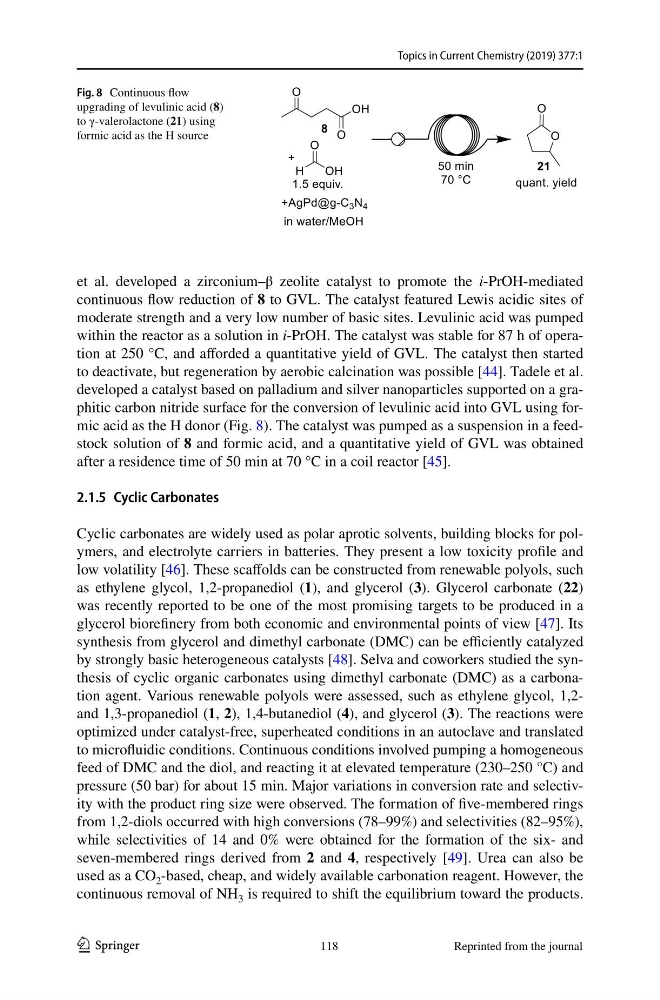
developed a catalyst based on palladium and silver nanoparticles supported on a gra‑
phitic carbon nitride surface for the conversion of levulinic acid into GVL using for‑
mic acid as the H donor (Fig. 8). The catalyst was pumped as a suspension in a feed‑
stock solution of 8 and formic acid, and a quantitative yield of GVL was obtained
after a residence time of 50 min at 70 °C in a coil reactor [45].
2.1.5 Cyclic Carbonates
Cyclic carbonates are widely used as polar aprotic solvents, building blocks for pol‑
ymers, and electrolyte carriers in batteries. They present a low toxicity profile and
low volatility [46]. These scaffolds can be constructed from renewable polyols, such
as ethylene glycol, 1,2‑propanediol (1), and glycerol (3). Glycerol carbonate (22)
was recently reported to be one of the most promising targets to be produced in a
glycerol biorefinery from both economic and environmental points of view [47]. Its
synthesis from glycerol and dimethyl carbonate (DMC) can be efficiently catalyzed
by strongly basic heterogeneous catalysts [48]. Selva and coworkers studied the syn‑
thesis of cyclic organic carbonates using dimethyl carbonate (DMC) as a carbona‑
tion agent. Various renewable polyols were assessed, such as ethylene glycol, 1,2‑
and 1,3‑propanediol (1, 2), 1,4‑butanediol (4), and glycerol (3). The reactions were
optimized under catalyst‑free, superheated conditions in an autoclave and translated
to microfluidic conditions. Continuous conditions involved pumping a homogeneous
feed of DMC and the diol, and reacting it at elevated temperature (230–250 °C) and
pressure (50 bar) for about 15 min. Major variations in conversion rate and selectiv‑
ity with the product ring size were observed. The formation of five‑membered rings
from 1,2‑diols occurred with high conversions (78–99%) and selectivities (82–95%),
while selectivities of 14 and 0% were obtained for the formation of the six‑ and
seven‑membered rings derived from 2 and 4, respectively [49]. Urea can also be
used as a CO 2 ‑based, cheap, and widely available carbonation reagent. However, the
continuous removal of NH 3 is required to shift the equilibrium toward the products.
Fig. 8 Continuous flow
upgrading of levulinic acid (8)
to γ‑valerolactone (21) using
formic acid as the H source
118
Reprinted from the journal
1 3
et al. developed a zirconium–β zeolite catalyst to promote the i‑PrOH‑mediated
continuous flow reduction of 8 to GVL. The catalyst featured Lewis acidic sites of
moderate strength and a very low number of basic sites. Levulinic acid was pumped
within the reactor as a solution in i‑PrOH. The catalyst was stable for 87 h of opera‑
tion at 250 °C, and afforded a quantitative yield of GVL. The catalyst then started
to deactivate, but regeneration by aerobic calcination was possible [44]. Tadele et al.
developed a catalyst based on palladium and silver nanoparticles supported on a gra‑
phitic carbon nitride surface for the conversion of levulinic acid into GVL using for‑
mic acid as the H donor (Fig. 8). The catalyst was pumped as a suspension in a feed‑
stock solution of 8 and formic acid, and a quantitative yield of GVL was obtained
after a residence time of 50 min at 70 °C in a coil reactor [45].
2.1.5 Cyclic Carbonates
Cyclic carbonates are widely used as polar aprotic solvents, building blocks for pol‑
ymers, and electrolyte carriers in batteries. They present a low toxicity profile and
low volatility [46]. These scaffolds can be constructed from renewable polyols, such
as ethylene glycol, 1,2‑propanediol (1), and glycerol (3). Glycerol carbonate (22)
was recently reported to be one of the most promising targets to be produced in a
glycerol biorefinery from both economic and environmental points of view [47]. Its
synthesis from glycerol and dimethyl carbonate (DMC) can be efficiently catalyzed
by strongly basic heterogeneous catalysts [48]. Selva and coworkers studied the syn‑
thesis of cyclic organic carbonates using dimethyl carbonate (DMC) as a carbona‑
tion agent. Various renewable polyols were assessed, such as ethylene glycol, 1,2‑
and 1,3‑propanediol (1, 2), 1,4‑butanediol (4), and glycerol (3). The reactions were
optimized under catalyst‑free, superheated conditions in an autoclave and translated
to microfluidic conditions. Continuous conditions involved pumping a homogeneous
feed of DMC and the diol, and reacting it at elevated temperature (230–250 °C) and
pressure (50 bar) for about 15 min. Major variations in conversion rate and selectiv‑
ity with the product ring size were observed. The formation of five‑membered rings
from 1,2‑diols occurred with high conversions (78–99%) and selectivities (82–95%),
while selectivities of 14 and 0% were obtained for the formation of the six‑ and
seven‑membered rings derived from 2 and 4, respectively [49]. Urea can also be
used as a CO 2 ‑based, cheap, and widely available carbonation reagent. However, the
continuous removal of NH 3 is required to shift the equilibrium toward the products.
Fig. 8 Continuous flow
upgrading of levulinic acid (8)
to γ‑valerolactone (21) using
formic acid as the H source
118
Reprinted from the journal