

1 3
Topics in Current Chemistry (2019) 377:1
(6) was converted into 2‑methylfuran (18). The second catalytic bed was operated
at 300 °C to reduce the furanyl ring, affording MeTHF with quantitative furfural
conversion and 82% selectivity [36]. Another emerging route for the prepara‑
tion of MeTHF starts from levulinic acid (8) as substrate (Fig. 6b). Upare et al.
described that at very high copper loading, a Cu/SiO 2 catalyst was selective for
MeTHF production. Quantitative levulinic acid conversion and 89% selectivity
for MeTHF were maintained for 320 h of operation over a nickel‑doped copper
catalyst. Notably, no metal leaching or sintering was observed [37].
2.1.4 Lactones
Similarly to THF (see Sect. 2.1.3), γ‑butyrolactone (GBL, 20) is already produced
on an industrial scale from potentially renewable 1,4‑butanediol (4). GBL has
applications as an aprotic polar solvent or as a building block for the preparation of
N‑methylpyrrolidone [38]. Copper‑based catalysts are known to trigger the oxida‑
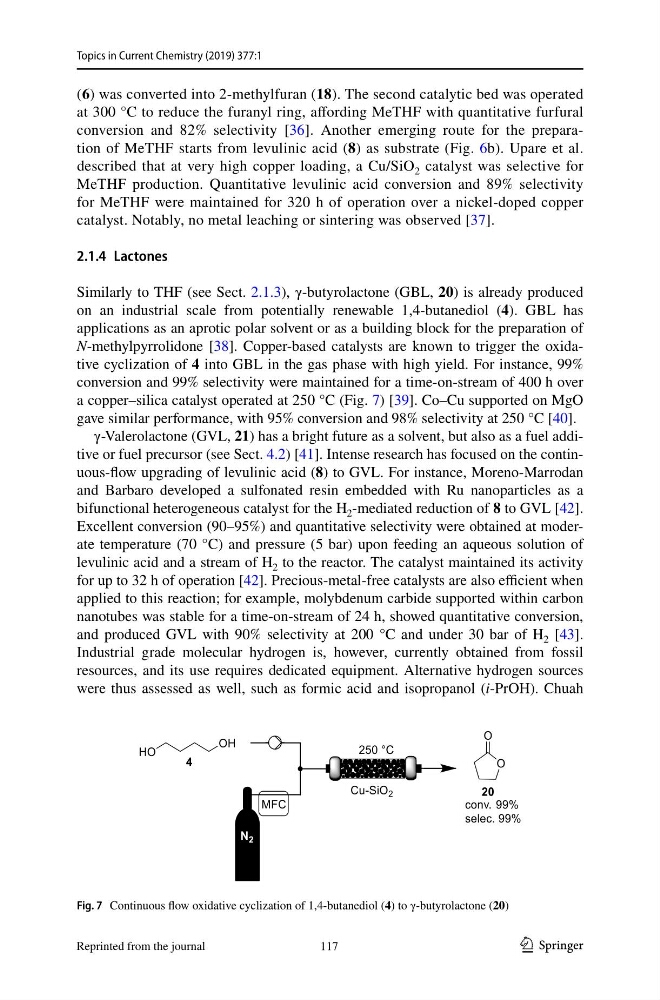
tive cyclization of 4 into GBL in the gas phase with high yield. For instance, 99%
conversion and 99% selectivity were maintained for a time‑on‑stream of 400 h over
a copper–silica catalyst operated at 250 °C (Fig. 7) [39]. Co–Cu supported on MgO
gave similar performance, with 95% conversion and 98% selectivity at 250 °C [40].
γ‑Valerolactone (GVL, 21) has a bright future as a solvent, but also as a fuel addi‑
tive or fuel precursor (see Sect. 4.2) [41]. Intense research has focused on the contin‑
uous‑flow upgrading of levulinic acid (8) to GVL. For instance, Moreno‑Marrodan
and Barbaro developed a sulfonated resin embedded with Ru nanoparticles as a
bifunctional heterogeneous catalyst for the H 2 ‑mediated reduction of 8 to GVL [42].
Excellent conversion (90–95%) and quantitative selectivity were obtained at moder‑
ate temperature (70 °C) and pressure (5 bar) upon feeding an aqueous solution of
levulinic acid and a stream of H 2 to the reactor. The catalyst maintained its activity
for up to 32 h of operation [42]. Precious‑metal‑free catalysts are also efficient when
applied to this reaction; for example, molybdenum carbide supported within carbon
nanotubes was stable for a time‑on‑stream of 24 h, showed quantitative conversion,
and produced GVL with 90% selectivity at 200 °C and under 30 bar of H 2 [43].
Industrial grade molecular hydrogen is, however, currently obtained from fossil
resources, and its use requires dedicated equipment. Alternative hydrogen sources
were thus assessed as well, such as formic acid and isopropanol (i‑PrOH). Chuah
Fig. 7 Continuous flow oxidative cyclization of 1,4‑butanediol (4) to γ‑butyrolactone (20)
117
Reprinted from the journal
Topics in Current Chemistry (2019) 377:1
(6) was converted into 2‑methylfuran (18). The second catalytic bed was operated
at 300 °C to reduce the furanyl ring, affording MeTHF with quantitative furfural
conversion and 82% selectivity [36]. Another emerging route for the prepara‑
tion of MeTHF starts from levulinic acid (8) as substrate (Fig. 6b). Upare et al.
described that at very high copper loading, a Cu/SiO 2 catalyst was selective for
MeTHF production. Quantitative levulinic acid conversion and 89% selectivity
for MeTHF were maintained for 320 h of operation over a nickel‑doped copper
catalyst. Notably, no metal leaching or sintering was observed [37].
2.1.4 Lactones
Similarly to THF (see Sect. 2.1.3), γ‑butyrolactone (GBL, 20) is already produced
on an industrial scale from potentially renewable 1,4‑butanediol (4). GBL has
applications as an aprotic polar solvent or as a building block for the preparation of
N‑methylpyrrolidone [38]. Copper‑based catalysts are known to trigger the oxida‑
tive cyclization of 4 into GBL in the gas phase with high yield. For instance, 99%
conversion and 99% selectivity were maintained for a time‑on‑stream of 400 h over
a copper–silica catalyst operated at 250 °C (Fig. 7) [39]. Co–Cu supported on MgO
gave similar performance, with 95% conversion and 98% selectivity at 250 °C [40].
γ‑Valerolactone (GVL, 21) has a bright future as a solvent, but also as a fuel addi‑
tive or fuel precursor (see Sect. 4.2) [41]. Intense research has focused on the contin‑
uous‑flow upgrading of levulinic acid (8) to GVL. For instance, Moreno‑Marrodan
and Barbaro developed a sulfonated resin embedded with Ru nanoparticles as a
bifunctional heterogeneous catalyst for the H 2 ‑mediated reduction of 8 to GVL [42].
Excellent conversion (90–95%) and quantitative selectivity were obtained at moder‑
ate temperature (70 °C) and pressure (5 bar) upon feeding an aqueous solution of
levulinic acid and a stream of H 2 to the reactor. The catalyst maintained its activity
for up to 32 h of operation [42]. Precious‑metal‑free catalysts are also efficient when
applied to this reaction; for example, molybdenum carbide supported within carbon
nanotubes was stable for a time‑on‑stream of 24 h, showed quantitative conversion,
and produced GVL with 90% selectivity at 200 °C and under 30 bar of H 2 [43].
Industrial grade molecular hydrogen is, however, currently obtained from fossil
resources, and its use requires dedicated equipment. Alternative hydrogen sources
were thus assessed as well, such as formic acid and isopropanol (i‑PrOH). Chuah
Fig. 7 Continuous flow oxidative cyclization of 1,4‑butanediol (4) to γ‑butyrolactone (20)
117
Reprinted from the journal