

Topics in Current Chemistry (2019) 377:1
1 3
formation of THF in 97% yield when neat 1,4‑butanediol and nitrogen were co‑
fed into a fixed‑bed reactor packed with Al 2 O 3 or ZrO 2 at 325 °C under atmos‑
pheric pressure [33]. A continuous flow procedure in rupture with the gas‑phase
process was also described, where supercritical water was used as an alternative
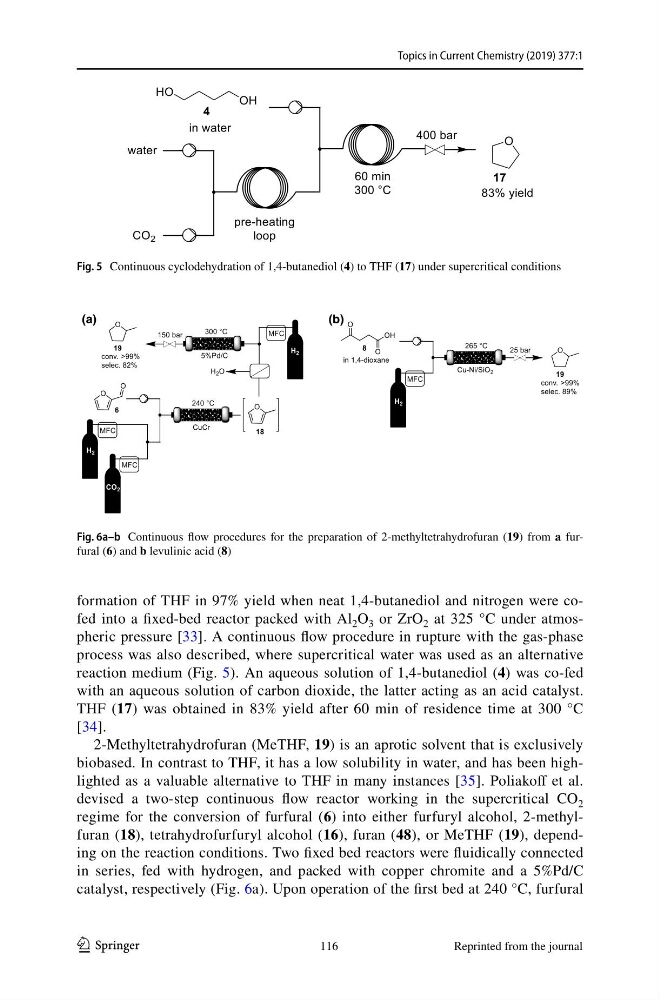
reaction medium (Fig. 5). An aqueous solution of 1,4‑butanediol (4) was co‑fed
with an aqueous solution of carbon dioxide, the latter acting as an acid catalyst.
THF (17) was obtained in 83% yield after 60 min of residence time at 300 °C
[34].
2‑Methyltetrahydrofuran (MeTHF, 19) is an aprotic solvent that is exclusively
biobased. In contrast to THF, it has a low solubility in water, and has been high‑
lighted as a valuable alternative to THF in many instances [35]. Poliakoff et al.
devised a two‑step continuous flow reactor working in the supercritical CO 2
regime for the conversion of furfural (6) into either furfuryl alcohol, 2‑methyl‑
furan (18), tetrahydrofurfuryl alcohol (16), furan (48), or MeTHF (19), depend‑
ing on the reaction conditions. Two fixed bed reactors were fluidically connected
in series, fed with hydrogen, and packed with copper chromite and a 5%Pd/C
catalyst, respectively (Fig. 6a). Upon operation of the first bed at 240 °C, furfural
Fig. 5 Continuous cyclodehydration of 1,4‑butanediol (4) to THF (17) under supercritical conditions
(a)
(b)
Fig. 6a–b Continuous flow procedures for the preparation of 2‑methyltetrahydrofuran (19) from a fur‑
fural (6) and b levulinic acid (8)
116
Reprinted from the journal
1 3
formation of THF in 97% yield when neat 1,4‑butanediol and nitrogen were co‑
fed into a fixed‑bed reactor packed with Al 2 O 3 or ZrO 2 at 325 °C under atmos‑
pheric pressure [33]. A continuous flow procedure in rupture with the gas‑phase
process was also described, where supercritical water was used as an alternative
reaction medium (Fig. 5). An aqueous solution of 1,4‑butanediol (4) was co‑fed
with an aqueous solution of carbon dioxide, the latter acting as an acid catalyst.
THF (17) was obtained in 83% yield after 60 min of residence time at 300 °C
[34].
2‑Methyltetrahydrofuran (MeTHF, 19) is an aprotic solvent that is exclusively
biobased. In contrast to THF, it has a low solubility in water, and has been high‑
lighted as a valuable alternative to THF in many instances [35]. Poliakoff et al.
devised a two‑step continuous flow reactor working in the supercritical CO 2
regime for the conversion of furfural (6) into either furfuryl alcohol, 2‑methyl‑
furan (18), tetrahydrofurfuryl alcohol (16), furan (48), or MeTHF (19), depend‑
ing on the reaction conditions. Two fixed bed reactors were fluidically connected
in series, fed with hydrogen, and packed with copper chromite and a 5%Pd/C
catalyst, respectively (Fig. 6a). Upon operation of the first bed at 240 °C, furfural
Fig. 5 Continuous cyclodehydration of 1,4‑butanediol (4) to THF (17) under supercritical conditions
(a)
(b)
Fig. 6a–b Continuous flow procedures for the preparation of 2‑methyltetrahydrofuran (19) from a fur‑
fural (6) and b levulinic acid (8)
116
Reprinted from the journal