

1 3
Topics in Current Chemistry (2019) 377:1
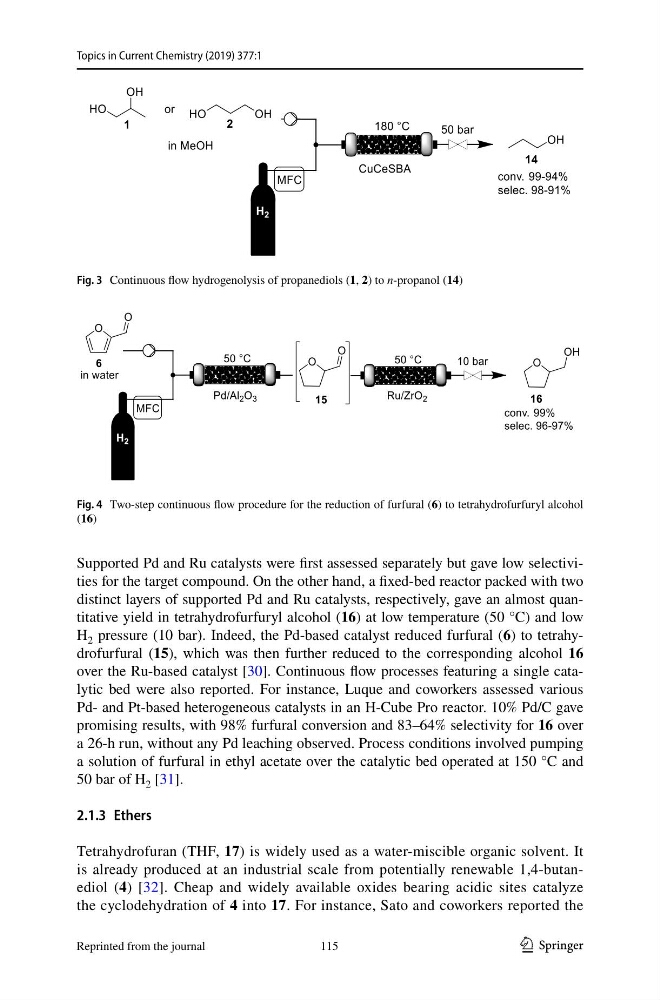
Supported Pd and Ru catalysts were first assessed separately but gave low selectivi‑
ties for the target compound. On the other hand, a fixed‑bed reactor packed with two
distinct layers of supported Pd and Ru catalysts, respectively, gave an almost quan‑
titative yield in tetrahydrofurfuryl alcohol (16) at low temperature (50 °C) and low
H 2 pressure (10 bar). Indeed, the Pd‑based catalyst reduced furfural (6) to tetrahy‑
drofurfural (15), which was then further reduced to the corresponding alcohol 16
over the Ru‑based catalyst [30]. Continuous flow processes featuring a single cata‑
lytic bed were also reported. For instance, Luque and coworkers assessed various
Pd‑ and Pt‑based heterogeneous catalysts in an H‑Cube Pro reactor. 10% Pd/C gave
promising results, with 98% furfural conversion and 83–64% selectivity for 16 over
a 26‑h run, without any Pd leaching observed. Process conditions involved pumping
a solution of furfural in ethyl acetate over the catalytic bed operated at 150 °C and
50 bar of H 2 [31].
2.1.3 Ethers
Tetrahydrofuran (THF, 17) is widely used as a water‑miscible organic solvent. It
is already produced at an industrial scale from potentially renewable 1,4‑butan‑
ediol (4) [32]. Cheap and widely available oxides bearing acidic sites catalyze
the cyclodehydration of 4 into 17. For instance, Sato and coworkers reported the
Fig. 3 Continuous flow hydrogenolysis of propanediols (1, 2) to n‑propanol (14)
Fig. 4 Two‑step continuous flow procedure for the reduction of furfural (6) to tetrahydrofurfuryl alcohol
(16)
115
Reprinted from the journal
Topics in Current Chemistry (2019) 377:1
Supported Pd and Ru catalysts were first assessed separately but gave low selectivi‑
ties for the target compound. On the other hand, a fixed‑bed reactor packed with two
distinct layers of supported Pd and Ru catalysts, respectively, gave an almost quan‑
titative yield in tetrahydrofurfuryl alcohol (16) at low temperature (50 °C) and low
H 2 pressure (10 bar). Indeed, the Pd‑based catalyst reduced furfural (6) to tetrahy‑
drofurfural (15), which was then further reduced to the corresponding alcohol 16
over the Ru‑based catalyst [30]. Continuous flow processes featuring a single cata‑
lytic bed were also reported. For instance, Luque and coworkers assessed various
Pd‑ and Pt‑based heterogeneous catalysts in an H‑Cube Pro reactor. 10% Pd/C gave
promising results, with 98% furfural conversion and 83–64% selectivity for 16 over
a 26‑h run, without any Pd leaching observed. Process conditions involved pumping
a solution of furfural in ethyl acetate over the catalytic bed operated at 150 °C and
50 bar of H 2 [31].
2.1.3 Ethers
Tetrahydrofuran (THF, 17) is widely used as a water‑miscible organic solvent. It
is already produced at an industrial scale from potentially renewable 1,4‑butan‑
ediol (4) [32]. Cheap and widely available oxides bearing acidic sites catalyze
the cyclodehydration of 4 into 17. For instance, Sato and coworkers reported the
Fig. 3 Continuous flow hydrogenolysis of propanediols (1, 2) to n‑propanol (14)
Fig. 4 Two‑step continuous flow procedure for the reduction of furfural (6) to tetrahydrofurfuryl alcohol
(16)
115
Reprinted from the journal