

Topics in Current Chemistry (2019) 377:2
1 3
to 3‑substituted oxepinones in liqCO 2 (Scheme 29b). However, in this case they used
a CO 2 ‑soluble porphyrin photosensitizer [5,10,15,20‑tetrakis‑(pentafluorophenyl)
porphyrin, TPFPP] [125]. The reactive intermediate was generated within a sapphire
tube reactor irradiated with LEDs strips, and the intermediate then decomposed
under thermal irradiation to yield the 3‑substituted oxepinones. The ratio of the dif‑
ferent products formed could be controlled by varying the reaction temperature in
the two different reactors, co‑solvent selection, substrate concentration and CO 2 flow
rate.
10.2 Water
Water is a green and non‑flammable solvent, thus, on these terms, water is the ideal
solvent for aerobic oxidations. However, a significant limitation associated with
using water within flow reactors is that the inherent carbon richness of organic sub‑
strates mean that most do not dissolve in water, causing slow reaction rates. Uozumi
and co‑workers studied the aerobic oxidation of alcohols in H 2 O within a catalyzed
by platinum nanoparticles dispersed in an amphiphilic polymer within a continuous
flow reactor, but very low substrate concentrations were used (10–100 µM) [126].
The likelihood of multiple phases complicates the development of a flow process
due to the multiple phases present. One approach to avoid multiple phases is through
the dissolution of organic compounds and O 2 within a single phase by operating in
the supercritical regime for water.
As a proof of concept study, Poliakoff and co‑workers demonstrated the aero‑
bic oxidation of methylaromatic compounds to their corresponding carboxylic acid
derivatives by using manganese(II) bromide as catalyst and scH 2 O as the reaction
medium [127]. H 2 O has a high critical point (T c = 374 °C, P c = 221 bar). Even at
high temperatures, below the supercritical regime H 2 O still displays some interest‑
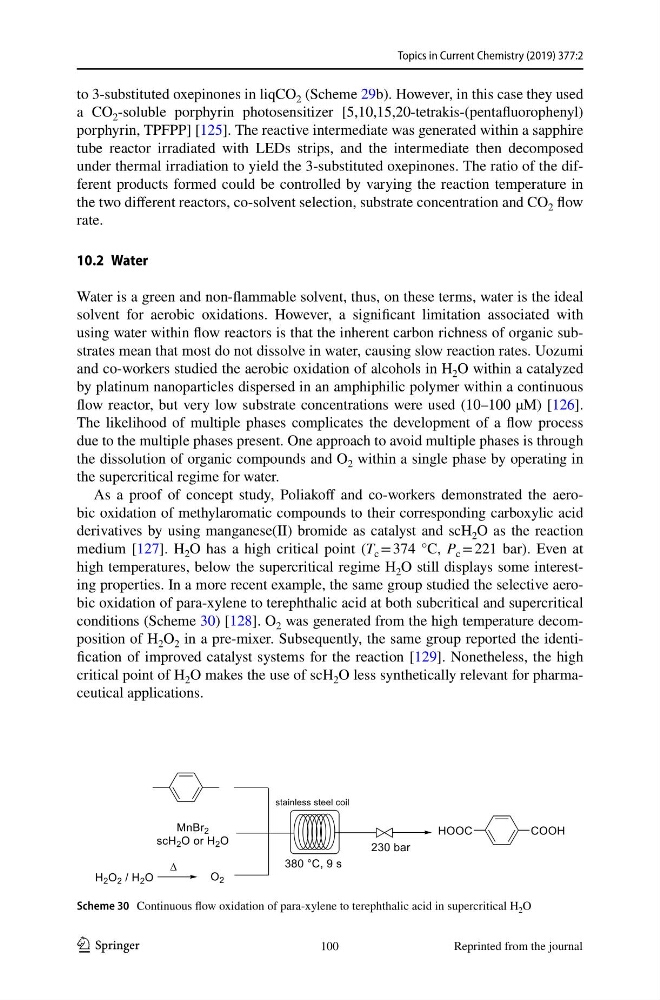
ing properties. In a more recent example, the same group studied the selective aero‑
bic oxidation of para‑xylene to terephthalic acid at both subcritical and supercritical
conditions (Scheme 30) [128]. O 2 was generated from the high temperature decom‑
position of H 2 O 2 in a pre‑mixer. Subsequently, the same group reported the identi‑
fication of improved catalyst systems for the reaction [129]. Nonetheless, the high
critical point of H 2 O makes the use of scH 2 O less synthetically relevant for pharma‑
ceutical applications.
Scheme 30 Continuous flow oxidation of para‑xylene to terephthalic acid in supercritical H 2 O
100
Reprinted from the journal
1 3
to 3‑substituted oxepinones in liqCO 2 (Scheme 29b). However, in this case they used
a CO 2 ‑soluble porphyrin photosensitizer [5,10,15,20‑tetrakis‑(pentafluorophenyl)
porphyrin, TPFPP] [125]. The reactive intermediate was generated within a sapphire
tube reactor irradiated with LEDs strips, and the intermediate then decomposed
under thermal irradiation to yield the 3‑substituted oxepinones. The ratio of the dif‑
ferent products formed could be controlled by varying the reaction temperature in
the two different reactors, co‑solvent selection, substrate concentration and CO 2 flow
rate.
10.2 Water
Water is a green and non‑flammable solvent, thus, on these terms, water is the ideal
solvent for aerobic oxidations. However, a significant limitation associated with
using water within flow reactors is that the inherent carbon richness of organic sub‑
strates mean that most do not dissolve in water, causing slow reaction rates. Uozumi
and co‑workers studied the aerobic oxidation of alcohols in H 2 O within a catalyzed
by platinum nanoparticles dispersed in an amphiphilic polymer within a continuous
flow reactor, but very low substrate concentrations were used (10–100 µM) [126].
The likelihood of multiple phases complicates the development of a flow process
due to the multiple phases present. One approach to avoid multiple phases is through
the dissolution of organic compounds and O 2 within a single phase by operating in
the supercritical regime for water.
As a proof of concept study, Poliakoff and co‑workers demonstrated the aero‑
bic oxidation of methylaromatic compounds to their corresponding carboxylic acid
derivatives by using manganese(II) bromide as catalyst and scH 2 O as the reaction
medium [127]. H 2 O has a high critical point (T c = 374 °C, P c = 221 bar). Even at
high temperatures, below the supercritical regime H 2 O still displays some interest‑
ing properties. In a more recent example, the same group studied the selective aero‑
bic oxidation of para‑xylene to terephthalic acid at both subcritical and supercritical
conditions (Scheme 30) [128]. O 2 was generated from the high temperature decom‑
position of H 2 O 2 in a pre‑mixer. Subsequently, the same group reported the identi‑
fication of improved catalyst systems for the reaction [129]. Nonetheless, the high
critical point of H 2 O makes the use of scH 2 O less synthetically relevant for pharma‑
ceutical applications.
Scheme 30 Continuous flow oxidation of para‑xylene to terephthalic acid in supercritical H 2 O
100
Reprinted from the journal