

1 3
Topics in Current Chemistry (2019) 377:2
to circumvent Pd deactivation, and immobilized within a flow reactor. It is important
to ensure good mixing between O 2 and CO 2 to form a homogeneous mixture before
the introduction of the substrate. The catalyst demonstrated reasonable activity and
selectivity under unoptimized flow conditions after a single pass.
Poliakoff and co‑workers reported the optimization of the oxidation of 2‑octanol
over a packed bed reactor (5% Pt + 1% Bi on Al 2 O 3 ) using scCO 2 (Scheme 28b)
[122]. The system afforded 2‑octanone in a consistent 75% yield for 5 h with no evi‑
dence for catalyst deactivation and no formation of the octene shown. Subsequently,
the system was applied for the oxidation of a number of secondary alcohols (11
examples, 10–75% yield).
Larger scale processes utilizing
1
O 2 normally require non‑flammable halogen‑
ated solvents to ensure safe operation. ScCO 2 is a greener alternative to these halo‑
genated solvents. ScCO 2 has an additional benefit that it lengthens the lifetime of
1
O 2 (5.1 ms). An early example by George, Poliakoff and co‑workers was the pho‑
tooxygenation of α‑terpinene and of citronellol using immobilized photosensitisers
[123]. More recently the same group have examined using liquid CO 2 (liqCO 2 ) for
conducting aerobic oxidations [124]. The vapor pressure of liqCO 2 can be much
lower than for scCO 2 , which can enable a reduced pressure limit for the reac‑
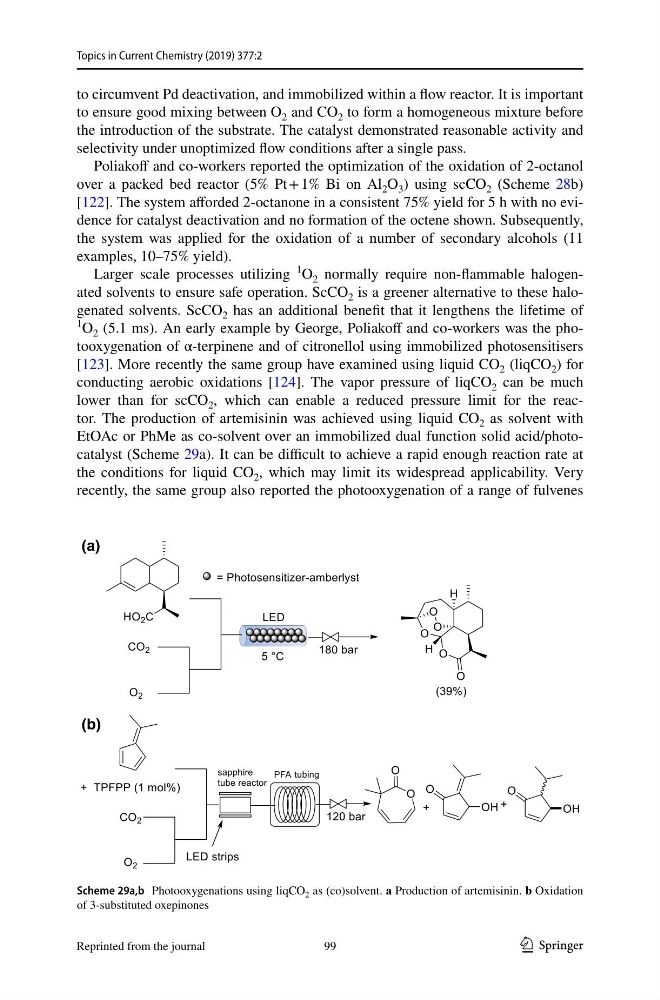
tor. The production of artemisinin was achieved using liquid CO 2 as solvent with
EtOAc or PhMe as co‑solvent over an immobilized dual function solid acid/photo‑
catalyst (Scheme 29a). It can be difficult to achieve a rapid enough reaction rate at
the conditions for liquid CO 2 , which may limit its widespread applicability. Very
recently, the same group also reported the photooxygenation of a range of fulvenes
(a)
(b)
Scheme 29a,b Photooxygenations using liqCO 2 as (co)solvent. a Production of artemisinin. b Oxidation
of 3‑substituted oxepinones
99
Reprinted from the journal
Topics in Current Chemistry (2019) 377:2
to circumvent Pd deactivation, and immobilized within a flow reactor. It is important
to ensure good mixing between O 2 and CO 2 to form a homogeneous mixture before
the introduction of the substrate. The catalyst demonstrated reasonable activity and
selectivity under unoptimized flow conditions after a single pass.
Poliakoff and co‑workers reported the optimization of the oxidation of 2‑octanol
over a packed bed reactor (5% Pt + 1% Bi on Al 2 O 3 ) using scCO 2 (Scheme 28b)
[122]. The system afforded 2‑octanone in a consistent 75% yield for 5 h with no evi‑
dence for catalyst deactivation and no formation of the octene shown. Subsequently,
the system was applied for the oxidation of a number of secondary alcohols (11
examples, 10–75% yield).
Larger scale processes utilizing
1
O 2 normally require non‑flammable halogen‑
ated solvents to ensure safe operation. ScCO 2 is a greener alternative to these halo‑
genated solvents. ScCO 2 has an additional benefit that it lengthens the lifetime of
1
O 2 (5.1 ms). An early example by George, Poliakoff and co‑workers was the pho‑
tooxygenation of α‑terpinene and of citronellol using immobilized photosensitisers
[123]. More recently the same group have examined using liquid CO 2 (liqCO 2 ) for
conducting aerobic oxidations [124]. The vapor pressure of liqCO 2 can be much
lower than for scCO 2 , which can enable a reduced pressure limit for the reac‑
tor. The production of artemisinin was achieved using liquid CO 2 as solvent with
EtOAc or PhMe as co‑solvent over an immobilized dual function solid acid/photo‑
catalyst (Scheme 29a). It can be difficult to achieve a rapid enough reaction rate at
the conditions for liquid CO 2 , which may limit its widespread applicability. Very
recently, the same group also reported the photooxygenation of a range of fulvenes
(a)
(b)
Scheme 29a,b Photooxygenations using liqCO 2 as (co)solvent. a Production of artemisinin. b Oxidation
of 3‑substituted oxepinones
99
Reprinted from the journal