

Topics in Current Chemistry (2019) 377:2
1 3
with neat reagents. However neat systems can add complications in terms of thermal
management, impurity formation and on the physical properties of the reagents for a
particular reaction. Ionic liquids and fluorous solvents are also potentially green sol‑
vents for conducting aerobic oxidations [115, 116]; however, as of yet there are no
reported aerobic oxidation examples that use these solvents within continuous‑flow
reactors.
10.1 Carbon Dioxide
CO 2 has attracted significant interest as a green solvent for organic synthesis and
chemical manufacture [117]. In fact, CO 2 has been proposed as an ideal solvent for
pure O 2 chemistry [118]. CO 2 is produced on a very large scale as a chemical waste
product and thus is available in large quantities. There are certain features of CO 2
that make it desirable for use as a solvent, and specifically for reactions utilizing O 2
[119]. CO 2 is inert because it is already oxidized and therefore cannot react further
with O 2 . CO 2 has a relatively low critical point (T c = 31.1 °C, P c = 72.9 bar). ScCO 2
has interesting physical properties such as zero surface tension and high diffusiv‑
ity. O 2 is completely miscible with scCO 2 thus the reaction will not be driven by
mass transfer from the gas to the liquid phase. Using CO 2 as a solvent is advan‑
tageous over conventional solvents as it is miscible with oxygen; therefore, only a
small excess, or sometimes even stoichiometric amounts, of oxygen are needed in
these reactions. However, product extraction after the reaction can be challenging.
Leitner, Greiner and co‑workers described a continuous‑flow system capable of pilot
scale production, although not specifically for a reaction utilizing O 2 [120]. Leitner
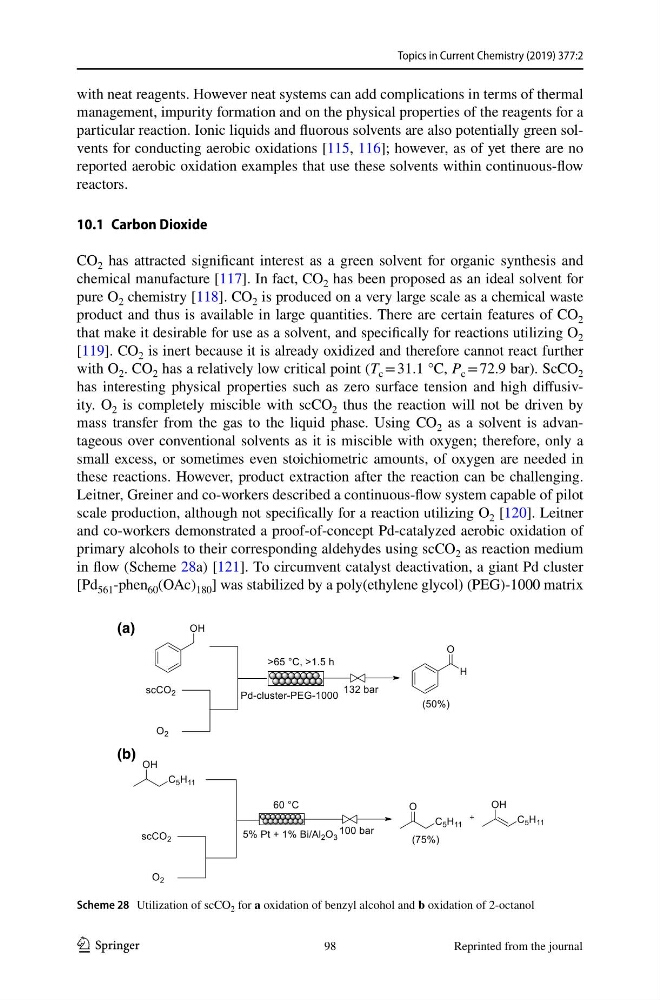
and co‑workers demonstrated a proof‑of‑concept Pd‑catalyzed aerobic oxidation of
primary alcohols to their corresponding aldehydes using scCO 2 as reaction medium
in flow (Scheme 28a) [121]. To circumvent catalyst deactivation, a giant Pd cluster
[Pd 561 ‑phen 60 (OAc) 180 ] was stabilized by a poly(ethylene glycol) (PEG)‑1000 matrix
(a)
(b)
Scheme 28 Utilization of scCO 2 for a oxidation of benzyl alcohol and b oxidation of 2‑octanol
98
Reprinted from the journal
1 3
with neat reagents. However neat systems can add complications in terms of thermal
management, impurity formation and on the physical properties of the reagents for a
particular reaction. Ionic liquids and fluorous solvents are also potentially green sol‑
vents for conducting aerobic oxidations [115, 116]; however, as of yet there are no
reported aerobic oxidation examples that use these solvents within continuous‑flow
reactors.
10.1 Carbon Dioxide
CO 2 has attracted significant interest as a green solvent for organic synthesis and
chemical manufacture [117]. In fact, CO 2 has been proposed as an ideal solvent for
pure O 2 chemistry [118]. CO 2 is produced on a very large scale as a chemical waste
product and thus is available in large quantities. There are certain features of CO 2
that make it desirable for use as a solvent, and specifically for reactions utilizing O 2
[119]. CO 2 is inert because it is already oxidized and therefore cannot react further
with O 2 . CO 2 has a relatively low critical point (T c = 31.1 °C, P c = 72.9 bar). ScCO 2
has interesting physical properties such as zero surface tension and high diffusiv‑
ity. O 2 is completely miscible with scCO 2 thus the reaction will not be driven by
mass transfer from the gas to the liquid phase. Using CO 2 as a solvent is advan‑
tageous over conventional solvents as it is miscible with oxygen; therefore, only a
small excess, or sometimes even stoichiometric amounts, of oxygen are needed in
these reactions. However, product extraction after the reaction can be challenging.
Leitner, Greiner and co‑workers described a continuous‑flow system capable of pilot
scale production, although not specifically for a reaction utilizing O 2 [120]. Leitner
and co‑workers demonstrated a proof‑of‑concept Pd‑catalyzed aerobic oxidation of
primary alcohols to their corresponding aldehydes using scCO 2 as reaction medium
in flow (Scheme 28a) [121]. To circumvent catalyst deactivation, a giant Pd cluster
[Pd 561 ‑phen 60 (OAc) 180 ] was stabilized by a poly(ethylene glycol) (PEG)‑1000 matrix
(a)
(b)
Scheme 28 Utilization of scCO 2 for a oxidation of benzyl alcohol and b oxidation of 2‑octanol
98
Reprinted from the journal