

1 3
Topics in Current Chemistry (2019) 377:2
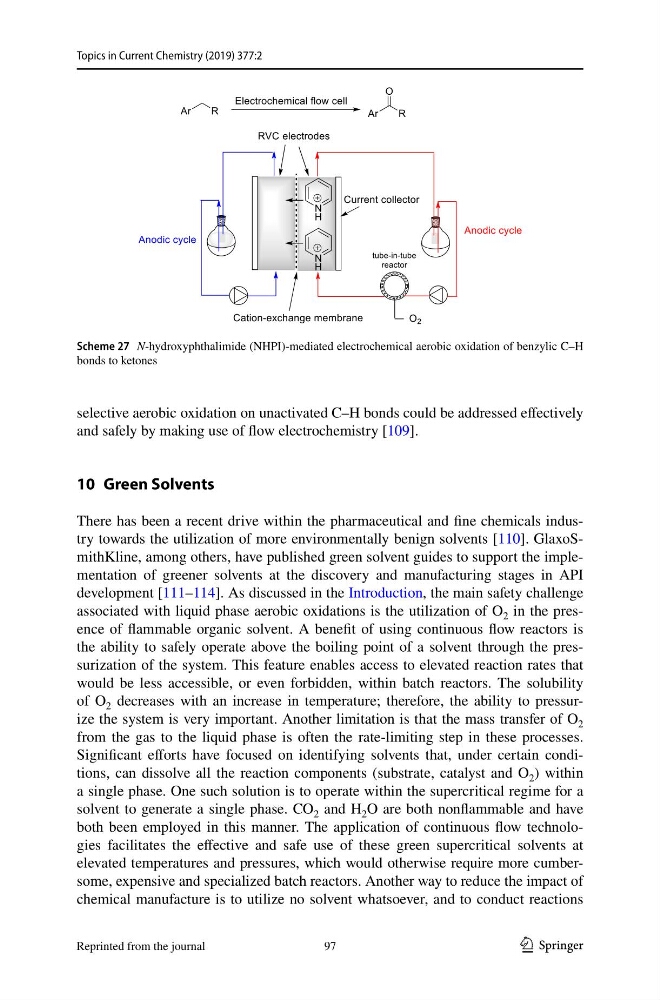
selective aerobic oxidation on unactivated C–H bonds could be addressed effectively
and safely by making use of flow electrochemistry [109].
10 Green Solvents
There has been a recent drive within the pharmaceutical and fine chemicals indus‑
try towards the utilization of more environmentally benign solvents [110]. GlaxoS‑
mithKline, among others, have published green solvent guides to support the imple‑
mentation of greener solvents at the discovery and manufacturing stages in API
development [111–114]. As discussed in the Introduction, the main safety challenge
associated with liquid phase aerobic oxidations is the utilization of O 2 in the pres‑
ence of flammable organic solvent. A benefit of using continuous flow reactors is
the ability to safely operate above the boiling point of a solvent through the pres‑
surization of the system. This feature enables access to elevated reaction rates that
would be less accessible, or even forbidden, within batch reactors. The solubility
of O 2 decreases with an increase in temperature; therefore, the ability to pressur‑
ize the system is very important. Another limitation is that the mass transfer of O 2
from the gas to the liquid phase is often the rate‑limiting step in these processes.
Significant efforts have focused on identifying solvents that, under certain condi‑
tions, can dissolve all the reaction components (substrate, catalyst and O 2 ) within
a single phase. One such solution is to operate within the supercritical regime for a
solvent to generate a single phase. CO 2 and H 2 O are both nonflammable and have
both been employed in this manner. The application of continuous flow technolo‑
gies facilitates the effective and safe use of these green supercritical solvents at
elevated temperatures and pressures, which would otherwise require more cumber‑
some, expensive and specialized batch reactors. Another way to reduce the impact of
chemical manufacture is to utilize no solvent whatsoever, and to conduct reactions
Scheme 27 N‑hydroxyphthalimide (NHPI)‑mediated electrochemical aerobic oxidation of benzylic C–H
bonds to ketones
97
Reprinted from the journal
Topics in Current Chemistry (2019) 377:2
selective aerobic oxidation on unactivated C–H bonds could be addressed effectively
and safely by making use of flow electrochemistry [109].
10 Green Solvents
There has been a recent drive within the pharmaceutical and fine chemicals indus‑
try towards the utilization of more environmentally benign solvents [110]. GlaxoS‑
mithKline, among others, have published green solvent guides to support the imple‑
mentation of greener solvents at the discovery and manufacturing stages in API
development [111–114]. As discussed in the Introduction, the main safety challenge
associated with liquid phase aerobic oxidations is the utilization of O 2 in the pres‑
ence of flammable organic solvent. A benefit of using continuous flow reactors is
the ability to safely operate above the boiling point of a solvent through the pres‑
surization of the system. This feature enables access to elevated reaction rates that
would be less accessible, or even forbidden, within batch reactors. The solubility
of O 2 decreases with an increase in temperature; therefore, the ability to pressur‑
ize the system is very important. Another limitation is that the mass transfer of O 2
from the gas to the liquid phase is often the rate‑limiting step in these processes.
Significant efforts have focused on identifying solvents that, under certain condi‑
tions, can dissolve all the reaction components (substrate, catalyst and O 2 ) within
a single phase. One such solution is to operate within the supercritical regime for a
solvent to generate a single phase. CO 2 and H 2 O are both nonflammable and have
both been employed in this manner. The application of continuous flow technolo‑
gies facilitates the effective and safe use of these green supercritical solvents at
elevated temperatures and pressures, which would otherwise require more cumber‑
some, expensive and specialized batch reactors. Another way to reduce the impact of
chemical manufacture is to utilize no solvent whatsoever, and to conduct reactions
Scheme 27 N‑hydroxyphthalimide (NHPI)‑mediated electrochemical aerobic oxidation of benzylic C–H
bonds to ketones
97
Reprinted from the journal