

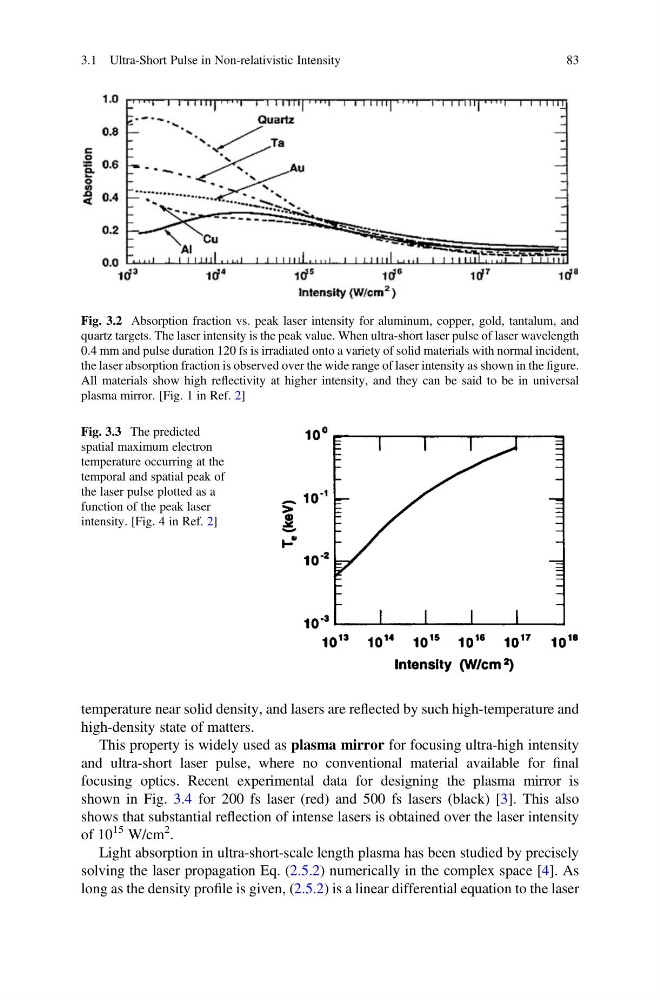
temperature near solid density, and lasers are reflected by such high-temperature and
high-density state of matters.
This property is widely used as plasma mirror for focusing ultra-high intensity
and ultra-short laser pulse, where no conventional material available for final
focusing optics. Recent experimental data for designing the plasma mirror is
shown in Fig. 3.4 for 200 fs laser (red) and 500 fs lasers (black) [3]. This also
shows that substantial reflection of intense lasers is obtained over the laser intensity
of 10
15 W/cm
2 .
Light absorption in ultra-short-scale length plasma has been studied by precisely
solving the laser propagation Eq. (2.5.2) numerically in the complex space [4]. As
long as the density profile is given, (2.5.2) is a linear differential equation to the laser
Fig. 3.2 Absorption fraction vs. peak laser intensity for aluminum, copper, gold, tantalum, and
quartz targets. The laser intensity is the peak value. When ultra-short laser pulse of laser wavelength
0.4 mm and pulse duration 120 fs is irradiated onto a variety of solid materials with normal incident,
the laser absorption fraction is observed over the wide range of laser intensity as shown in the figure.
All materials show high reflectivity at higher intensity, and they can be said to be in universal
plasma mirror. [Fig. 1 in Ref. 2]
Fig. 3.3 The predicted
spatial maximum electron
temperature occurring at the
temporal and spatial peak of
the laser pulse plotted as a
function of the peak laser
intensity. [Fig. 4 in Ref. 2]
3.1 Ultra-Short Pulse in Non-relativistic Intensity
83
high-density state of matters.
This property is widely used as plasma mirror for focusing ultra-high intensity
and ultra-short laser pulse, where no conventional material available for final
focusing optics. Recent experimental data for designing the plasma mirror is
shown in Fig. 3.4 for 200 fs laser (red) and 500 fs lasers (black) [3]. This also
shows that substantial reflection of intense lasers is obtained over the laser intensity
of 10
15 W/cm
2 .
Light absorption in ultra-short-scale length plasma has been studied by precisely
solving the laser propagation Eq. (2.5.2) numerically in the complex space [4]. As
long as the density profile is given, (2.5.2) is a linear differential equation to the laser
Fig. 3.2 Absorption fraction vs. peak laser intensity for aluminum, copper, gold, tantalum, and
quartz targets. The laser intensity is the peak value. When ultra-short laser pulse of laser wavelength
0.4 mm and pulse duration 120 fs is irradiated onto a variety of solid materials with normal incident,
the laser absorption fraction is observed over the wide range of laser intensity as shown in the figure.
All materials show high reflectivity at higher intensity, and they can be said to be in universal
plasma mirror. [Fig. 1 in Ref. 2]
Fig. 3.3 The predicted
spatial maximum electron
temperature occurring at the
temporal and spatial peak of
the laser pulse plotted as a
function of the peak laser
intensity. [Fig. 4 in Ref. 2]
3.1 Ultra-Short Pulse in Non-relativistic Intensity
83