

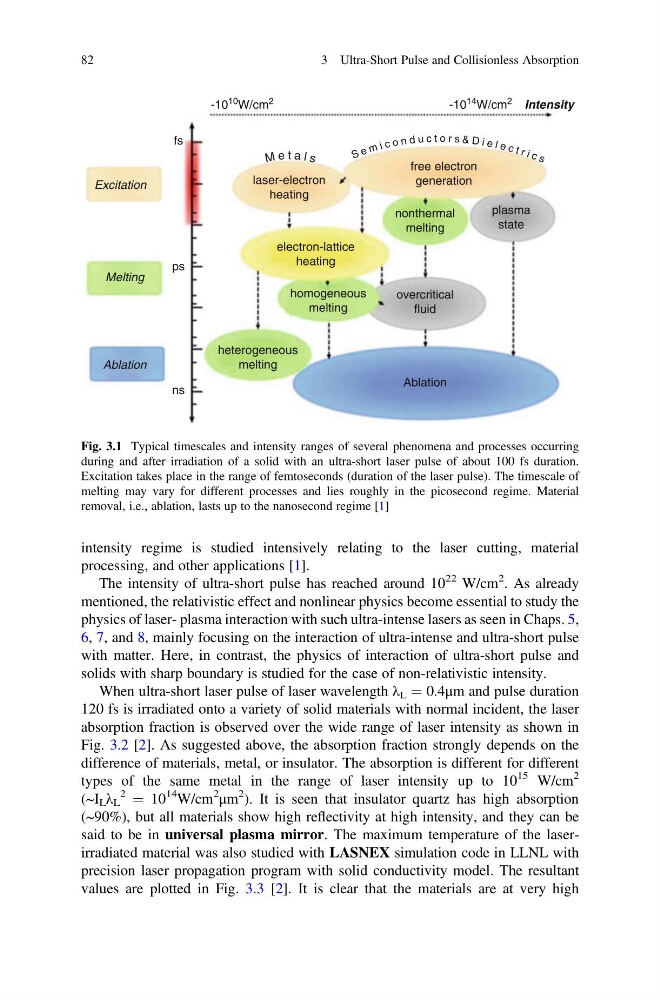
intensity regime is studied intensively relating to the laser cutting, material
processing, and other applications [1].
The intensity of ultra-short pulse has reached around 10
22 W/cm
2 . As already
mentioned, the relativistic effect and nonlinear physics become essential to study the
physics of laser- plasma interaction with such ultra-intense lasers as seen in Chaps. 5,
6, 7, and 8, mainly focusing on the interaction of ultra-intense and ultra-short pulse
with matter. Here, in contrast, the physics of interaction of ultra-short pulse and
solids with sharp boundary is studied for the case of non-relativistic intensity.
When ultra-short laser pulse of laser wavelength λ L ¼ 0.4μm and pulse duration
120 fs is irradiated onto a variety of solid materials with normal incident, the laser
absorption fraction is observed over the wide range of laser intensity as shown in
Fig. 3.2 [2]. As suggested above, the absorption fraction strongly depends on the
difference of materials, metal, or insulator. The absorption is different for different
types of the same metal in the range of laser intensity up to 10
15 W/cm
2
(~I L λ L
2
¼ 10
14 W/cm
2
μm
2 ). It is seen that insulator quartz has high absorption
(~90%), but all materials show high reflectivity at high intensity, and they can be
said to be in universal plasma mirror. The maximum temperature of the laserirradiated material was also studied with LASNEX simulation code in LLNL with
precision laser propagation program with solid conductivity model. The resultant
values are plotted in Fig. 3.3 [2]. It is clear that the materials are at very high
laser-electron
heating
-10
10 W/cm
2
-10
14 W/cm
2
fs
ps
ns
Excitation
Melting
free electron
generation
plasma
state
Intensity
nonthermal
melting
electron-lattice
heating
homogeneous
melting
heterogeneous
melting
Ablation
Ablation
overcritical
fluid
M e t a l s
S e m i c o n d u c t o r s & D i e l e c t r i c s
Fig. 3.1 Typical timescales and intensity ranges of several phenomena and processes occurring
during and after irradiation of a solid with an ultra-short laser pulse of about 100 fs duration.
Excitation takes place in the range of femtoseconds (duration of the laser pulse). The timescale of
melting may vary for different processes and lies roughly in the picosecond regime. Material
removal, i.e., ablation, lasts up to the nanosecond regime [1]
82
3 Ultra-Short Pulse and Collisionless Absorption
processing, and other applications [1].
The intensity of ultra-short pulse has reached around 10
22 W/cm
2 . As already
mentioned, the relativistic effect and nonlinear physics become essential to study the
physics of laser- plasma interaction with such ultra-intense lasers as seen in Chaps. 5,
6, 7, and 8, mainly focusing on the interaction of ultra-intense and ultra-short pulse
with matter. Here, in contrast, the physics of interaction of ultra-short pulse and
solids with sharp boundary is studied for the case of non-relativistic intensity.
When ultra-short laser pulse of laser wavelength λ L ¼ 0.4μm and pulse duration
120 fs is irradiated onto a variety of solid materials with normal incident, the laser
absorption fraction is observed over the wide range of laser intensity as shown in
Fig. 3.2 [2]. As suggested above, the absorption fraction strongly depends on the
difference of materials, metal, or insulator. The absorption is different for different
types of the same metal in the range of laser intensity up to 10
15 W/cm
2
(~I L λ L
2
¼ 10
14 W/cm
2
μm
2 ). It is seen that insulator quartz has high absorption
(~90%), but all materials show high reflectivity at high intensity, and they can be
said to be in universal plasma mirror. The maximum temperature of the laserirradiated material was also studied with LASNEX simulation code in LLNL with
precision laser propagation program with solid conductivity model. The resultant
values are plotted in Fig. 3.3 [2]. It is clear that the materials are at very high
laser-electron
heating
-10
10 W/cm
2
-10
14 W/cm
2
fs
ps
ns
Excitation
Melting
free electron
generation
plasma
state
Intensity
nonthermal
melting
electron-lattice
heating
homogeneous
melting
heterogeneous
melting
Ablation
Ablation
overcritical
fluid
M e t a l s
S e m i c o n d u c t o r s & D i e l e c t r i c s
Fig. 3.1 Typical timescales and intensity ranges of several phenomena and processes occurring
during and after irradiation of a solid with an ultra-short laser pulse of about 100 fs duration.
Excitation takes place in the range of femtoseconds (duration of the laser pulse). The timescale of
melting may vary for different processes and lies roughly in the picosecond regime. Material
removal, i.e., ablation, lasts up to the nanosecond regime [1]
82
3 Ultra-Short Pulse and Collisionless Absorption