

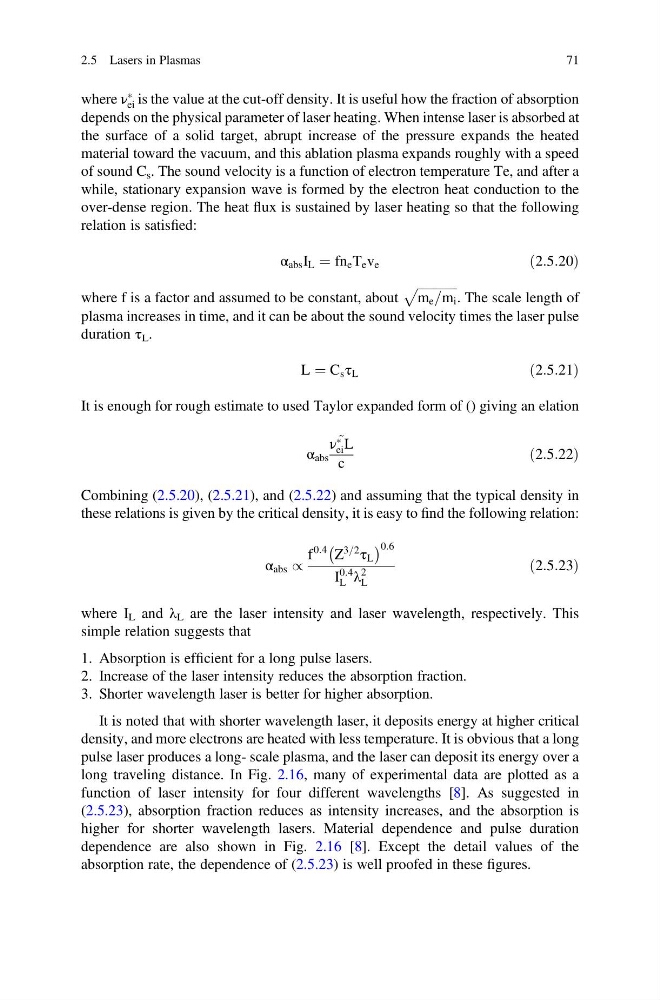
where ν
Ã
ei is the value at the cut-off density. It is useful how the fraction of absorption
depends on the physical parameter of laser heating. When intense laser is absorbed at
the surface of a solid target, abrupt increase of the pressure expands the heated
material toward the vacuum, and this ablation plasma expands roughly with a speed
of sound C s . The sound velocity is a function of electron temperature Te, and after a
while, stationary expansion wave is formed by the electron heat conduction to the
over-dense region. The heat flux is sustained by laser heating so that the following
relation is satisfied:
α abs I L ¼ fn e T e v e
ð2:5:20Þ
where f is a factor and assumed to be constant, about
ffiffiffiffiffiffiffiffiffiffiffiffiffi
m e =m i
p
. The scale length of
plasma increases in time, and it can be about the sound velocity times the laser pulse
duration τ L .
L ¼ C s τ L
ð2:5:21Þ
It is enough for rough estimate to used Taylor expanded form of () giving an elation
α abs
~
ν Ã
ei L
c
ð2:5:22Þ
Combining (2.5.20), (2.5.21), and (2.5.22) and assuming that the typical density in
these relations is given by the critical density, it is easy to find the following relation:
α abs /
f
0:4 Z
3=2
τ L
À
Á 0:6
I
0:4
L λ
2
L
ð2:5:23Þ
where I L and λ L are the laser intensity and laser wavelength, respectively. This
simple relation suggests that
1. Absorption is efficient for a long pulse lasers.
2. Increase of the laser intensity reduces the absorption fraction.
3. Shorter wavelength laser is better for higher absorption.
It is noted that with shorter wavelength laser, it deposits energy at higher critical
density, and more electrons are heated with less temperature. It is obvious that a long
pulse laser produces a long- scale plasma, and the laser can deposit its energy over a
long traveling distance. In Fig. 2.16, many of experimental data are plotted as a
function of laser intensity for four different wavelengths [8]. As suggested in
(2.5.23), absorption fraction reduces as intensity increases, and the absorption is
higher for shorter wavelength lasers. Material dependence and pulse duration
dependence are also shown in Fig. 2.16 [8]. Except the detail values of the
absorption rate, the dependence of (2.5.23) is well proofed in these figures.
2.5 Lasers in Plasmas
71
Ã
ei is the value at the cut-off density. It is useful how the fraction of absorption
depends on the physical parameter of laser heating. When intense laser is absorbed at
the surface of a solid target, abrupt increase of the pressure expands the heated
material toward the vacuum, and this ablation plasma expands roughly with a speed
of sound C s . The sound velocity is a function of electron temperature Te, and after a
while, stationary expansion wave is formed by the electron heat conduction to the
over-dense region. The heat flux is sustained by laser heating so that the following
relation is satisfied:
α abs I L ¼ fn e T e v e
ð2:5:20Þ
where f is a factor and assumed to be constant, about
ffiffiffiffiffiffiffiffiffiffiffiffiffi
m e =m i
p
. The scale length of
plasma increases in time, and it can be about the sound velocity times the laser pulse
duration τ L .
L ¼ C s τ L
ð2:5:21Þ
It is enough for rough estimate to used Taylor expanded form of () giving an elation
α abs
~
ν Ã
ei L
c
ð2:5:22Þ
Combining (2.5.20), (2.5.21), and (2.5.22) and assuming that the typical density in
these relations is given by the critical density, it is easy to find the following relation:
α abs /
f
0:4 Z
3=2
τ L
À
Á 0:6
I
0:4
L λ
2
L
ð2:5:23Þ
where I L and λ L are the laser intensity and laser wavelength, respectively. This
simple relation suggests that
1. Absorption is efficient for a long pulse lasers.
2. Increase of the laser intensity reduces the absorption fraction.
3. Shorter wavelength laser is better for higher absorption.
It is noted that with shorter wavelength laser, it deposits energy at higher critical
density, and more electrons are heated with less temperature. It is obvious that a long
pulse laser produces a long- scale plasma, and the laser can deposit its energy over a
long traveling distance. In Fig. 2.16, many of experimental data are plotted as a
function of laser intensity for four different wavelengths [8]. As suggested in
(2.5.23), absorption fraction reduces as intensity increases, and the absorption is
higher for shorter wavelength lasers. Material dependence and pulse duration
dependence are also shown in Fig. 2.16 [8]. Except the detail values of the
absorption rate, the dependence of (2.5.23) is well proofed in these figures.
2.5 Lasers in Plasmas
71