

Γ ee ¼
e
2
= 4πε 0 r a
ð
Þ
T e
¼
1
4π
ffiffi ffi
3
p
À
Á 2=3
1
n e λ
3
De
2=3
ð2:5:14Þ
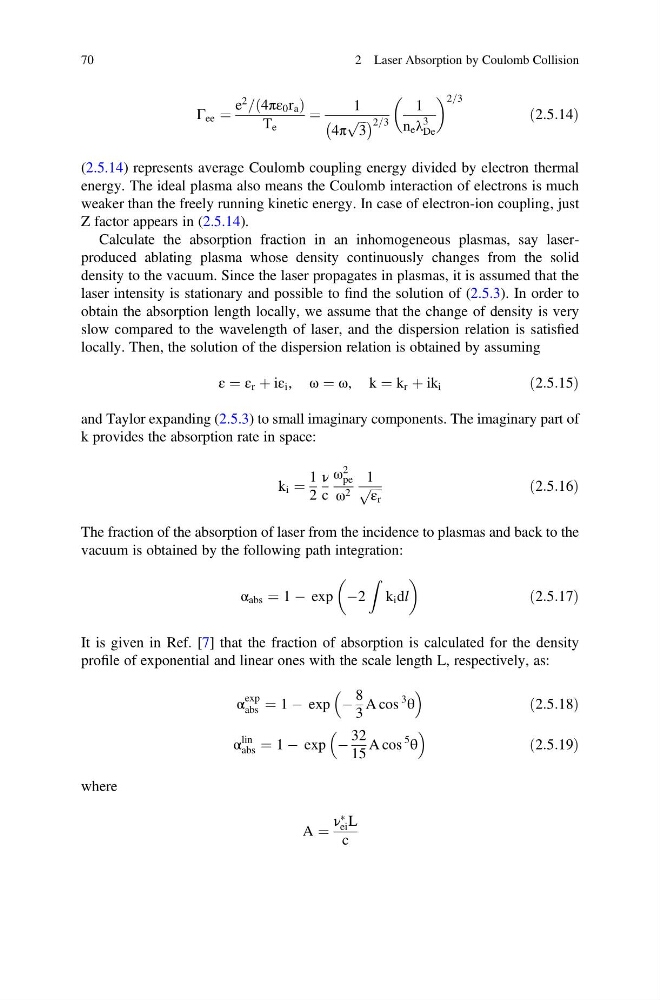
(2.5.14) represents average Coulomb coupling energy divided by electron thermal
energy. The ideal plasma also means the Coulomb interaction of electrons is much
weaker than the freely running kinetic energy. In case of electron-ion coupling, just
Z factor appears in (2.5.14).
Calculate the absorption fraction in an inhomogeneous plasmas, say laserproduced ablating plasma whose density continuously changes from the solid
density to the vacuum. Since the laser propagates in plasmas, it is assumed that the
laser intensity is stationary and possible to find the solution of (2.5.3). In order to
obtain the absorption length locally, we assume that the change of density is very
slow compared to the wavelength of laser, and the dispersion relation is satisfied
locally. Then, the solution of the dispersion relation is obtained by assuming
ε ¼ ε r þ iε i , ω ¼ ω, k ¼ k r þ ik i
ð2:5:15Þ
and Taylor expanding (2.5.3) to small imaginary components. The imaginary part of
k provides the absorption rate in space:
k i ¼
1
2
ν
c
ω
2
pe
ω 2
1
ffiffiffiffi
ε r
p
ð2:5:16Þ
The fraction of the absorption of laser from the incidence to plasmas and back to the
vacuum is obtained by the following path integration:
α abs ¼ 1 À exp À2
Z
k i dl
ð2:5:17Þ
It is given in Ref. [7] that the fraction of absorption is calculated for the density
profile of exponential and linear ones with the scale length L, respectively, as:
α
exp
abs ¼ 1 À exp À
8
3
A cos
3
θ
ð2:5:18Þ
α
lin
abs ¼ 1 À exp À
32
15
A cos
5
θ
ð2:5:19Þ
where
A ¼
ν
Ã
ei L
c
70
2 Laser Absorption by Coulomb Collision
e
2
= 4πε 0 r a
ð
Þ
T e
¼
1
4π
ffiffi ffi
3
p
À
Á 2=3
1
n e λ
3
De
2=3
ð2:5:14Þ
(2.5.14) represents average Coulomb coupling energy divided by electron thermal
energy. The ideal plasma also means the Coulomb interaction of electrons is much
weaker than the freely running kinetic energy. In case of electron-ion coupling, just
Z factor appears in (2.5.14).
Calculate the absorption fraction in an inhomogeneous plasmas, say laserproduced ablating plasma whose density continuously changes from the solid
density to the vacuum. Since the laser propagates in plasmas, it is assumed that the
laser intensity is stationary and possible to find the solution of (2.5.3). In order to
obtain the absorption length locally, we assume that the change of density is very
slow compared to the wavelength of laser, and the dispersion relation is satisfied
locally. Then, the solution of the dispersion relation is obtained by assuming
ε ¼ ε r þ iε i , ω ¼ ω, k ¼ k r þ ik i
ð2:5:15Þ
and Taylor expanding (2.5.3) to small imaginary components. The imaginary part of
k provides the absorption rate in space:
k i ¼
1
2
ν
c
ω
2
pe
ω 2
1
ffiffiffiffi
ε r
p
ð2:5:16Þ
The fraction of the absorption of laser from the incidence to plasmas and back to the
vacuum is obtained by the following path integration:
α abs ¼ 1 À exp À2
Z
k i dl
ð2:5:17Þ
It is given in Ref. [7] that the fraction of absorption is calculated for the density
profile of exponential and linear ones with the scale length L, respectively, as:
α
exp
abs ¼ 1 À exp À
8
3
A cos
3
θ
ð2:5:18Þ
α
lin
abs ¼ 1 À exp À
32
15
A cos
5
θ
ð2:5:19Þ
where
A ¼
ν
Ã
ei L
c
70
2 Laser Absorption by Coulomb Collision