

2.5.1 Classical Absorption of Laser Energy
Before calculating the absorption rate of laser energy to electrons in plasma, discuss
about the effect of Coulomb collision between two electrons. It is clear that the total
energy and momentum of two electrons are conserved after the collision. Even if
the momentum change of one electron like the case of the collision by ions, but the
changed amount goes to the other electron. As the two electron systems, the
momentum is conserved, and the energy of two electron system is conserved. This
represents that the electron-electron Coulomb collision does not contribute to the
absorption of laser energy to the electrons in plasma.
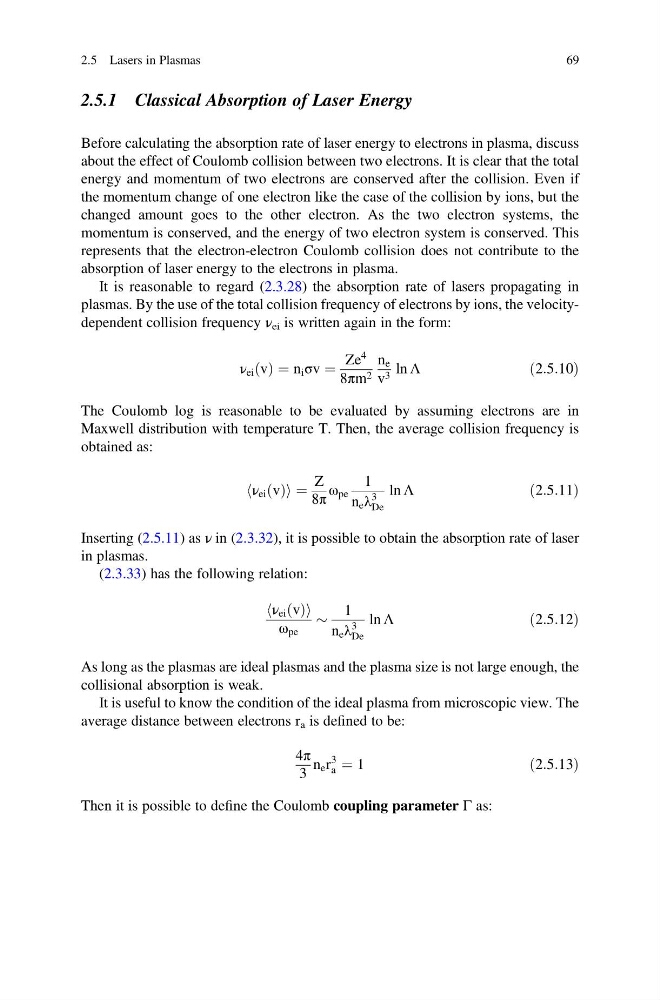
It is reasonable to regard (2.3.28) the absorption rate of lasers propagating in
plasmas. By the use of the total collision frequency of electrons by ions, the velocitydependent collision frequency ν ei is written again in the form:
ν ei v
ð Þ ¼ n i σv ¼
Ze
4
8πm 2
n e
v 3 ln Λ
ð2:5:10Þ
The Coulomb log is reasonable to be evaluated by assuming electrons are in
Maxwell distribution with temperature T. Then, the average collision frequency is
obtained as:
ν ei v
ð Þ
h
i¼
Z
8π
ω pe
1
n e λ
3
De
ln Λ
ð2:5:11Þ
Inserting (2.5.11) as ν in (2.3.32), it is possible to obtain the absorption rate of laser
in plasmas.
(2.3.33) has the following relation:
ν ei v
ð Þ
h
i
ω pe
$
1
n e λ
3
De
ln Λ
ð2:5:12Þ
As long as the plasmas are ideal plasmas and the plasma size is not large enough, the
collisional absorption is weak.
It is useful to know the condition of the ideal plasma from microscopic view. The
average distance between electrons r a is defined to be:
4π
3
n e r
3
a ¼ 1
ð2:5:13Þ
Then it is possible to define the Coulomb coupling parameter Γ as:
2.5 Lasers in Plasmas
69
Before calculating the absorption rate of laser energy to electrons in plasma, discuss
about the effect of Coulomb collision between two electrons. It is clear that the total
energy and momentum of two electrons are conserved after the collision. Even if
the momentum change of one electron like the case of the collision by ions, but the
changed amount goes to the other electron. As the two electron systems, the
momentum is conserved, and the energy of two electron system is conserved. This
represents that the electron-electron Coulomb collision does not contribute to the
absorption of laser energy to the electrons in plasma.
It is reasonable to regard (2.3.28) the absorption rate of lasers propagating in
plasmas. By the use of the total collision frequency of electrons by ions, the velocitydependent collision frequency ν ei is written again in the form:
ν ei v
ð Þ ¼ n i σv ¼
Ze
4
8πm 2
n e
v 3 ln Λ
ð2:5:10Þ
The Coulomb log is reasonable to be evaluated by assuming electrons are in
Maxwell distribution with temperature T. Then, the average collision frequency is
obtained as:
ν ei v
ð Þ
h
i¼
Z
8π
ω pe
1
n e λ
3
De
ln Λ
ð2:5:11Þ
Inserting (2.5.11) as ν in (2.3.32), it is possible to obtain the absorption rate of laser
in plasmas.
(2.3.33) has the following relation:
ν ei v
ð Þ
h
i
ω pe
$
1
n e λ
3
De
ln Λ
ð2:5:12Þ
As long as the plasmas are ideal plasmas and the plasma size is not large enough, the
collisional absorption is weak.
It is useful to know the condition of the ideal plasma from microscopic view. The
average distance between electrons r a is defined to be:
4π
3
n e r
3
a ¼ 1
ð2:5:13Þ
Then it is possible to define the Coulomb coupling parameter Γ as:
2.5 Lasers in Plasmas
69