

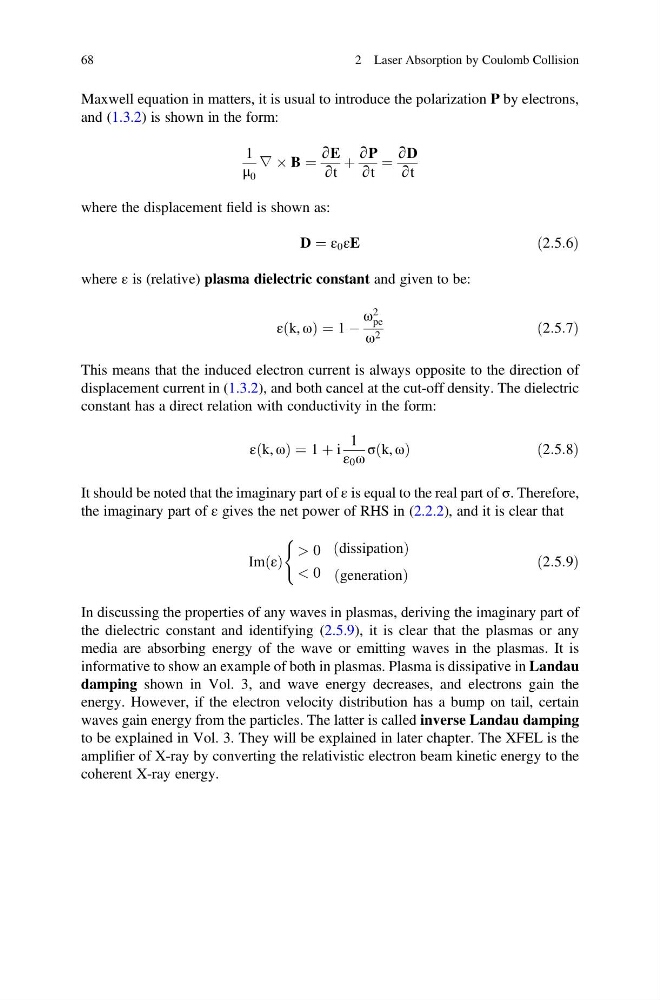
Maxwell equation in matters, it is usual to introduce the polarization P by electrons,
and (1.3.2) is shown in the form:
1
μ 0
∇ Â B ¼
∂E
∂t
þ
∂P
∂t
¼
∂D
∂t
where the displacement field is shown as:
D ¼ ε 0 εE
ð2:5:6Þ
where ε is (relative) plasma dielectric constant and given to be:
ε k, ω
ð
Þ ¼ 1 À
ω
2
pe
ω 2
ð2:5:7Þ
This means that the induced electron current is always opposite to the direction of
displacement current in (1.3.2), and both cancel at the cut-off density. The dielectric
constant has a direct relation with conductivity in the form:
ε k, ω
ð
Þ ¼ 1 þ i
1
ε 0 ω
σ k, ω
ð
Þ
ð2:5:8Þ
It should be noted that the imaginary part of ε is equal to the real part of σ. Therefore,
the imaginary part of ε gives the net power of RHS in (2.2.2), and it is clear that
Im ε
ð Þ
> 0
< 0
dissipation
ð
Þ
generation
ð
Þ
(
ð2:5:9Þ
In discussing the properties of any waves in plasmas, deriving the imaginary part of
the dielectric constant and identifying (2.5.9), it is clear that the plasmas or any
media are absorbing energy of the wave or emitting waves in the plasmas. It is
informative to show an example of both in plasmas. Plasma is dissipative in Landau
damping shown in Vol. 3, and wave energy decreases, and electrons gain the
energy. However, if the electron velocity distribution has a bump on tail, certain
waves gain energy from the particles. The latter is called inverse Landau damping
to be explained in Vol. 3. They will be explained in later chapter. The XFEL is the
amplifier of X-ray by converting the relativistic electron beam kinetic energy to the
coherent X-ray energy.
68
2 Laser Absorption by Coulomb Collision
and (1.3.2) is shown in the form:
1
μ 0
∇ Â B ¼
∂E
∂t
þ
∂P
∂t
¼
∂D
∂t
where the displacement field is shown as:
D ¼ ε 0 εE
ð2:5:6Þ
where ε is (relative) plasma dielectric constant and given to be:
ε k, ω
ð
Þ ¼ 1 À
ω
2
pe
ω 2
ð2:5:7Þ
This means that the induced electron current is always opposite to the direction of
displacement current in (1.3.2), and both cancel at the cut-off density. The dielectric
constant has a direct relation with conductivity in the form:
ε k, ω
ð
Þ ¼ 1 þ i
1
ε 0 ω
σ k, ω
ð
Þ
ð2:5:8Þ
It should be noted that the imaginary part of ε is equal to the real part of σ. Therefore,
the imaginary part of ε gives the net power of RHS in (2.2.2), and it is clear that
Im ε
ð Þ
> 0
< 0
dissipation
ð
Þ
generation
ð
Þ
(
ð2:5:9Þ
In discussing the properties of any waves in plasmas, deriving the imaginary part of
the dielectric constant and identifying (2.5.9), it is clear that the plasmas or any
media are absorbing energy of the wave or emitting waves in the plasmas. It is
informative to show an example of both in plasmas. Plasma is dissipative in Landau
damping shown in Vol. 3, and wave energy decreases, and electrons gain the
energy. However, if the electron velocity distribution has a bump on tail, certain
waves gain energy from the particles. The latter is called inverse Landau damping
to be explained in Vol. 3. They will be explained in later chapter. The XFEL is the
amplifier of X-ray by converting the relativistic electron beam kinetic energy to the
coherent X-ray energy.
68
2 Laser Absorption by Coulomb Collision