

2.6 Laser Absorption in Plasma
2.6.1 Physical Image of Classical Absorption
Before going to mathematics, consider how electrons oscillating under laser field can
get energy from laser via Coulomb collision with fixed ions. For example, an
electron running to y-direction is located at (1) in Fig. 2.17 with the oscillation
shown with red arrow by the electric field in y-direction, linear polarized in
100
a
b
80
10.6 μm, 1 ns
1.06 μm, 100 ps
1.06 μm,
2.5 ps
0.53 μm,
80 ps
0.53 μm,
0.35 μm,
Experiment
Long pulse
Short pulse
CH
CH
Ni, Au
Ni
Au
Au
CH
Be
Be
Calculated
SAGE
0.26 μm,
0.53 μm,
2 ns
60
40
20
10
11
10
12
Intensity (W/cm
2 )
Absorption (%)
Absorption (%)
Absorption (%)
Intensity (W/cm
2 )
(c) LLE (planar)
(a) LLNL (planar)
Intensity (W/cm
2 )
10
13
10
14
10
15
10
13
10
14
10
15
10
13
10
14
10
15
10
16
100
80
60
40
20
0
100
100
80
60
80
60
40
0
SAGE
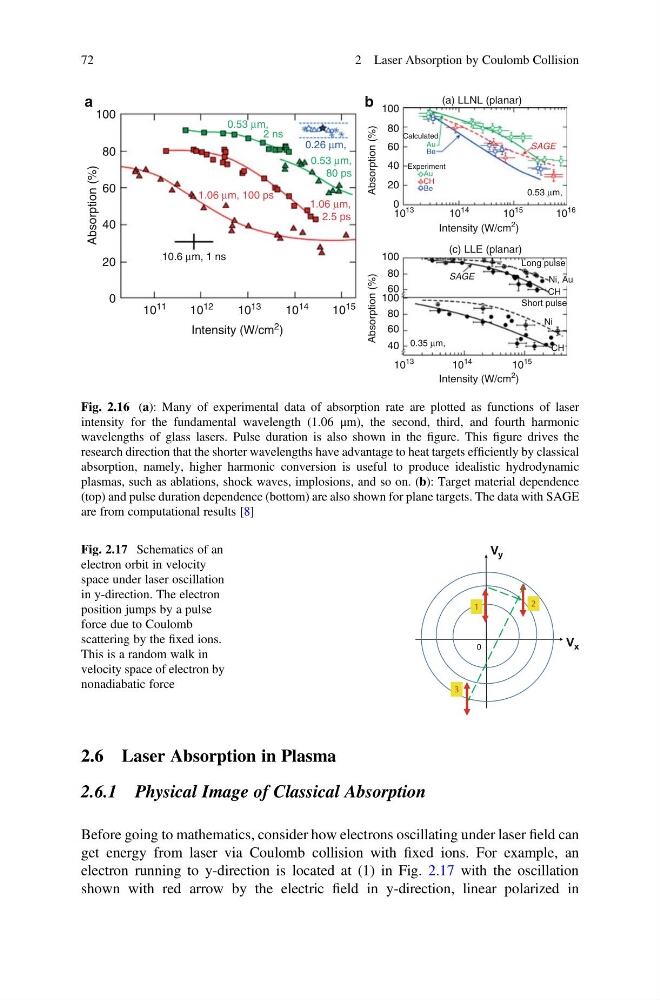
Fig. 2.16 (a): Many of experimental data of absorption rate are plotted as functions of laser
intensity for the fundamental wavelength (1.06 μm), the second, third, and fourth harmonic
wavelengths of glass lasers. Pulse duration is also shown in the figure. This figure drives the
research direction that the shorter wavelengths have advantage to heat targets efficiently by classical
absorption, namely, higher harmonic conversion is useful to produce idealistic hydrodynamic
plasmas, such as ablations, shock waves, implosions, and so on. (b): Target material dependence
(top) and pulse duration dependence (bottom) are also shown for plane targets. The data with SAGE
are from computational results [8]
3
2
1
V x
V y
0
Fig. 2.17 Schematics of an
electron orbit in velocity
space under laser oscillation
in y-direction. The electron
position jumps by a pulse
force due to Coulomb
scattering by the fixed ions.
This is a random walk in
velocity space of electron by
nonadiabatic force
72
2 Laser Absorption by Coulomb Collision
2.6.1 Physical Image of Classical Absorption
Before going to mathematics, consider how electrons oscillating under laser field can
get energy from laser via Coulomb collision with fixed ions. For example, an
electron running to y-direction is located at (1) in Fig. 2.17 with the oscillation
shown with red arrow by the electric field in y-direction, linear polarized in
100
a
b
80
10.6 μm, 1 ns
1.06 μm, 100 ps
1.06 μm,
2.5 ps
0.53 μm,
80 ps
0.53 μm,
0.35 μm,
Experiment
Long pulse
Short pulse
CH
CH
Ni, Au
Ni
Au
Au
CH
Be
Be
Calculated
SAGE
0.26 μm,
0.53 μm,
2 ns
60
40
20
10
11
10
12
Intensity (W/cm
2 )
Absorption (%)
Absorption (%)
Absorption (%)
Intensity (W/cm
2 )
(c) LLE (planar)
(a) LLNL (planar)
Intensity (W/cm
2 )
10
13
10
14
10
15
10
13
10
14
10
15
10
13
10
14
10
15
10
16
100
80
60
40
20
0
100
100
80
60
80
60
40
0
SAGE
Fig. 2.16 (a): Many of experimental data of absorption rate are plotted as functions of laser
intensity for the fundamental wavelength (1.06 μm), the second, third, and fourth harmonic
wavelengths of glass lasers. Pulse duration is also shown in the figure. This figure drives the
research direction that the shorter wavelengths have advantage to heat targets efficiently by classical
absorption, namely, higher harmonic conversion is useful to produce idealistic hydrodynamic
plasmas, such as ablations, shock waves, implosions, and so on. (b): Target material dependence
(top) and pulse duration dependence (bottom) are also shown for plane targets. The data with SAGE
are from computational results [8]
3
2
1
V x
V y
0
Fig. 2.17 Schematics of an
electron orbit in velocity
space under laser oscillation
in y-direction. The electron
position jumps by a pulse
force due to Coulomb
scattering by the fixed ions.
This is a random walk in
velocity space of electron by
nonadiabatic force
72
2 Laser Absorption by Coulomb Collision