

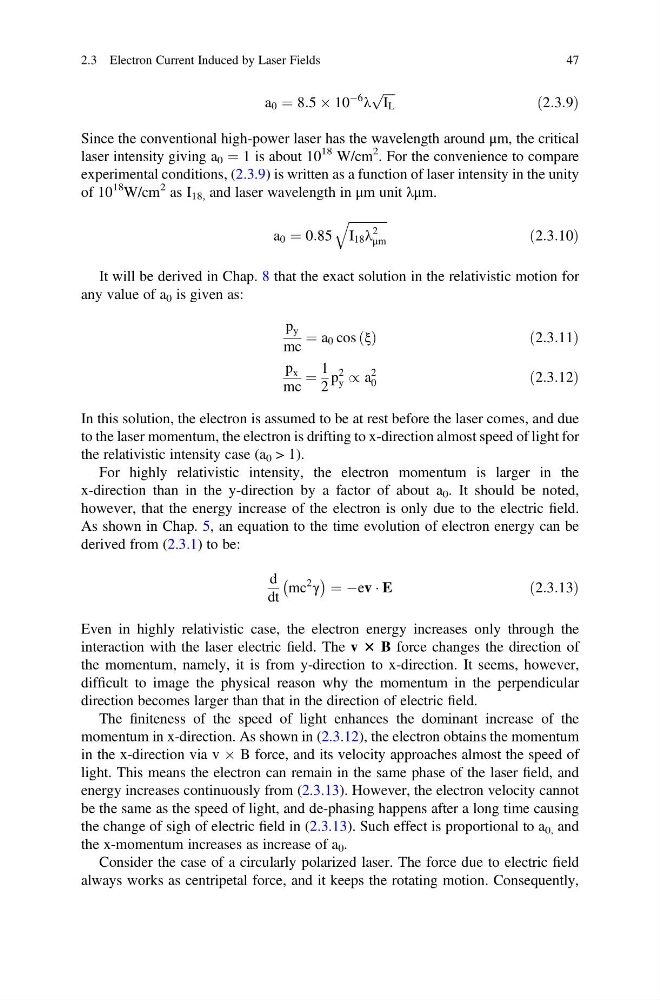
a 0 ¼ 8:5 Â 10
À6
λ
ffiffiffiffi
I L
p
ð2:3:9Þ
Since the conventional high-power laser has the wavelength around μm, the critical
laser intensity giving a 0 ¼ 1 is about 10
18 W/cm
2 . For the convenience to compare
experimental conditions, (2.3.9) is written as a function of laser intensity in the unity
of 10
18 W/cm
2 as I 18, and laser wavelength in μm unit λμm.
a 0 ¼ 0:85
ffiffiffiffiffiffiffiffiffiffiffiffi ffi
I 18 λ
2
μm
q
ð2:3:10Þ
It will be derived in Chap. 8 that the exact solution in the relativistic motion for
any value of a 0 is given as:
p y
mc
¼ a 0 cos ξ
ð Þ
ð2:3:11Þ
p x
mc
¼
1
2
p
2
y / a
2
0
ð2:3:12Þ
In this solution, the electron is assumed to be at rest before the laser comes, and due
to the laser momentum, the electron is drifting to x-direction almost speed of light for
the relativistic intensity case (a 0 > 1).
For highly relativistic intensity, the electron momentum is larger in the
x-direction than in the y-direction by a factor of about a 0 . It should be noted,
however, that the energy increase of the electron is only due to the electric field.
As shown in Chap. 5, an equation to the time evolution of electron energy can be
derived from (2.3.1) to be:
d
dt
mc
2
γ
À
Á ¼ Àev Á E
ð2:3:13Þ
Even in highly relativistic case, the electron energy increases only through the
interaction with the laser electric field. The v 3 B force changes the direction of
the momentum, namely, it is from y-direction to x-direction. It seems, however,
difficult to image the physical reason why the momentum in the perpendicular
direction becomes larger than that in the direction of electric field.
The finiteness of the speed of light enhances the dominant increase of the
momentum in x-direction. As shown in (2.3.12), the electron obtains the momentum
in the x-direction via v  B force, and its velocity approaches almost the speed of
light. This means the electron can remain in the same phase of the laser field, and
energy increases continuously from (2.3.13). However, the electron velocity cannot
be the same as the speed of light, and de-phasing happens after a long time causing
the change of sigh of electric field in (2.3.13). Such effect is proportional to a 0, and
the x-momentum increases as increase of a 0 .
Consider the case of a circularly polarized laser. The force due to electric field
always works as centripetal force, and it keeps the rotating motion. Consequently,
2.3 Electron Current Induced by Laser Fields
47
À6
λ
ffiffiffiffi
I L
p
ð2:3:9Þ
Since the conventional high-power laser has the wavelength around μm, the critical
laser intensity giving a 0 ¼ 1 is about 10
18 W/cm
2 . For the convenience to compare
experimental conditions, (2.3.9) is written as a function of laser intensity in the unity
of 10
18 W/cm
2 as I 18, and laser wavelength in μm unit λμm.
a 0 ¼ 0:85
ffiffiffiffiffiffiffiffiffiffiffiffi ffi
I 18 λ
2
μm
q
ð2:3:10Þ
It will be derived in Chap. 8 that the exact solution in the relativistic motion for
any value of a 0 is given as:
p y
mc
¼ a 0 cos ξ
ð Þ
ð2:3:11Þ
p x
mc
¼
1
2
p
2
y / a
2
0
ð2:3:12Þ
In this solution, the electron is assumed to be at rest before the laser comes, and due
to the laser momentum, the electron is drifting to x-direction almost speed of light for
the relativistic intensity case (a 0 > 1).
For highly relativistic intensity, the electron momentum is larger in the
x-direction than in the y-direction by a factor of about a 0 . It should be noted,
however, that the energy increase of the electron is only due to the electric field.
As shown in Chap. 5, an equation to the time evolution of electron energy can be
derived from (2.3.1) to be:
d
dt
mc
2
γ
À
Á ¼ Àev Á E
ð2:3:13Þ
Even in highly relativistic case, the electron energy increases only through the
interaction with the laser electric field. The v 3 B force changes the direction of
the momentum, namely, it is from y-direction to x-direction. It seems, however,
difficult to image the physical reason why the momentum in the perpendicular
direction becomes larger than that in the direction of electric field.
The finiteness of the speed of light enhances the dominant increase of the
momentum in x-direction. As shown in (2.3.12), the electron obtains the momentum
in the x-direction via v  B force, and its velocity approaches almost the speed of
light. This means the electron can remain in the same phase of the laser field, and
energy increases continuously from (2.3.13). However, the electron velocity cannot
be the same as the speed of light, and de-phasing happens after a long time causing
the change of sigh of electric field in (2.3.13). Such effect is proportional to a 0, and
the x-momentum increases as increase of a 0 .
Consider the case of a circularly polarized laser. The force due to electric field
always works as centripetal force, and it keeps the rotating motion. Consequently,
2.3 Electron Current Induced by Laser Fields
47